
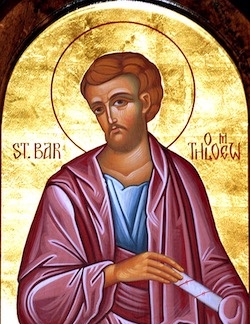
 9th SUNDAY AFTER PENTECOST — Tone 8. Return of the Relics of the Apostle Bartholomew from Anastasiopolis to Lipari (6th c.). Holy Apostle Titus of the Seventy, Bishop of Crete (1st c.).
Tone 8 Troparion (Resurrection)
You descended from on high, O Merciful One! You accepted the three day burial to free us from our sufferings!// O Lord, our Life and Resurrection, glory to You!
Tone 4 Troparion (St. Nicholas)
The truth of your deeds has revealed you to your flock as a rule of faith, an image of meekness and a teacher of self-control; your humility exalted you; your poverty enriched you.// O Father Bishop Nicholas, pray to Christ God that our souls may be saved.
Tone 3 Troparion (Apostles)
Holy Apostles Bartholomew and Titus, entreat the merciful God,// to grant our souls forgiveness of transgressions!
Tone 8 Kontakion (Resurrection)
By rising from the tomb, You raised the dead and resurrected Adam. Eve exults in Your Resurrection,// and the world celebrates Your rising from the dead, O greatly Merciful One!
Tone 3 Kontakion (St. Nicholas)
You proved yourself to be be a holy priest, O Nicholas. You served God in Myra and lived the gospel of Christ. You offered your life for your people, And rescued the innocent from death. Therefore God has glorified you as a trustworthy guide of things divine.
Tone 4 Kontakion (St. Bartholomew)
You have appeared to the universe as a great sun, shining with the radiance of thy teachings and awesome miracles.// You enlighten those who honor you, O Apostle of the Lord, Bartholomew.
Tone 2 Kontakion (St. Titus)
Titus, worthy of all praise and preacher of Christ’s mysteries, you were Paul’s companion, and with him taught us the doctrine of God. Therefore we cry out to you:// “Never cease to intercede for the sake of us all!”
Tone 8 Prokeimenon (Resurrection)
Pray and make your vows / before the Lord, our God! (Ps. 75:10a)
V. In Judah God is known; His Name is great in Israel. (Ps. 75:1)
1 Corinthians 3:9-17 (Epistle)
For we are God’s fellow workers; you are God’s field, you are God’s building. According to the grace of God which was given to me, as a wise master builder I have laid the foundation, and another builds on it. But let each one take heed how he builds on it. For no other foundation can anyone lay than that which is laid, which is Jesus Christ. Now if anyone builds on this foundation with gold, silver, precious stones, wood, hay, straw, each one’s work will become clear; for the Day will declare it, because it will be revealed by fire; and the fire will test each one’s work, of what sort it is. If anyone’s work which he has built on it endures, he will receive a reward. If anyone’s work is burned, he will suffer loss; but he himself will be saved, yet so as through fire. Do you not know that you are the temple of God and that the Spirit of God dwells in you? If anyone defiles the temple of God, God will destroy him. For the temple of God is holy, which temple you are.
Tone 8
Alleluia, Alleluia, Alleluia!
V. Come, let us rejoice in the Lord! Let us make a joyful noise to God our Savior! (Ps. 94:1)
V. Let us come before His face with thanksgiving; let us make a joyful noise to Him with songs of praise! (Ps. 94:2)
Matthew 14:22-34 (Gospel)
Immediately Jesus made His disciples get into the boat and go before Him to the other side, while He sent the multitudes away. And when He had sent the multitudes away, He went up on the mountain by Himself to pray. Now when evening came, He was alone there. But the boat was now in the middle of the sea, tossed by the waves, for the wind was contrary. Now in the fourth watch of the night Jesus went to them, walking on the sea. And when the disciples saw Him walking on the sea, they were troubled, saying, “It is a ghost!” And they cried out for fear. But immediately Jesus spoke to them, saying, “Be of good cheer! It is I; do not be afraid.” And Peter answered Him and said, “Lord, if it is You, command me to come to You on the water.” So He said, “Come.” And when Peter had come down out of the boat, he walked on the water to go to Jesus. But when he saw that the wind was boisterous, he was afraid; and beginning to sink he cried out, saying, “Lord, save me!” And immediately Jesus stretched out His hand and caught him, and said to him, “O you of little faith, why did you doubt?” And when they got into the boat, the wind ceased. Then those who were in the boat came and worshiped Him, saying, “Truly You are the Son of God.” When they had crossed over, they came to the land of Gennesaret.
Return of the Relics of the Apostle Bartholomew from Anastasiopolis to Lipari
The Transfer of the Relics of the Apostle Bartholomew took place at the end of the sixth century. His apostolic activity and martyr’s end are remembered by the Church on June 11. The Apostle Bartholomew suffered for Christ in Armenian Albanus (now Baku) in the year 71, where his holy relics were. Numerous miracles occurred from the relics of the holy Apostle, and many of the unbelieving were converted to Christ. Under the emperor Anastasius (491-518) the relics of the Apostle Bartholomew were transferred into the newly constructed city of Anastasiopolis (or Dura) and remained there until the end of the sixth century.
When the city of Anastasiopolis was captured by the Persian emperor Chozroes, Christians took up the chest with the relics of the Apostle Bartholomew and fled with it to the shores of the Black Sea. Having overtaken them, pagan priests threw the chest with the relics of the Apostle Bartholomew into the sea. Four other chests containing the relics of the holy Martyrs Papian, Lucian, Gregory and Acacius were also thrown into the sea.
By the power of God the chests did not sink into the depths of the sea, but miraculously floated upon the waves and reached Italy. The chest with the relics of the Apostle Bartholomew came to land at the island of Lipari, and the remaining chests continued their journey and came to land at various places in Italy. The chest with the relics of the Martyr Papian halted at Sicily, the Martyr Lucian at Messina, the Martyr Gregory at Calabria, and the Martyr Acacius at Askalon.
The arrival of the relics of the holy Apostle Bartholomew was revealed to Bishop Agathon of the island of Lipari, who went with clergy to the shores of the sea, took the chest from the waters and solemnly transferred it to church.
Myrrh flowed from the relics of the Apostle Bartholomew, healing people of various illnesses. The holy relics remained in the church of the island of Lipari until the middle of the ninth century when the island was captured by pagans. Christian merchants took up the holy relics of the Apostle Bartholomew and transferred them to the city of Beneventum, near Naples, where they were received with great veneration and placed in the main church of the city.
Apostle Titus of the Seventy and Bishop of Crete
Saint Titus, Apostle of the Seventy was a native of the island of Crete, the son of an illustrious pagan. In his youth he studied Hellenistic philosophy and the ancient poets. Preoccupied by the sciences, Titus led a virtuous life, not devoting himself to the vices and passions characteristic of the majority of pagans. He preserved his virginity, as the Hieromartyr Ignatius the God-bearer (December 20) testifies of him.
For such a manner of life the Lord did not leave him without His help. At age twenty Saint Titus heard a voice in a dream, suggesting that he abandon Hellenistic wisdom, which could not provide salvation for his soul, but rather to seek that which would save him. After this dream, Saint Titus waited yet another year, since it was not actually a command, but it did guide him to familiarize himself with the teachings of the prophets of God. The first that he happened to read was the Book of the Prophet Isaiah. Having opened it to the 47th Chapter, he was struck by the words, speaking as it were about his own spiritual condition. When news reached Crete about the appearance of a Great Prophet in Palestine, and about the great miracles He worked, the governor of the island of Crete (an uncle of Titus) sent him there. This Prophet was the Lord Jesus Christ Himself, incarnate of the Most Holy Virgin Mary Who came into the world for the redemption of the race of mankind from the oppression of ancestral sin. At Jerusalem, Saint Titus saw the Lord. He heard His preaching and believed in Him. He witnessed the suffering and death of the Savior on the Cross, His glorious Resurrection and Ascension to Heaven. On the day of Pentecost the future apostle heard how the Twelve Apostles, after the descent of the Holy Spirit, spoke in various languages, among which was the Cretan language (Acts 2: 11).
Saint Titus accepted Baptism from the Apostle Paul and became his closest disciple. He accompanied Saint Paul on his missionary journeys, fulfilling the tasks entrusted to him. He was involved in establishing new churches, and was with Paul in Jerusalem.
Saint Titus was numbered among the Seventy Apostles and was made Bishop of Crete by the Apostle Paul. Around the year 65, not long before his second imprisonment, the Apostle Paul sent a pastoral epistle to his son in the Faith (Tit. 1: 4).
When the Apostle Paul was taken like a criminal to Rome to stand trial before Caesar, Saint Titus left his flock in Crete for a time and went to Rome to be of service to his spiritual Father. After Saint Paul’s death by martyrdom, Titus returned to Gortyna, the chief city of Crete.
Saint Titus peacefully guided his flock and toiled at enlightening the pagans with the light of faith in Christ. He was granted the gift of wonderworking by the Lord. During one of the pagan feasts in honor of the goddess Diana, Titus preached to a crowd of pagans.
When he saw that they would not listen to him, he prayed to the Lord, so that the Lord Himself would show to the mistaken people the falseness of idols. By the prayer of Saint Titus, the idol of Diana fell down and shattered before the eyes of all. Another time Saint Titus prayed that the Lord would not permit the completion of a temple of Zeus, and it collapsed.
By such miracles Saint Titus brought many to faith in Christ. After bringing the light of faith to the surrounding regions, Saint Titus died peacefully at the age of 97. At the time of his death, his face shone like the sun.
On Forgiveness
“From an Orthodox perspective, then, in approaching a situation in which forgiveness and resentment is the basic choice. We look at the situation not from the vantage point of moral justice, but from the vantage point of humility and love. Humility is so connected to an Orthodox approach to forgiveness that we read in the sayings of the desert fathers that “An old man was asked, ‘What is humility?’ He replied, ‘It is when your brother sins against you and you forgive him BEFORE he comes to ask for forgiveness.’” Where there is humility, there will be forgiveness. And where there is love, there will be forgiveness. If we learn to be humble, if we learn to love, we will also learn to forgive.”
— Bishop Alexei, from a series of talks on forgiveness. From the YouTube page of the Diocese of Sitka and Alaska
 Sunday Bulletin August 18, 2024