
27th SUNDAY AFTER PENTECOST — Tone 2.
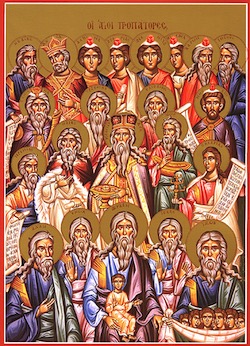
Sunday of the Forefathers.
Tone 2 Troparion (Resurrection)
When You descended to death, O Life Immortal, You slew hell with the splendor of Your Godhead. And when from the depths You raised the dead, all the powers of heaven cried out:// “O Giver of life, Christ our God, glory to You!”
Tone 4 Troparion (Forefathers)
Through faith You justified the Forefathers, betrothing through them the Church of the gentiles. These saints exult in glory, for from their seed came forth a glorious fruit: she who bore You without seed.// So by their prayers, O Christ God, have mercy on us!
Tone 6 Kontakion (Forefathers)
You did not worship the graven image, O thrice-blessed ones, but armed with the immaterial Essence of God, you were glorified in a trial by fire. From the midst of unbearable flames you called on God, crying: “Hasten, O compassionate One! Speedily come to our aid,// for You are merciful and able to do as You will!”
Tone 4 Prokeimenon (Forefathers)
Blessed are You, O Lord God of our fathers, / and praised and glorified is Your Name forever! (Song of theThree Holy Children, v.3)
V. For You are just in all that You have done for us! (v. 4)
Colossians 3:4-11 (Epistle)
When Christ who is our life appears, then you also will appear with Him in glory. Therefore put to death your members which are on the earth: fornication, uncleanness, passion, evil desire, and covetousness, which is idolatry. Because of these things the wrath of God is coming upon the sons of disobedience, in which you yourselves once walked when you lived in them. But now you yourselves are to put off all these: anger, wrath, malice, blasphemy, filthy language out of your mouth. Do not lie to one another, since you have put off the old man with his deeds, and have put on the new man who is renewed in knowledge according to the image of Him who created him, where there is neither Greek nor Jew, circumcised nor uncircumcised, barbarian, Scythian, slave nor free, but Christ is all and in all.
Tone 4
Alleluia, Alleluia, Alleluia!
V. Moses and Aaron were among His priests; Samuel also was among those who called on His Name. (Ps. 98:6)
V. They called to the Lord and He answered them. (Ps. 98:6)
Luke 14:16-24 (Gospel)
Then He said to him, “A certain man gave a great supper and invited many, and sent his servant at supper time to say to those who were invited, ‘Come, for all things are now ready.’ But they all with one accord began to make excuses. The first said to him, ‘I have bought a piece of ground, and I must go and see it. I ask you to have me excused.’ And another said, ‘I have bought five yoke of oxen, and I am going to test them. I ask you to have me excused.’ Still another said, ‘I have married a wife, and therefore I cannot come.’ So that servant came and reported these things to his master. Then the master of the house, being angry, said to his servant, ‘Go out quickly into the streets and lanes of the city, and bring in here the poor and the maimed and the lame and the blind.’ And the servant said, ‘Master, it is done as you commanded, and still there is room.’ Then the master said to the servant, ‘Go out into the highways and hedges, and compel them to come in, that my house may be filled. ’For I say to you that none of those men who were invited shall taste my supper.’”
Sunday of the Forefathers
The Sunday that falls between December 11-17 is known as the Sunday of the Holy Forefathers. These are the ancestors of Christ according to the flesh, who lived before the Law and under the Law, especially the Patriarch Abraham, to whom God said, “In thy seed shall all of the nations of the earth be blessed” (Gen. 12:3, 22:18).
From the Prologue:
REFLECTION
There are three types of praiseworthy zeal: zeal in cleansing oneself of sinful desires and thoughts, zeal for the truth of the Faith, and zeal for God’s justice among men. All three of these filled the soul of St. Nicholas the Wonderworker to perfection. He showed zeal in purifying himself throughout his life, vigilantly guarding over his heart. He especially showed zeal for the truth of the Faith at the First Ecumenical Council in Nicaea [325] when he entered into a fearful confrontation with Arius. His zeal for God’s justice among men was seen particularly in two notable events, when on each occasion he saved three innocent men from the punishment of death. Once, in his absence from the city of Myra, the avaricious commander Eustathius condemned three men to be beheaded, receiving a bribe for this from some of their enemies. Informed of this, St. Nicholas returned to Myra with the greatest haste. The condemned men had already been brought to the place of execution, and the executioner had already raised the sword over the innocent men. At that moment, Nicholas grabbed the sword, pulled it out of the executioner’s hand, and freed the condemned men. Afterward, he rebuked the commander Eustathius and brought him to shame and repentance. In a similar way, three imperial commanders—Nepotian, Ursus and Herpylion—were slandered before Eulavius the Eparch of Constantinople and before the emperor himself. The emperor signed their death sentence. On the eve of their execution, the three commanders prayed to God, saying: “O God of Nicholas, deliver us innocent ones from death!” That night, St. Nicholas appeared to both the emperor and the eparch in a dream, rebuked them for this injustice, and ordered them to free the three commanders from prison immediately. The next day, the emperor and eparch each related to the other the same dream and they immediately freed the commanders, both from the death sentence and from prison.
— Velimirovic, Saint Nikolai. The Prologue of Ohrid
HOMILY
on Jacob
For I have seen God face to face and my life is preserved (Genesis 32:30)
The God of Abraham and Isaac is also the God of Jacob the faithful, the obedient, the merciful and the meek. The meek beholder of God, Jacob, can be called the “one who saw God.” For in truth he was meek, and he saw God and spoke with God, and he saw the angels of God and the ladder from earth to heaven. By his meekness he defeated Laban his father-in-law, and Esau his brother; by his meekness he made peace between his wives, Leah and Rachel; for his meekness he was even dear to pharaoh. Jacob’s meekness is a prefiguration of the meekness of Christ. Blessed are the meek, said the Lord, for they shall inherit the earth (Matthew 5:5). These words were also realized in Jacob. He inherited the land of his fathers; his descendants were delivered from Egypt and inherited the Promised Land; through Christ the Lord, his descendant according to the flesh, he inherited the whole earth, that is, the Church of God which spread over the entire world. I have seen God face to face. Jacob saw God in the form of man but not as true man. And even this vision was only a prefiguring of the true Incarnation of God as man. And my life is preserved. His soul was preserved from fear and from every unrighteousness. If Jacob was preserved by only seeing a vision of God, how much easier is it for us to be preserved who know God as true man and as the God-man. O meek Lord, the strength and glory of the meek, as Thou didst preserve Jacob by Thy vision, preserve us also by Thy true Body and Blood. To Thee be glory and praise forever. Amen.
— Velimirovic, Saint Nikolai. The Prologue of Ohrid
The Mystery of Repentance
Abba Pambo was a renowned hermit, one of the foremost ascetics after Saint Anthony the Great. At one point during Great Lent, specifically Holy Week, he went to attend church. He sat outside the entrance and watched the monks and laypeople as they entered. With his gift of clairvoyance, he could penetrate into each person’s spiritual state. As people entered the church, he noticed that some of them were fragrant and dressed in white. Furthermore, he observed that angels were preceding and following these souls, who were radiant to different degrees. Lastly, a man with a darkened soul entered, accompanied by various beasts and sinister beings. This revealed and testified to the many crimes he had committed. As soon as Abba Pambo witnessed this sight, he was deeply grieved and saddened.
He felt pain in his soul, and, as a man of God, he withdrew to a concealed area, where he knelt and began to pray, beseeching God to be merciful to this man, to enlighten him, and lead him to repentance. His eyes became swollen from the copious tears, which fell and soaked the ground. Once the service had ended, he went and sat near the entrance again and anxiously waited to see if there had been any change in the soul of the person whom he had lamented. The people who had entered with radiance were now exiting brighter and shinier. They were covered with myrrh, which made the entire surrounding area fragrant, and their angels followed them with greater joy. This revealed that they had derived benefit from the Church service. Suddenly, the sinful person who had previously entered with the dark soul exited clean and white. The demons who were initially following him had disappeared. His guardian angel was now accompanying him gleefully.
The joy of the saint, as you can imagine, was immense. On account of his great delight—which he could not keep to himself—Abba Pambo climbed upon a boulder and started to shout, “Come and see the works of our God; how great, wondrous, and glorious they are!” (cf. Ps. 65:4). When the fathers heard these words from the saint, they suspected that something marvelous had occurred. They surrounded him and began asking, “Saint of God, what is the reason for your great joy?” “My fathers, call that man over here. I want to ask him something.” They called the sinful person, and Abba Pambo asked him, “Tell us, man of God, about yourself, and what moved you to come to the church of God today?” The man then declared, “Father, my sins are innumerable. My crimes are horrible, and my actions are filthy. Today, since the centers of entertainment and sin are closed on account of Holy Week, I could not go out to enjoy myself as usual. So, as a matter of formality, I decided to attend the service of Great Friday.
During the service, however, I heard the Prophet Isaiah commanding, ‘Wash yourselves, make yourselves clean. Put away the evils from your souls before My eyes. Cease from your evils. Learn to do good. Seek judgment and redeem the wronged. Defend the orphan, and obtain justice for the widow. And come, let us reason together, says the Lord. And although your sins are like crimson, I shall make them white like snow; and although they are as scarlet, I shall make them white like wool’ (Isa. 1:16-18). I then thought and asked myself, ‘How long will I persist in sin? How long will I remain estranged from God? How long will I not reconcile with Him? Why don’t I ask Him to forgive me? Why don’t I change my life, since my soul will become as white as snow and lamb’s wool? I will become a new person. God is calling me; how long will I delay?’ ‘Approach!’ ‘Come!’ So I decided to obey God, Who was speaking through the prophet. I made the decision, O saint of God, to completely change my life after I exited the church. I have decided to repent and proceed to Holy Confession.”
Then the saint related what he had seen with his gift of clairvoyance, how he beseeched God with tears for this person, and how he indeed witnessed his soul become white and clean, even before the man confessed. As soon as he decided to return, the Heavenly Father immediately opened His loving embrace. God purified him and granted him the initial impetus that helps man to reach and bow under the sacred epitrachelion. Here we see just how easily God accepts a sinful person, how He waits for him, how much the prayers (of the angels and holy men) help, and especially the immense importance and value that we must place on the Mystery of Confession. If a person does not humble himself, he will not proceed to Holy Confession, he will not walk through this “low” door of humility. The Lord warns us, “Watch therefore, for you know neither the day nor the hour in which the Son of Man is coming” (Mt. 25:13). Prepare yourselves because you don’t know when Christ will come. “But know this, that if the master of the house had known what hour the thief would come, he would have watched and not allowed his house to be broken into” (Mt. 24:43). A thief seizes the homeowner, binds him “hand and foot,” and then robs him. In order to become clean and free of the passions, we must confess continuously—not at the final moment of our life. The saints would cry; we, however, remain indifferent. We occupy ourselves with so many trivial things, but we disregard what is of paramount importance, “the one thing needed”: to remember and prepare for our departure.
— Ephraim, Elder. The Art of Salvation
From Metropolitan Tikhon on yesterday’s Feast of St. Herman:
In this cold and dark season before the Nativity, we celebrate the memory of one of our great northern saints: the monk who went to Valaam seeking the tradition of the holy Fathers, the missionary who went to Alaska seeking souls for Christ. As we prepare to welcome our Lord and God and Savior into the cold cave of Bethlehem – and, indeed, into the dark and chilly cave of our hearts, where the blackness of sin and the clamminess of despair make their reign – let us be guided toward salvation by the teaching and example of this great North Star of the Church of Christ. If we sincerely set out to follow the kindly guiding light radiating from St. Herman, the brightness of his holiness will surely lead us to Christ our true God, just as surely as the star once led the Magi to the place where the young Child lay.
 Sunday Bulletin December 7, 2025