

1st SUNDAY AFTER PENTECOST — Tone 8. All Saints. “Seven Arrows.”
Tone 8 Troparion (Resurrection)
You descended from on high, O Merciful One! You accepted the three day burial to free us from our sufferings!// O Lord, our Life and Resurrection, glory to You!
Tone 4 Troparion (All Saints)
As with fine porphyry and royal purple, Your Church has been adorned with Your martyrs’ blood shed throughout all the world. She cries to You, O Christ God “Send down Your bounties on Your people,// grant peace to Your habitation and great mercy to our souls!”
Tone 8 Kontakion (All Saints)
The universe offers You the God-bearing Martyrs as the first fruits of creation, O Lord and Creator. By their prayers keep Your Church, Your habitation, in abiding peace// through the Theotokos, O most Merciful One!
Tone 8 Prokeimenon (Resurrection)
Pray and make your vows / before the Lord, our God! (Ps. 75:10a)
V. In Judah God is known; His Name is great in Israel. (Ps. 75:1)
Tone 4 Prokeimenon (All Saints)
God is wonderful in His saints, / the God of Israel. (Ps. 67:35a)
Hebrews 11:33-12:2 (Epistle)
who through faith subdued kingdoms, worked righteousness, obtained promises, stopped the mouths of lions, quenched the violence of fire, escaped the edge of the sword, out of weakness were made strong, became valiant in battle, turned to flight the armies of the aliens. Women received their dead raised to life again. Others were tortured, not accepting deliverance, that they might obtain a better resurrection.
Still others had trial of mockings and scourgings, yes, and of chains and imprisonment. They were stoned, they were sawn in two, were tempted, were slain with the sword. They wandered about in sheepskins and goatskins, being destitute, afflicted, tormented – of whom the world was not worthy. They wandered in deserts and mountains, in dens and caves of the earth. And all these, having obtained a good testimony through faith, did not receive the promise, God having provided something better for us, that they should not be made perfect apart from us. Therefore we also, since we are surrounded by so great a cloud of witnesses, let us lay aside every weight, and the sin which so easily ensnares us, and let us run with endurance the race that is set before us, looking unto Jesus, the author and finisher of our faith, who for the joy that was set before Him endured the cross, despising the shame, and has sat down at the right hand of the throne of God.
Tone 4
Alleluia, Alleluia, Alleluia!
V. The righteous cried and the Lord heard them, and delivered them out of all their troubles. (Ps. 33:17)
V. Many are the afflictions of the righteous; the Lord will deliver them out of them all. (Ps. 33:19)
Matthew 10:32-33, 37-38, 19:27-30 (Gospel)
Therefore whoever confesses Me before men, him I will also confess before My Father who is in heaven. But whoever denies Me before men, him I will also deny before My Father who is in heaven. He who loves father or mother more than Me is not worthy of Me. And he who loves son or daughter more than Me is not worthy of Me. And he who does not take his cross and follow after Me is not worthy of Me. Then Peter answered and said to Him, “See, we have left all and followed You. Therefore what shall we have?” So Jesus said to them, “Assuredly I say to you, that in the regeneration, when the Son of Man sits on the throne of His glory, you who have followed Me will also sit on twelve thrones, judging the twelve tribes of Israel. And everyone who has left houses or brothers or sisters or father or mother or wife or children or lands, for My name’s sake, shall receive a hundredfold, and inherit eternal life. But many who are first will be last, and the last first.
Synaxis of All Saints
The Sunday following Pentecost is dedicated to All Saints, both those who are known to us, and those who are known only to God. There have been saints at all times, and they have come from every corner of the earth. They were Apostles, Martyrs, Prophets, Hierarchs, Monastics, and Righteous, yet all were perfected by the same Holy Spirit.
The Descent of the Holy Spirit makes it possible for us to rise above our fallen state and to attain sainthood, thereby fulfilling God’s directive to “be holy, for I am holy” (Lev. 11:44, 1 Peter 1:16, etc.). Therefore, it is fitting to commemorate All Saints on the first Sunday after Pentecost.
This feast may have originated at an early date, perhaps as a celebration of all martyrs, then it was broadened to include all men and women who had borne witness to Christ by their virtuous lives, even if they did not shed their blood for Him.
Saint Peter of Damascus, in his “Fourth Stage of Contemplation,” mentions five categories of saints: Apostles, Martyrs, Prophets, Hierarchs, and Monastic Saints (Philokalia [in English] Vol. 3, p.131). He is actually quoting from the Octoechos, Tone 2 for Saturday Matins, kathisma after the first stichology.
Saint Νikόdēmos of the Holy Mountain (July 14) adds the Righteous to Saint Peter’s five categories. The list of Saint Νikόdēmos is found in his book The Fourteen Epistles of Saint Paul (Venice, 1819, p. 384) in his discussion of I Corinthians 12:28.
The hymnology for the feast of All Saints also lists six categories: “Rejoice, assembly of the Apostles, Prophets of the Lord, loyal choirs of the Martyrs, divine Hierarchs, Monastic Fathers, and the Righteous….”
Some of the saints are described as Confessors, a category which does not appear in the above lists. Since they are similar in spirit to the martyrs, they are regarded as belonging to the category of Martyrs. They were not put to death as the Martyrs were, but they boldly confessed Christ and came close to being executed for their faith. Saint Maximus the Confessor (January 21) is such a saint.
The order of these six types of saints seems to be based on their importance to the Church. The Apostles are listed first, because they were the first to spread the Gospel throughout the world.
The Martyrs come next because of their example of courage in professing their faith before the enemies and persecutors of the Church, which encouraged other Christians to remain faithful to Christ even unto death.
Although they come first chronologically, the Prophets are listed after the Apostles and Martyrs. This is because the Old Testament Prophets saw only the shadows of things to come, whereas the Apostles and Martyrs experienced them firsthand. The New Testament also takes precedence over the Old Testament.
The holy Hierarchs comprise the fourth category. They are the leaders of their flocks, teaching them by their word and their example.
The Monastic Saints are those who withdrew from this world to live in monasteries, or in seclusion. They did not do this out of hatred for the world, but in order to devote themselves to unceasing prayer, and to do battle against the power of the demons. Although some people erroneously believe that monks and nuns are useless and unproductive, Saint John Climacus had a high regard for them: “Angels are a light for monks, and the monastic life is a light for all men” (LADDER, Step 26:31).
The last category, the Righteous, are those who attained holiness of life while living “in the world.” Examples include Abraham and his wife Sarah, Job, Saints Joachim and Anna, Saint Joseph the Betrothed, Saint Juliana of Lazarevo, and others.
The feast of All Saints achieved great prominence in the ninth century, in the reign of the Byzantine Emperor Leo VI the Wise (886-911). His wife, the Holy Empress Theophano (December 16) lived in the world, but was not attached to worldly things. She was a great benefactor to the poor, and was generous to the monasteries. She was a true mother to her subjects, caring for widows and orphans, and consoling the sorrowful.
Even before the death of Saint Theophano in 893 or 894, her husband started to build a church, intending to dedicate it to Theophano, but she forbade him to do so. It was this emperor who decreed that the Sunday after Pentecost be dedicated to All Saints. Believing that his wife was one of the righteous, he knew that she would also be honored whenever the Feast of All Saints was celebrated.
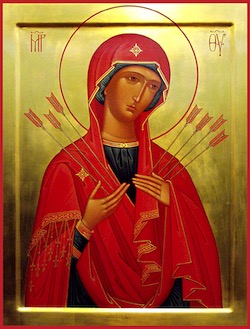
“Seven Arrows” Icon of the Mother of God
On the Seven Arrows Icon, the Most Holy Theotokos is depicted without the Divine Infant. She inclines her head toward her right shoulder, and her heart is pierced with seven arrows or swords, of which four are on the left side and three on the right. A similar image of the Mother of God is also found on the icons “Softener of Evil Hearts,” and “Simeon’s Prophecy,” on which the swords are placed somewhat differently: three on the right and left, and the seventh at the bottom.
The “Seven Arrows” Icon is at least 600 years old. For a long time, the holy image was at the landing in the bell tower of the church of the Apostle John the Theologian (near Vologda). The Icon, facing downward, was mistaken for an ordinary board on which people walked, until a paralyzed man in the city of Kadnikov had a vision in which it was revealed that he would receive healing after praying before this Icon. A Moleben was served before the Icon, and the man recovered.
The Icon became especially famous in 1830 during an outbreak of cholera in Vologda.
The real, authentic image (the “Seven Arrows” Icon) is now in the church of Saint Lazarus, in Vologda. The Icon has been in that temple since 1945, after the Great Patriotic War.
Muscovites can pray before the wonderworking copies located in the Moscow region. There are two images of the “Seven Arrows” Mother of God. Both exude an amazing myrrh – an oily liquid which inexplicably appeared on them.
The first copy of the “Seven Arrows” Icon is now in the church dedicated to the Holy Archangel Michael, located in Moscow. The second copy is in the village of Bachurino in the Moscow region.
The Feast Day of this Icon is celebrated on August 13, and on the Sunday of All Saints (First Sunday after Pentecost).
The same Troparion and Kontakion are used for the “Seven Arrows” Icon (August 13), and the “Softener of Evil Hearts” Icon (Sunday of All Saints).
 Sunday Bulletin May 31, 2026