
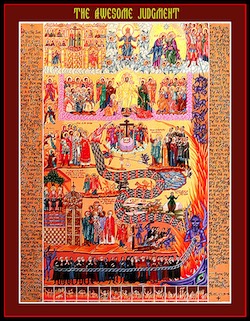
 SUNDAY OF MEATFARE — Tone 7. Sunday of the Last Judgment. Martyr Quadratus and those with him.
Tone 7 Troparion (Resurrection)
By Your Cross You destroyed death. To the thief You opened Paradise. For the Myrrhbearers You changed weeping into joy. And You commanded Your disciples, O Christ God, to proclaim that You are risen,// granting the world great mercy.
Tone 4 Troparion (St. Nicholas)
The truth of your deeds has revealed you to your flock as a rule of faith, an image of meekness and a teacher of self-control; your humility exalted you; your poverty enriched you.// O Father Bishop Nicholas, pray to Christ God that our souls may be saved.
Tone 3 Kontakion (St. Nicholas)
You proved yourself to be be a holy priest, O Nicholas. You served God in Myra and lived the gospel of Christ. You offered your life for your people, And rescued the innocent from death. Therefore God has glorified you as a trustworthy guide of things divine.
Tone 1 Kontakion (from the Lenten Triodion)
When You, O God, shall come to earth with glory, all things shall tremble, and the river of fire shall flow before Your judgment seat; the books shall be opened, and the hidden things disclosed; then deliver me from the unquenchable fire,// and make me worthy to stand at Your right hand, O Righteous Judge!
Tone 3 Prokeimenon (from the Lenten Triodion)
Great is our Lord, and abundant in power, / His understanding is beyond measure. (Ps. 146:5)
V. Praise the Lord! For it is good to sing praises to our God! (Ps.146:1)
1 Corinthians 8:8-9:2 (Epistle)
But food does not commend us to God; for neither if we eat are we the better, nor if we do not eat are we the worse. But beware lest somehow this liberty of yours become a stumbling block to those who are weak. For if anyone sees you who have knowledge eating in an idol’s temple, will not the conscience of him who is weak be emboldened to eat those things offered to idols? And because of your knowledge shall the weak brother perish, for whom Christ died? But when you thus sin against the brethren, and wound their weak conscience, you sin against Christ. Therefore, if food makes my brother stumble, I will never again eat meat, lest I make my brother stumble. Am I not an apostle? Am I not free? Have I not seen Jesus Christ our Lord? Are you not my work in the Lord? If I am not an apostle to others, yet doubtless I am to you. For you are the seal of my apostleship in the Lord.
Tone 8
Alleluia, Alleluia, Alleluia!
V. Come, let us rejoice in the Lord! Let us make a joyful noise to God our Savior! (Ps. 94:1)
V. Let us come before His presence with thanksgiving; let us make a joyful noise to Him with songs of praise. (Ps. 94:2)
Matthew 25:31-46 (Gospel)
When the Son of Man comes in His glory, and all the holy angels with Him, then He will sit on the throne of His glory. All the nations will be gathered before Him, and He will separate them one from another, as a shepherd divides his sheep from the goats. And He will set the sheep on His right hand, but the goats on the left. Then the King will say to those on His right hand, ‘Come, you blessed of My Father, inherit the kingdom prepared for you from the foundation of the world: for I was hungry and you gave Me food; I was thirsty and you gave Me drink; I was a stranger and you took Me in; I was naked and you clothed Me; I was sick and you visited Me; I was in prison and you came to Me.’ Then the righteous will answer Him, saying, ‘Lord, when did we see You hungry and feed You, or thirsty and give You drink? When did we see You a stranger and take You in, or naked and clothe You? Or when did we see You sick, or in prison, and come to You?’ And the King will answer and say to them, ‘Assuredly, I say to you, inasmuch as you did it to one of the least of these My brethren, you did it to Me.’ Then He will also say to those on the left hand, ‘Depart from Me, you cursed, into the everlasting fire prepared for the devil and his angels: for I was hungry and you gave Me no food; I was thirsty and you gave Me no drink; I was a stranger and you did not take Me in, naked and you did not clothe Me, sick and in prison and you did not visit Me.’ Then they also will answer Him, saying, ‘Lord, when did we see You hungry or thirsty or a stranger or naked or sick or in prison, and did not minister to You?’ Then He will answer them, saying, ‘Assuredly, I say to you, inasmuch as you did not do it to one of the least of these, you did not do it to Me.’ And these will go away into everlasting punishment, but the righteous into eternal life.”
Sunday of Meatfare of the Last Judgment
Today’s Gospel reading is Matthew 25:31-46, the parable of the Last Judgment. It reminds us that while trusting in Christ’s love and mercy, we must not forget His righteous judgment when He comes again in glory. If our hearts remain hardened and unrepentant, we should not expect the Lord to overlook our transgressions simply because He is a good and loving God. Although He does not desire the death of a sinner, He also expects us to turn from our wickedness and live (Ezek. 33:11). This same idea is expressed in the prayer read by the priest after the penitent has confessed his or her sins (Slavic practice).
The time for repentance and forgiveness is now, in the present life. At the Second Coming, Christ will appear as the righteous Judge, “Who will render to every man according to his deeds” (Rom. 2:6). Then the time for entreating God’s mercy and forgiveness will have passed.
As Father Alexander Schmemann reminds us in his book GREAT LENT (Ch. 1:4), sin is the absence of love, it is separation and isolation. When Christ comes to judge the world, His criterion for judgment will be love. Christian love entails seeing Christ in other people, our family, our friends, and everyone else we may encounter in our lives. We shall be judged on whether we have loved, or not loved, our neighbor. We show Christian love when we feed the hungry, give drink to the thirsty, clothe the naked, visit those who are sick or in prison. If we did such things for the least of Christ’s brethren, then we also did them for Christ (Mt.25:40). If we did not do such things for the least of the brethren, neither did we do them for Christ (Mt.25:45).
Today is the last day for eating meat and meat products until Pascha, though eggs and dairy products are permitted every day during the coming week. This limited fasting prepares us gradually for the more intense fasting of Great Lent.
Lenten Fasting, by Fr. Thomas Hopko
A special word must be said about fasting during lent. Generally speaking, fasting is an essential element of the Christian life. Christ fasted and taught men to fast. Blessed fasting is done in secret, without ostentation or accusation of others (Mt 6.16; Rom 14). It has as its goal the purification of our lives, the liberation of our souls and bodies from sin, the strengthening of our human powers of love for God and man, the enlightening of our entire being for communion with the Blessed Trinity.
The Orthodox rules for lenten fasting are the monastic rules. No meat is allowed after Meatfare Sunday, and no eggs or dairy products after Cheesefare Sunday. These rules exist not as a Pharisaic “burden too hard to bear” (Lk 11.46), but as an ideal to be striven for; not as an end in themselves, but as a means to spiritual perfection crowned in love. The lenten services themselves continually remind us of this.
Let us fast with a fast pleasing to the Lord. This is the true fast: the casting off of evil, the bridling of the tongue, the cutting off of anger, the cessation of lusts, evil talking, lies and cursing. The stopping of these is the fast true and acceptable (Monday Vespers of the First Week).
The lenten services also make the undeniable point that we should not pride ourselves with external fasting since the devil also never eats!
The ascetic fast of Great Lent continues from Meatfare Sunday to Easter Sunday, and is broken only after the Paschal Divine Liturgy. Knowing the great effort to which they are called, Christians should make every effort to fast as well as they can, in secret, so that God would see and bless them openly with a holy life. Each person must do his best in the light of the given ideal.
In addition to the ascetic fasting of the lenten season, the Orthodox alone among Christians also practice what is known as eucharistic or liturgical fasting. This fasting does not refer to the normal abstinence in preparation for receiving the holy eucharist; it means fasting from the holy eucharist itself.
During the week days of Great Lent the regular eucharistic Divine Liturgy is not celebrated in Orthodox churches since the Divine Liturgy is always a paschal celebration of communion with the Risen Lord. Because the lenten season is one of preparation for the Lord’s Resurrection through the remembrance of sin and separation from God, the liturgical order of the Church eliminates the eucharistic service on the weekdays of lent. Instead the non-eucharistic services are extended with additional scripture readings and hymnology of a lenten character. In order that the faithful would not be entirely deprived of Holy Communion on the lenten days, however, the Liturgy of the Presanctified Gifts is celebrated on Wednesday and Friday evenings.
Even during Great Lent, Saturday (the Sabbath Day) and Sunday (the Lord’s Day) remain eucharistic days, and the Divine Liturgy is celebrated. On Saturdays it is the normal Liturgy of Saint John Chrysostom, usually with prayers for the dead. On Sundays it is the longer Liturgy of Saint Basil the Great.
The well-known teaching that Saturdays and Sundays are never days of fasting in the Orthodox Church, an issue emphasized centuries ago when controversy arose with the Latin Church, refers only to this eucharistic-liturgical fast. During Great Lent, even though the eucharistic fast is broken on Saturdays and Sundays, the ascetical fast continues through the weekends since this fasting is an extended effort made from Meatfare Sunday right to Easter itself.
Reflection, by St. Nicholai Velimirovic
“Good works are accomplished not by our efforts alone, but by the power and will of God. Nevertheless, God demands effort on our part in conforming to His will.”
These are the words of Saints Barsanuphius and John—few words, but much is said in them. We are obliged to labor, cultivate and prepare every good thing, and if some good will take root, grow, and bring forth fruit, that is up to the power and will of God. We plow the furrows, and God sows—if He wills it. We cleanse the vessels of the Spirit, and God pours the Spirit into these vessels—if He wills it. He can do anything if He wills it. And He will do everything that answers to the highest wisdom and wholeness, that is, to His plan of man’s salvation. In interpreting the words of our Lord, Be ye therefore wise as serpents, and harmless as doves (Matthew 10:16), St. John Chrysostom writes that our Lord gave this commandment to His disciples that “they themselves should cooperate in some way, so that it will not appear that all effort is of grace alone and so that they will not think that they received the wreaths of glory for nothing.” And so, both of them are indispensable for our salvation: our effort and the power of God’s grace.
— Velimirovic, Saint Nikolai. The Prologue of Ohrid. Sebastian Press Publishing House.
His Beatitude Metropolitan Tikhon to Consecrate Holy Chrism During Holy Week
SPRINGFIELD, VA [OCA]
March 4, 2024
His Beatitude Metropolitan Tikhon will be presiding at the Rite of Consecration of Preparation of Holy Chrism during the Vesperal Divine Liturgy of Great and Holy Thursday, May 2, 2024 at St. Tikhon’s Monastery. This rite is reserved for Primates of autocephalous Orthodox Churches. The last time Holy Chrism was consecrated for the Orthodox Church in America was in 2017 and marks the second time His Beatitude has presided at the rite.
After the Chrism has been consecrated it will be distributed for parish use across North America for the Holy Mystery of Chrismation.
Holy Chrism is distinct from other blessed oils in Orthodox Christian rites and undergoes careful preparation, incorporating various ingredients such as olive oil, aromatic incenses, and fragrant oils. The process, overseen this year by Protodeacon Peter Ilchuk, will begin on Great and Holy Monday, April 29, and will conclude on Great and Holy Wednesday, May 1, with continuous stirring and readings from the Holy Gospels.
A word of Encouragement from Fr. Sergius at St. Tikhon’s Monastery
“It is easy to focus on the potential difficulties of Lent. However, it is imperative that we remember its true purpose: preparing for Holy Pascha, our Lord’s resurrection and ours! Our resurrection is the focus of Great Lent, both spiritually and bodily. Following Christ while praying and participating in the services fills us with His life, which in time heals our souls and enlivens our minds and hearts. This in turn helps us to be strong in our daily lives and to flourish in our tasks and work.”
In the love of Christ,
ARCHIMANDRITE SERGIUS
Abbot of St. Tikhon’s Monastery
St. Vladimir’s Seminary is offering an opportunity to study and learn more about our worship with an online course!
Join us on a journey to explore the historical origins and practice of Orthodox Christian worship. From understanding the centrality of liturgy in Church life to unveiling the theology of the eucharistic celebration, this course invites you to participate in an enlightening overview of the beauty and meaning of Orthodox liturgical tradition.
By joining this course, you will:
- Discover the biblical foundations underlying Orthodox liturgical tradition
- Understand the spiritual significance of Orthodox worship & practices
- Gain insight into the essence of Christian identity through liturgical participation
The course runs for four weeks: April 2, 9, 16, 23
If you’re interested, this is a 5 minute long video of Abp. Christophoros of Jordan, speaking of the Last Judgment and what our approach to it should be! Turn on your subtitles!
 Sunday Bulletin March 3, 2024