
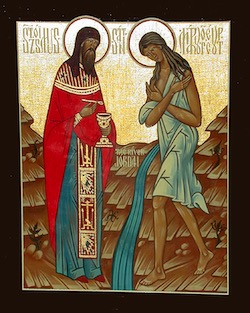
FIFTH SUNDAY OF LENT — Tone 1. St Mary of Egypt.
Tone 1 Troparion (Resurrection)
When the stone had been sealed by the Jews, while the soldiers were guarding Your most pure body, You rose on the third day, O Savior, granting life to the world. The powers of heaven therefore cried to You, O Giver of Life: “Glory to Your Resurrection, O Christ! Glory to Your Kingdom!// Glory to Your dispensation, O Lover of mankind!”
Tone 4 Troparion (St. Nicholas)
The truth of your deeds has revealed you to your flock as a rule of faith, an image of meekness and a teacher of self-control; your humility exalted you; your poverty enriched you.// O Father Bishop Nicholas, pray to Christ God that our souls may be saved.
Tone 8 Troparion (St. Mary of Egypt)
The image of God was truly preserved in you, O Mother, for you took up the Cross and followed Christ. By so doing, you taught us to disregard the flesh for it passes away; but to care instead for the soul, for it is immortal.// Therefore your spirit, O holy Mother Mary, rejoices with the angels.
Tone 3 Kontakion (St. Nicholas)
You proved yourself to be be a holy priest, O Nicholas. You served God in Myra and lived the gospel of Christ. You offered your life for your people, And rescued the innocent from death. Therefore God has glorified you as a trustworthy guide of things divine.
Tone 4 Kontakion (St. Mary of Egypt)
Having been a sinful woman, you became through repentance a bride of Christ. Having attained angelic life, you defeated demons with the weapon of the Cross.// Therefore, O most glorious Mary, you are a bride of the Kingdom.
Tone 6 Kontakion (Steadfast Protectress)
Steadfast Protectress of Christians, Constant Advocate before the Creator; despise not the cry of us sinners, but in your goodness come speedily to help us who call on you in faith. Hasten to hear our petition and to intercede for us, O Theotokos, for you always protect those who honor you!
Tone 1 Prokeimenon (Resurrection)
Let Your mercy, O Lord, be upon us /as we have set our hope on You! (Ps. 32:22)
V. Rejoice in the Lord, O you righteous! Praise befits the just! (Ps. 32:1)
Tone 7 Prokeimenon (St. Mary of Egypt)
God is wonderful in His saints, / the God of Israel. (Ps. 67:35a)
Hebrews 9:11-14 (Epistle)
But Christ came as High Priest of the good things to come, with the greater and more perfect tabernacle not made with hands, that is, not of this creation. Not with the blood of goats and calves, but with His own blood He entered the Most Holy Place once for all, having obtained eternal redemption. For if the blood of bulls and goats and the ashes of a heifer, sprinkling the unclean, sanctifies for the purifying of the flesh, how much more shall the blood of Christ, who through the eternal Spirit offered Himself without spot to God, cleanse your conscience from dead works to serve the living God?
Galatians 3:23-29 (Epistle, Saint)
But before faith came, we were kept under guard by the law, kept for the faith which would afterward be revealed. Therefore the law was our tutor to bring us to Christ, that we might be justified by faith. But after faith has come, we are no longer under a tutor. For you are all sons of God through faith in Christ Jesus. For as many of you as were baptized into Christ have put on Christ. There is neither Jew nor Greek, there is neither slave nor free, there is neither male nor female; for you are all one in Christ Jesus. And if you are Christ’s, then you are Abraham’s seed, and heirs according to the promise.
Tone 1
Alleluia, Alleluia, Alleluia!
V. God gives vengeance unto me, and subdues people under me. (Ps. 17:48)
V. He magnifies the salvation of the King and deals mercifully with David, His anointed, and his seed forever. (Ps. 17:51)
Tone 1
V. I waited patiently for the Lord; He attended to me and heard my supplication. (Ps. 39:1)
Mark 10:32-45 (Gospel)
Now they were on the road, going up to Jerusalem, and Jesus was going before them; and they were amazed. And as they followed they were afraid. Then He took the twelve aside again and began to tell them the things that would happen to Him: “Behold, we are going up to Jerusalem, and the Son of Man will be betrayed to the chief priests and to the scribes; and they will condemn Him to death and deliver Him to the Gentiles; and they will mock Him, and scourge Him, and spit on Him, and kill Him. And the third day He will rise again.” Then James and John, the sons of Zebedee, came to Him, saying, “Teacher, we want You to do for us whatever we ask.” And He said to them, “What do you want Me to do for you?” They said to Him, “Grant us that we may sit, one on Your right hand and the other on Your left, in Your glory.” But Jesus said to them, “You do not know what you ask. Are you able to drink the cup that I drink, and be baptized with the baptism that I am baptized with?” They said to Him, “We are able.” So Jesus said to them, “You will indeed drink the cup that I drink, and with the baptism I am baptized with you will be baptized; but to sit on My right hand and on My left is not Mine to give, but it is for those for whom it is prepared.” And when the ten heard it, they began to be greatly displeased with James and John. But Jesus called them to Himself and said to them, “You know that those who are considered rulers over the Gentiles lord it over them, and their great ones exercise authority over them. Yet it shall not be so among you; but whoever desires to become great among you shall be your servant. And whoever of you desires to be first shall be slave of all. For even the Son of Man did not come to be served, but to serve, and to give His life a ransom for many.
Luke 7:36-50 (Gospel, Saint)
Then one of the Pharisees asked Him to eat with him. And He went to the Pharisee’s house, and sat down to eat. And behold, a woman in the city who was a sinner, when she knew that Jesus sat at the table in the Pharisee’s house, brought an alabaster flask of fragrant oil, and stood at His feet behind Him weeping; and she began to wash His feet with her tears, and wiped them with the hair of her head; and she kissed His feet and anointed them with the fragrant oil. Now when the Pharisee who had invited Him saw this, he spoke to himself, saying, “This Man, if He were a prophet, would know who and what manner of woman this is who is touching Him, for she is a sinner.” And Jesus answered and said to him, “Simon, I have something to say to you.” So he said, “Teacher, say it.” “There was a certain creditor who had two debtors. One owed five hundred denarii, and the other fifty. And when they had nothing with which to repay, he freely forgave them both. Tell Me, therefore, which of them will love him more?” Simon answered and said, “I suppose the one whom he forgave more.” And He said to him, “You have rightly judged.” Then He turned to the woman and said to Simon, “Do you see this woman? I entered your house; you gave Me no water for My feet, but she has washed My feet with her tears and wiped them with the hair of her head. You gave Me no kiss, but this woman has not ceased to kiss My feet since the time I came in. You did not anoint My head with oil, but this woman has anointed My feet with fragrant oil. Therefore I say to you, her sins, which are many, are forgiven, for she loved much. But to whom little is forgiven, the same loves little.” Then He said to her, “Your sins are forgiven.” And those who sat at the table with Him began to say to themselves, “Who is this who even forgives sins?” Then He said to the woman, “Your faith has saved you. Go in peace.”
The Life of St. Mary of Egypt
The Fifth Sunday recalls the memory of Saint Mary of Egypt, the repentant harlot. Mary tells us, first of all, that no amount of sin and wickedness can keep a person from God if he truly repents. Christ himself has come “to call sinners to repentance” and to save them from their sins (Lk 5.32). In addition, Saint Mary tells us that it is never too late in life—or in Lent—to repent. Christ will gladly receive all who come to him even at the eleventh hour of their lives. But their coming must be in serious and sincere repentance.
Lazarus Saturday and Palm Sunday
The week following the Sunday of Saint Mary of Egypt is called Palm or Branch Week. At the Tuesday services of this week the Church recalls that Jesus’ friend Lazarus has died and that the Lord is going to raise him from the dead (Jn 11). As the days continue toward Saturday, the Church, in its hymns and verses, continues to follow Christ towards Bethany to the tomb of Lazarus. On Friday evening, the eve of the celebration of the Resurrection of Lazarus, the “great and saving forty days” of Great Lent are formally brought to an end:
Having accomplished the forty days for the benefit of our souls, we pray to Thee, O Lover of Man, that we may see the holy week of Thy passion, that in it we may glorify Thy greatness and Thine unspeakable plan of salvation for our sake . . . (Vespers Hymn).
Lazarus Saturday is a paschal celebration. It is the only time in the entire Church Year that the resurrectional service of Sunday is celebrated on another day. At the liturgy of Lazarus Saturday, the Church glorifies Christ as “the Resurrection and the Life” who, by raising Lazarus, has confirmed the universal resurrection of mankind even before His own suffering and death.
By raising Lazarus from the dead before Thy passion, Thou didst confirm the universal resurrection, O Christ God! Like the children with the branches of victory, we cry out to Thee, O Vanquisher of Death: Hosanna in the highest! Blessed is he that comes in the name of the Lord! (Troparion).
Christ —the Joy, the Truth and the Light of All, the Life of the world and its Resurrection—has appeared in his goodness to those on earth. He has become the Image of our Resurrection, granting divine forgiveness to all (Kontakion).
At the Divine Liturgy of Lazarus Saturday the baptismal verse from Galatians: As many as have been baptized into Christ have put on Christ (Gal 3.27) replaces the Thrice-holy Hymn thus indicating the resurrectional character of the celebration, and the fact that Lazarus Saturday was once among the few great baptismal days in the Orthodox Church Year.
Because of the resurrection of Lazarus from the dead, Christ was hailed by the masses as the long-expected Messiah-King of Israel. Thus, in fulfillment of the prophecies of the Old Testament, He entered Jerusalem, the City of the King, riding on the colt of an ass (Zech 9.9; Jn 12.12). The crowds greeted Him with branches in their hands and called out to Him with shouts of praise: Hosanna! Blessed is He who comes in the name of the Lord! The Son of David! The King of Israel! Because of this glorification by the people, the priests and scribes were finally driven “to destroy Him, to put Him to death” (Lk 19.47; Jn 11.53, 12.10).
The feast of Christ’s triumphal Entry into Jerusalem, Palm Sunday, is one of the twelve major feasts of the Church. The services of this Sunday follow directly from those of Lazarus Saturday. The church building continues to be vested in resurrectional splendor, filled with hymns which continually repeat the Hosanna offered to Christ as the Messiah-King who comes in the name of God the Father for the salvation of the world.
The main troparion of Palm Sunday is the same one sung on Lazarus Saturday. It is sung at all of the services, and is used at the Divine Liturgy as the third antiphon which follows the other special psalm verses which are sung as the liturgical antiphons in the place of those normally used. The second troparion of the feast, as well as the kontakion and the other verses and hymns, all continue to glorify Christ’s triumphal manifestation “six days before the Passover” when he will give himself at the Supper and on the Cross for the life of the world.
Today the grace of the Holy Spirit has gathered us together. Let us all take up Thy cross and say: Blessed is he who comes in the name of the Lord. Hosanna in the highest! (First Verse of Vespers). When we were buried with Thee in baptism, O Christ God, we were made worthy of eternal life by Thy resurrection. Now we praise Thee and sing: Hosanna in the highest! Blessed is he that comes in the name of the Lord! (Second Troparion).
Sitting on Thy throne in heaven, and carried on a foal on earth, O Christ God, accept the praise of angels and the songs of children who sing: BIessed is he who comes to recall Adam! (Kontakion).
At the vigil of the feast of Palm Sunday the prophecies of the Old Testament about the Messiah-King are read together with the Gospel accounts of the entry of Christ into Jerusalem. At Matins branches are blessed which the people carry throughout the celebration as the sign of their own glorification of Jesus as Saviour and King. These branches are usually palms, or, in the Slavic churches, pussy willows which came to be customary because of their availability and their early blossoming in the springtime.
 Sunday Bulletin March 22, 2026