
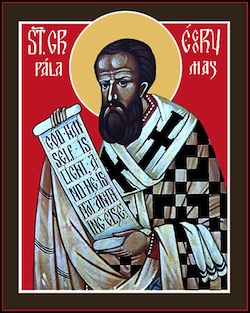
SECOND SUNDAY OF LENT — Tone 6. St. Gregory Palamas. Synaxis of the Venerable Fathers of the Kiev Caves Lavra.
Tone 6 Troparion (Resurrection)
The Angelic Powers were at Your tomb; the guards became as dead men. Mary stood by Your grave, seeking Your most pure body. You captured hell, not being tempted by it. You came to the Virgin, granting life. O Lord, Who rose from the dead,// glory to You.
Tone 4 Troparion (St. Nicholas)
The truth of your deeds has revealed you to your flock as a rule of faith, an image of meekness and a teacher of self-control; your humility exalted you; your poverty enriched you.// O Father Bishop Nicholas, pray to Christ God that our souls may be saved.
Tone 8 Troparion (St. Gregory Palamas)
O light of Orthodoxy, teacher of the Church, its confirmation, O ideal of monks and invincible champion of theologians, O wonderworking Gregory, glory of Thessalonica and preacher of grace,// always intercede before the Lord that our souls may be saved!
Tone 3 Kontakion (St. Nicholas)
You proved yourself to be be a holy priest, O Nicholas. You served God in Myra and lived the gospel of Christ. You offered your life for your people, And rescued the innocent from death. Therefore God has glorified you as a trustworthy guide of things divine.
Tone 8 Kontakion (St. Gregory Palamas)
Holy and divine instrument of wisdom, joyful trumpet of theology, together we sing your praises, O God-inspired Gregory. Since you now stand before the Original Mind, guide our minds to Him, O Father,// so that we may sing to you: “Rejoice, preacher of grace!”
Tone 4 Kontakion (from the Lenten Triodion)
Now is the time for action! Judgment is at the doors! So let us rise and fast, offering alms with tears of compunction and crying: “Our sins are more in number than the sands of the sea; but forgive us, O Master of all,// so that we may receive the incorruptible crowns!”
Tone 5 Prokeimenon
You, O Lord, shall protect us / and preserve us from this generation forever. (Ps. 11:7)
V. Save me, O Lord, for there is no longer any that is godly! (Ps. 11:1a)
Tone 1 Prokeimenon (St. Gregory Palamas)
My mouth shall speak wisdom; / the meditation of my heart shall be understanding. (Ps. 48:3)
Hebrews 1:10-2:3 (Epistle)
And: “You, LORD, in the beginning laid the foundation of the earth, and the heavens are the work of Your hands. They will perish, but You remain; and they will all grow old like a garment; like a cloak You will fold them up, and they will be changed. But You are the same, and Your years will not fail.” But to which of the angels has He ever said: “Sit at My right hand, till I make Your enemies Your footstool”? Are they not all ministering spirits sent forth to minister for those who will inherit salvation? Therefore we must give the more earnest heed to the things we have heard, lest we drift away. For if the word spoken through angels proved steadfast, and every transgression and disobedience received a just reward, how shall we escape if we neglect so great a salvation, which at the first began to be spoken by the Lord, and was confirmed to us by those who heard Him,
Hebrews 7:26-8:2 (Epistle, Saint)
For such a High Priest was fitting for us, who is holy, harmless, undefiled, separate from sinners, and has become higher than the heavens; who does not need daily, as those high priests, to offer up sacrifices, first for his own sins and then for the people’s, for this He did once for all when He offered up Himself. For the law appoints as high priests men who have weakness, but the word of the oath, which came after the law, appoints the Son who has been perfected forever. Now this is the main point of the things we are saying: We have such a High Priest, who is seated at the right hand of the throne of the Majesty in the heavens, a Minister of the sanctuary and of the true tabernacle which the Lord erected, and not man.
Tone 6
Alleluia, Alleluia, Alleluia!
V. He who dwells in the shelter of the Most High will abide in the shadow of the heavenly God. (Ps. 90:1)
V. He will say to the Lord: “My Protector and my Refuge; my God, in Whom I trust.”(Ps. 90:2)
Tone 2
V. The mouth of the righteous shall meditate wisdom, and his tongue shall speak of judgment. (Ps. 36:31)
Mark 2:1-12 (Gospel)
And again He entered Capernaum after some days, and it was heard that He was in the house. Immediately many gathered together, so that there was no longer room to receive them, not even near the door. And He preached the word to them. Then they came to Him, bringing a paralytic who was carried by four men. And when they could not come near Him because of the crowd, they uncovered the roof where He was. So when they had broken through, they let down the bed on which the paralytic was lying. When Jesus saw their faith, He said to the paralytic, “Son, your sins are forgiven you.” And some of the scribes were sitting there and reasoning in their hearts, “Why does this Man speak blasphemies like this? Who can forgive sins but God alone? But immediately, when Jesus perceived in His spirit that they reasoned thus within themselves, He said to them, “Why do you reason about these things in your hearts? Which is easier, to say to the paralytic, ‘Your sins are forgiven you,’ or to say, ‘Arise, take up your bed and walk’? But that you may know that the Son of Man has power on earth to forgive sins” – He said to the paralytic, “I say to you, arise, take up your bed, and go to your house.” Immediately he arose, took up the bed, and went out in the presence of them all, so that all were amazed and glorified God, saying, “We never saw anything like this!”
John 10:9-16 (Gospel, Saint)
I am the door. If anyone enters by Me, he will be saved, and will go in and out and find pasture. The thief does not come except to steal, and to kill, and to destroy. I have come that they may have life, and that they may have it more abundantly. I am the good shepherd. The good shepherd gives His life for the sheep. But a hireling, he who is not the shepherd, one who does not own the sheep, sees the wolf coming and leaves the sheep and flees; and the wolf catches the sheep and scatters them. The hireling flees because he is a hireling and does not care about the sheep. I am the good shepherd; and I know My sheep, and am known by My own. As the Father knows Me, even so I know the Father; and I lay down My life for the sheep. And other sheep I have which are not of this fold; them also I must bring, and they will hear My voice; and there will be one flock and one shepherd.
2nd Sunday of Great Lent: St. Gregory Palamas
This Sunday was originally dedicated to Saint Polycarp of Smyrna (February 23). After his glorification in 1368, a second commemoration of Saint Gregory Palamas (November 14) was appointed for the Second Sunday of Great Lent as a second “Triumph of Orthodoxy.” Saint Gregory Palamas, Archbishop of Thessalonica, was born in the year 1296 in Constantinople. Saint Gregory’s father became a prominent dignitiary at the court of Andronicus II Paleologos (1282-1328), but he soon died, and Andronicus himself took part in the raising and education of the fatherless boy. Endowed with fine abilities and great diligence, Gregory mastered all the subjects which then comprised the full course of medieval higher education. The emperor hoped that the youth would devote himself to government work. But Gregory, barely twenty years old, withdrew to Mount Athos in the year 1316 (other sources say 1318) and became a novice in the Vatopedi monastery under the guidance of the monastic Elder Saint Νikόdēmos of Vatopedi (July 11). There he was tonsured and began on the path of asceticism. A year later, the holy Evangelist John the Theologian appeared to him in a vision and promised him his spiritual protection. Gregory’s mother and sisters also became monastics… Saint Gregory performed many miracles in the three years before his death, healing those afflicted with illness. On the eve of his repose, Saint John Chrysostom appeared to him in a vision. With the words “To the heights! To the heights!” Saint Gregory Palamas fell asleep in the Lord on November 14, 1359. In 1368 he was canonized at a Constantinople Council under Patriarch Philotheus (1354-1355, 1364-1376), who compiled the Life and Services to the saint.
This is just a small excerpt. More on the OCA website.
Almsgiving
In Christ’s teaching, almsgiving goes together with fasting and prayer. We have seen that this is also the teaching of Isaiah (See Fasting) and of the Old Testament generally. When one prays and fasts, one must show love through active generosity to others.
Beware of practicing your piety before men, in order to be seen by them, for then you will have no reward from your Father who is in heaven. Thus, when you give alms, sound no trumpet before you, as the hypocrites do . . . that they may be praised by men. Truly, I say to you, they have their reward. But when you give alms, do not let your left hand know what your right hand is doing, so that your alms may be in secret; and your Father who sees in secret will reward you (Mt 6.1–4).
As with fasting and prayer, the gifts of help to the poor must be done strictly in secret, so much so that one should, as it were, even hide from himself what he is giving to others, not letting one hand know what the other is doing. Every effort must be made, if the gift will be pleasing to God, to avoid all ostentation and boastfulness in its giving.
As we have already seen, there is no real love if one does not share what he has with the poor.
. . . if anyone has the world’s goods and sees his brother in need, yet closes his heart against him, how does God’s love abide in him? (1 Jn 3.17).
Such was the command of the law of Moses as well.
If there is among you a poor man, one of your brethren, in any of your towns within your land which the Lord your God gives you, you shall not harden your heart or shut your hand against your poor brother, but you shall open your hand to him, and lend him sufficient for his need, whatever it may be. Take heed lest there be a base thought in your heart, and you say, “The seventh year, the year of release is near,” and your eye be hostile to your poor brother, and you give him nothing, and he cry to the Lord against you, and it be sin in you. You shall give to him freely, and your heart shall not be grudging when you give to him; because for this the Lord your God will bless you in all your work and in all that you undertake. For the poor will never cease out of the land; therefore I command you, you shall open wide your hand to your brother, to the needy and to the poor, in the land (Deut 15.7–11).
Such also was the teaching of Wisdom.
The poor is disliked even by his neighbor, but the rich has many friends.
He who despises his neighbor is a sinner, but happy is he who is kind to the poor. He who mocks the poor, insults his Maker, he who is glad at calamity will not go unpunished (Prov 14.20–21, 17.5).
According to Saint John Chrysostom, no one can be saved without giving alms and without caring for the poor. Saint Basil the Great says that a man who has two coats or two pair of shoes, when his neighbor has none, is a thief. All earthly things are the possessions of God. “The earth is the Lord’s and the fullness thereof, the world and those who dwell in it” (Ps 24.1).
Men are but stewards of what belongs to the Lord and should share the gifts of His creation with one another as much as they can. To store up earthly possessions, according to Christ, is the epitome of foolishness, and a rich man shall hardly be saved (cf. Lk 12.15–21).
How hard it is for those who have riches to enter the Kingdom of God! For it is easier for a camel to pass through the eye of a needle than for a rich man to enter the Kingdom of God.
Those who heard it said, “Then who can be saved?”
But he said, “What is impossible with men is possible with God” (Lk 15.24–27, Mt 19: 23–26, Mk 10.23–27).
Woe unto you that are rich, for you have received your consolation. Woe unto you that are full now, for you shall hunger (Lk 6.24–25).
For He who is mighty . . . has filled the hungry with good things, but the rich He sent away empty (Lk 1.53)…The spiritual person must share what he has with the poor. He must do so cheerfully and not reluctantly, secretly and not for the praise of men. He also must do so, as the poor widow in the gospel, not out of his abundance, but out of his need.
And Jesus sat down opposite the treasury, and watched the multitude putting money into the treasury. Many rich people put in large sums. And a poor widow came, and put in two copper coins, which make a penny. And He called His disciples to Him, and said to them, “Truly, I say to you, this poor widow has put in more than all those who are contributing to the treasury. For they all contributed out of their abundance; but she out of her poverty has put in everything she had, her whole living” (Mk 12.41–44, Lk 21.2).
Giving alms, therefore, must be a sacrificial act if it has any spiritual worth. One cannot give merely what is left over when all his own needs are satisfied. One must take from oneself and give to others. In the spiritual tradition of the Church it is the teaching that what one saves through fasting and abstinence, for example during the special lenten seasons, should not be kept for other times but should be given away to the poor. oca.org
Synaxis of the Venerable Fathers of the Kiev Caves Lavra
On the second Sunday of Great Lent, we commemorate the Synaxis of all the Venerable Fathers of the Kiev Caves Monastery: those who rest in the Near Caves of Saint Anthony (see September 28), as well as those who rest in the Far Caves of Saint Theodosios (see August 28).
The Canon, which was added to the Service for today’s Feast, was composed by Hieromonk Meletios during the second half of the XVII century.
 Sunday Bulletin March 1, 2026