
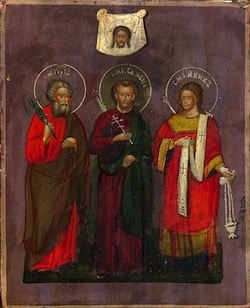
24th SUNDAY AFTER PENTECOST — Tone 7. Holy Martyrs and Confessors Gurias, Samonas, and Habibus, of Edessa (299-306).
Tone 7 Troparion (Resurrection)
By Your Cross You destroyed death. To the thief You opened Paradise. For the Myrrhbearers You changed weeping into joy. And You commanded Your disciples, O Christ God, to proclaim that You are risen,// granting the world great mercy.
Tone 4 Troparion (St. Nicholas)
The truth of your deeds has revealed you to your flock as a rule of faith, an image of meekness and a teacher of self-control; your humility exalted you; your poverty enriched you.// O Father Bishop Nicholas, pray to Christ God that our souls may be saved.
Tone 5 Troparion (Martyrs)
O Christ our God, You have granted us the miracles of Your holy martyrs Gúrias, Samónas, and Abíbus, as a stronghold and protection. Through their prayers, strengthen those in authority in ev’ry good deed,// for You alone are merciful and lovest mankind!
Tone 7 Kontakion (Resurrection)
The dominion of death can no longer hold men captive, for Christ descended, shattering and destroying its powers. Hell is bound, while the Prophets rejoice and cry: “The Savior has come to those in faith;// enter, you faithful, into the Resurrection!”
Tone 3 Kontakion (St. Nicholas)
You proved yourself to be be a holy priest, O Nicholas. You served God in Myra and lived the gospel of Christ. You offered your life for your people, And rescued the innocent from death. Therefore God has glorified you as a trustworthy guide of things divine.
Tone 2 Kontakion (Martyrs)
You received grace from on high, O all-praised martyrs, and you intercede for those in the midst of temptations. Therefore, O saints, you freed a young woman from bitter death,// and are indeed the glory of Edessa and the joy of the world.
Tone 6 Kontakion (Steadfast Protectress)
Steadfast Protectress of Christians, Constant Advocate before the Creator; despise not the cry of us sinners, but in your goodness come speedily to help us who call on you in faith. Hasten to hear our petition and to intercede for us, O Theotokos, for you always protect those who honor you!
Tone 7 Prokeimenon (Resurrection)
The Lord shall give strength to His people. / The Lord shall bless His people with peace. (Ps. 28:11)
V. Offer to the Lord, O you sons of God! Offer young rams to the Lord! (Ps. 28:1a)
Ephesians 2:14-22 (Epistle)
For He Himself is our peace, who has made both one, and has broken down the middle wall of separation, having abolished in His flesh the enmity, that is, the law of commandments contained in ordinances, so as to create in Himself one new man from the two, thus making peace, and that He might reconcile them both to God in one body through the cross, thereby putting to death the enmity. And He came and preached peace to you who were afar off and to those who were near. For through Him we both have access by one Spirit to the Father. Now, therefore, you are no longer strangers and foreigners, but fellow citizens with the saints and members of the household of God, having been built on the foundation of the apostles and prophets, Jesus Christ Himself being the chief cornerstone, in whom the whole building, being fitted together, grows into a holy temple in the Lord, in whom you also are being built together for a dwelling place of God in the Spirit.
Tone 7
Alleluia, Alleluia, Alleluia!
V. It is good to give thanks to the Lord, to sing praises to Your Name, O Most High. (Ps. 91:1)
V. To declare Your mercy in the morning, and Your truth by night (Ps. 91:2a)
Tone 5
V. Praise Him, all His angels, praise Him, all His hosts! (Ps. 148:2)
Luke 10:25-37 (Gospel)
And behold, a certain lawyer stood up and tested Him, saying, “Teacher, what shall I do to inherit eternal life?” He said to him, “What is written in the law? What is your reading of it?” So he answered and said, “’You shall love the LORD your God with all your heart, with all your soul, with all your strength, and with all your mind,’ and ‘your neighbor as yourself.’” And He said to him, “You have answered rightly; do this and you will live.” But he, wanting to justify himself, said to Jesus, “And who is my neighbor?” Then Jesus answered and said: “A certain man went down from Jerusalem to Jericho, and fell among thieves, who stripped him of his clothing, wounded him, and departed, leaving him half dead. Now by chance a certain priest came down that road. And when he saw him, he passed by on the other side. Likewise a Levite, when he arrived at the place, came and looked, and passed by on the other side. But a certain Samaritan, as he journeyed, came where he was. And when he saw him, he had compassion. So he went to him and bandaged his wounds, pouring on oil and wine; and he set him on his own animal, brought him to an inn, and took care of him. On the next day, when he departed, he took out two denarii, gave them to the innkeeper, and said to him, ‘Take care of him; and whatever more you spend, when I come again, I will repay you.’ So which of these three do you think was neighbor to him who fell among the thieves?” And he said, “He who showed mercy on him.” Then Jesus said to him, “Go and do likewise.”
Holy Martyrs and Confessors Gurias, Samonas, and Habibus, of Edessa
The Holy Martyrs and Confessors Gurias, Samonas and Habibus suffered during the persecution against Christians under the emperors Diocletian (284-305) and Maximian (305-311). The two friends Gurias and Samonas, preachers of the Word of God, were arrested in the city of Edessa.
The saints refused to offer sacrifice to the gods, and boldly confessed their faith in Christ. For this they were subjected to cruel tortures: they were beaten, hung up by their hands, heavy weights were tied to their feet, and they were cast into a stifling prison.
The martyrs endured everything with firmness and Samonas uttered a prayer to the Lord, which one of the witnesses to their death wrote down: “O Lord my God, against Whose will not a single sparrow falls into the snare. It was You Who made room for David in his sorrow (Ps. 4:1), Who proved the Prophet Daniel stronger than lions (Dan. 6:16-24), and granted a child of Abraham to be victor over torture and flames (Dan. ch. 3, ch. 14). You know also, Lord, the infirmity of our nature, You see the struggle set before us. Our foe strives to snatch us, the work of Your right hand, away from You and to deprive us of the glory which is in You. With Your compassionate eye watching over us, preserve in us the inextinguishable light of Your Commandments. Guide our steps by Your light, and make us worthy of Your Kingdom, for You are blessed unto ages of ages.” By night, they took the martyrs out beyond the city and beheaded them (+ 299-306). Christians buried their holy bodies with reverence.
After some years, the last pagan emperor, Licinius (311-324), began a persecution against Christians. Habibus, a deacon of the Church of Edessa whom the emperor ordered to be arrested for his zealous spreading of the true Faith, presented himself before the executioners when he learned they were searching for him. The saint confessed his faith in Christ and was sentenced to be burned alive. The martyr went willingly into the fire and with a prayer surrendered his soul to the Lord. When the fire went out, the mother and relatives of the saint found his body unharmed. They buried the martyr next to Saints Gurias and Samonas.
After the death of the saints, numerous miracles were wrought by them for those who entreated their help with faith and love. Once, a certain Gothic soldier, sent to serve at Edessa, took the pious virgin Euphemia as his wife. Before this the barbarian vowed to her mother Sophia at the graves of the Martyrs Gurias, Samonas and Habibus that he would do his spouse no harm, and would never insult her, but would always love and cherish her.
At the completion of his service in Edessa, he took Euphemia with him back to his native land. It turned out that he had deceived her, for he already had a wife at home, and Euphemia became her slave. Her evil husband threatened to kill her if she revealed to anyone that they were married. Euphemia suffered much abuse and humiliation. When she gave birth to a son, the jealous Gothic woman poisoned him. Euphemia turned with prayer to the holy Martyrs Gurias, Samonas and Habibus, the witnesses to the perjurer’s oath, and the Lord delivered Euphemia from her suffering and miraculously returned her to Edessa, where she was welcomed by her mother.
After a certain while the Goth was again sent to serve in Edessa. The whole city learned of his misdeeds after he was denounced by Sophia. The Goth was executed by order of the prefect of the city.
In an Akathist, the Holy Church addresses the martyrs: “Rejoice, Gurias, Samonas and Habibus, Heavenly Patrons of honorable marriage.” We pray to them for deliverance from family turmoil, and from marital difficulties, especially where one spouse hates the other without cause.
The Church Year: Nativity of Christ
The celebration of the feast of the Nativity of Christ in the Orthodox Church is patterned after the celebration of the feast of the Lord’s Resurrection. A fast of forty days precedes the feast, with special preparatory days announcing the approaching birth of the Saviour. Thus, on Saint Andrew’s Day (November 30) and Saint Nicholas Day (December 6) songs are sung to announce the coming birthday of the Lord:
Adorn yourself, O Cavern. Make ready, O Manger. O Shepherds and wisemen, bring your gifts and bear witness. For the Virgin is coming bearing Christ in her womb (Vesperal Hymn of Saint Nicholas Day).
On the eve of Christmas, the Royal Hours are read and the Divine Liturgy of Saint Basil is served with Vespers. At these services the Old Testament prophecies of Christ’s birth are chanted, emphasizing the prophecy of Micah which foretells Bethlehem as the birthplace of the Saviour, and the prophecies of Isaiah about the appearance and character of the Messiah:
The Lord Himself will give you a sign. Behold a virgin shall conceive and bear a son, and shall call His name Immanuel, which translated is, God with us (Is 7.14–15).
God is with us, understand all ye nations, and submit yourselves, for God is with us (Is 8.9).
For unto us a Child is born, unto us a Son is given; and the government shall be upon His shoulders, and His name shall be
called Wonderful, Counselor, the Everlasting Father, the Prince of Peace. Of the increase of His government and peace there will be no end (Is 9.6–7).
The Vigil of Christmas begins with Great Compline, highlighted once again by the solemn chanting of God is with us and the words of the prophecy of Isaiah. At Compline there is also the singing of the Troparion and Kontakion of the feast along with the special hymns glorifying the Saviour’s birth. There are also the special long litanies of intercession and the solemn blessing of the five loaves of bread together with the wheat and the wine of which the faithful partake and the oil with which they are anointed. This part of the festal vigil, which is done on all great feasts, is called the litya (in Greek, the artoklasia or the breaking of the bread).
At the beginning of the Christmas Matins, which together with Compline form the Christmas Vigil, the six matinal psalms begin as usual with the words: “Glory to God in the highest and on earth peace, good will among men” (Lk 2.14).
At the Christmas services these words of the angelic song are normally sung with great solemnity rather than being chanted as at the daily service. The Christmas Matins proceed as usual. The gospel reading from Matthew (1.18–25) tells of the birth of Christ, and all of the hymns and verses glorify His appearance on earth:
Christ is born, glorify Him. Christ is from heaven, go to meet Him. Christ is on earth, be ye lifted up. Sing to the Lord, all the earth. Sing out with gladness, all ye people. For He is glorified (First Ode of the Christmas Canon). To read the rest click on this.
Practical Answers about Fasting
On the Church’s fasting rules, their spiritual purpose, and the importance of personal guidance.
As we begin the Nativity Fast, it is important to be reminded both of the importance of fasting in the Church, as well as the reasons for it. Here is a very beneficial article from Metropolitan SABA of the Antiochian Archdiocese on the subject.
During this fasting season, we are often asked, as spiritual shepherds, detailed questions about how to fast, differences in fasting practices from one region to another, and related matters. In this brief article, I will shed some light on the questions most frequently discussed within the Archdiocese.
- Let us begin with the Church’s guiding principle: the faithful prepare for a feast by fasting. For this reason, fasting periods generally precede the major feasts. On a personal level, a believer may also prepare by fasting for significant circumstances in life: a serious illness, a great tragedy, a decisive turning point, and so forth. This is arranged with one’s spiritual father.
- The same principle also holds that the greater the feast, the more rigorous and ascetical the fast becomes. Since Pascha, for example, is the greatest feast, the “Feast of feasts and Festival of festivals,” we prepare for it with a fast that is both longer and more rigorous than the Nativity Fast. In Great Lent, fish is permitted only on the Annunciation and Palm Sunday, since both are feasts of the Lord and the Theotokos, directly concerning Christ and His Mother. During the Nativity Fast, however, fish and seafood are permitted during the first two weeks.
- In keeping with this principle, fish is not permitted during the final two weeks of the Nativity Fast. This is precisely because the feast is drawing near, preparation becomes more earnest, and ascetical restraint intensifies. For this reason, the celebration of the sacrament of marriage is also, as a rule, prohibited during this period.
- We abstain from certain foods during a fast because abstinence teaches us self-control, helps us rise above the appetites of the belly, and deepens our solidarity with the poor and hungry in a tangible way. These foods are not considered unclean. This helps us understand why believers living in Mediterranean countries abstain from fish, while those in cold countries such as Russia and Ukraine eat it, since fish and seafood are abundant there and vegetables are almost unavailable during winter.
- Likewise, in coastal cities generally, the faithful have traditionally eaten seafood classified as mollusks, such as octopus and similar creatures, because it is readily available and inexpensive. Some attribute this practice to the absence of blood in these creatures, since blood of animals is not to be shed during a fast. In one of its meanings, fasting is a return to peace with creation. Permission to eat meat was given after Noah’s flood, not at the beginning of human creation.
- As living conditions have changed, shellfish, for example, has become very expensive in some countries. Eating it, therefore, does not fit with the spirit and purpose of fasting. A believer may discern and abstain from it even though the fasting rule permits it. The same applies to any food that is costly or expensive in the region where we live.
- The prohibition against celebrating the sacrament of marriage during Great Lent and the final part of the Nativity Fast has both spiritual and practical pastoral reasons. During an ascetical fast, married couples abstain, as far as they are able, from marital relations, following the Apostle’s words: “Do not deprive one another except with consent for a time, that you may give yourselves to prayer” (1 Corinthians 7:5). Weddings are also usually accompanied by festivities and banquets which do not accord with fasting. Moreover, most of the faithful do not consider a banquet worthy of the occasion unless it includes meat.
- When many Churches adopted the Western calendar for the fixed feasts, including the Nativity, we retained the forty-day fast. The period during which marriages were prohibited, however, continued to follow the Eastern calendar, from December 20 to January 7. Twenty-five years ago, the Holy Synod of Antioch adjusted this period to five days, from December 20 to 25. This change responded to increasing emigration and employment outside the traditional territory of the Patriarchate of “Antioch and All the East.” It also took into account both the availability of transportation and travel and the difficulty of obtaining leave from work at any time of the year.
- The faithful’s reverence for the Theotokos, together with her place in the heart and doctrine of the Church, has made the fast preceding her feast on August 15 widely cherished and observed by the great majority of believers. Since the Theotokos is the model of virginity and chastity, the faithful have also traditionally refrained from holding weddings during this fast. Fasting practices vary, shaped both by devotion to the Theotokos and by the abundance of vegetables and fruit. Thus, some believers observe this fast without oil, cooked food, or the use of fire.
- During Great Lent, the most important fasting season, we observe two forms of fasting: abstaining from all food and drink from the night before until twelve noon the following day, and then eating fasting food, free of meat and animal products.
- In decades past, abstinence from food and drink continued until sunset. Exercising the authority to bind and loose given to her by Christ, the Church changed this to 12:00 noon because the conditions in which the faithful lived had changed. Society was no longer agricultural; occupations had multiplied and diversified, and working hours had grown longer. Cities had also expanded greatly, requiring people to spend considerable time commuting and traveling each day. These and other structural changes have taken place and continue to do so.
- The Lenten observance includes the preparatory week (Cheese-fare) before the fast, during which we abstain only from meat; the six weeks of Great Lent itself; and then Holy Week, when ascetical restraint becomes more rigorous than during the other days of the fast.
- Abstinence from olive oil has two aspects. First, it refers to every kind of oil. The liturgical books use the term “olive oil” because historically this was the oil available to the faithful; other vegetable oils were not known in earlier times. Today, therefore, the expression means all oils, not olive oil alone. For this reason, recently printed liturgical books use simply the word “oil.” Second, abstinence from oil is practiced today in monasteries. Outside monasteries, most Orthodox Churches no longer regard it as obligatory. Many of the faithful therefore observe it voluntarily, under the guidance of their spiritual father.
- The Church has its fasting rules, but applying them to one’s personal circumstances requires the help of a spiritual guide when a believer needs to relax the fast, break it occasionally, or cannot observe it as prescribed because of a health condition. These particular personal circumstances are addressed with one’s spiritual guide: the parish priest or father confessor. The believer keeps this guidance private and does not turn it into a general prescription to announce or recommend to others. Personal spiritual guidance is necessary and essential in every aspect and circumstance of a believer’s life, not only in fasting.
A believer who did not grow up in a household that observed the fasts begins fasting under the guidance of a spiritual father or parish priest, who gradually helps the person experience the fasts and enter their spirit and essence. This takes place through patient formation that considers the believer’s health, physical condition, work, and psychological well-being. We are on the path of salvation. Some run along it; others walk calmly and steadily. Still others, carried away by enthusiasm, exceed their strength, grow tired, and must sit down for a little while to rest and regain their energy.
Any understanding that associates fasting with deprivation and self-torment is not Orthodox. We fast so that we may rise above our passions, be purified, and be sanctified in spirit, soul, and body. God asks us to fast for our own sake, for our salvation, because fasting benefits us, strengthens us, and makes us steadfast. God wants us to grow, mature, and attain the measure of the stature of the fullness of Christ (Ephesians 4:13).
Everyone who has experienced something of life with God knows the sweetness of fasting and the benefit it brings.
 Sunday Bulletin November 8, 2026