
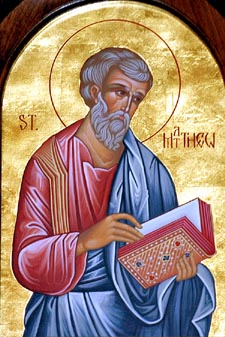
23rd SUNDAY AFTER PENTECOST — Tone 6. Holy Apostle and Evangelist Matthew (60 A.D.)
Tone 6 Troparion (Resurrection)
The Angelic Powers were at Your tomb; the guards became as dead men. Mary stood by Your grave, seeking Your most pure body. You captured hell, not being tempted by it. You came to the Virgin, granting life. O Lord, Who rose from the dead,// glory to You.
Tone 3 Troparion (St. Matthew)
With zeal you followed Christ the Master, Who, in His goodness, appeared on earth to mankind. Summoning you from the customs house, He revealed you as a chosen apostle: the proclaimer of the Gospel to the whole world. Therefore, divinely eloquent Matthew, we honor your precious memory.// Entreat the merciful God that He may grant our souls remission of transgressions!
Tone 6 Kontakion (Resurrection)
When Christ God, the Giver of Life, raised all of the dead from the valleys of misery with His mighty hand, He bestowed resurrection on the human race.// He is the Savior of all, the Resurrection, the Life, and the God of all.
Tone 3 Kontakion (St. Matthew)
Casting aside the bonds of the customs house for the yoke of justice, you were revealed as an excellent merchant, rich in wisdom from on high. You proclaimed the word of truth and roused the souls of the slothful// by writing of the hour of Judgment.
Tone 6 Kontakion (Steadfast Protectress)
Steadfast Protectress of Christians, Constant Advocate before the Creator; despise not the cry of us sinners, but in your goodness come speedily to help us who call on you in faith. Hasten to hear our petition and to intercede for us, O Theotokos, for you always protect those who honor you!
Tone 6 Prokeimenon (Resurrection)
O Lord, save Your people, / and bless Your inheritance! (Ps. 27:9a)
V. To You, O Lord, will I call. O my God, be not silent to me! (Ps. 27:1a)
Tone 8 Prokeimenon (St. Matthew)
Their proclamation has gone out into all the earth, / and their words to the ends of the universe. (Ps. 18:4)
Ephesians 2:4-10 (Epistle)
But God, who is rich in mercy, because of His great love with which He loved us, even when we were dead in trespasses, made us alive together with Christ (by grace you have been saved), and raised us up together, and made us sit together in the heavenly places in Christ Jesus, that in the ages to come He might show the exceeding riches of His grace in His kindness toward us in Christ Jesus. For by grace you have been saved through faith, and that not of yourselves; it is the gift of God, not of works, lest anyone should boast. For we are His workmanship, created in Christ Jesus for good works, which God prepared beforehand that we should walk in them.
1 Corinthians 4:9-16 (Epistle, Apostle)
For I think that God has displayed us, the apostles, last, as men condemned to death; for we have been made a spectacle to the world, both to angels and to men. We are fools for Christ’s sake, but you are wise in Christ! We are weak, but you are strong! You are distinguished, but we are dishonored! To the present hour we both hunger and thirst, and we are poorly clothed, and beaten, and homeless. And we labor, working with our own hands. Being reviled, we bless; being persecuted, we endure; being defamed, we entreat. We have been made as the filth of the world, the offscouring of all things until now. I do not write these things to shame you, but as my beloved children I warn you. For though you might have ten thousand instructors in Christ, yet you do not have many fathers; for in Christ Jesus I have begotten you through the gospel. Therefore I urge you, imitate me.
Tone 6
Alleluia, Alleluia, Alleluia!
V. He who dwells in the shelter of the Most High will abide in the shadow of the heavenly God. (Ps. 90:1)
V. He will say to the Lord: “My Protector and my Refuge; my God, in Whom I trust.”(Ps. 90:2)
Tone 1
V. The heavens will praise Your wonders, O Lord; and Your truth in the congregation of the saints. (Ps. 88:5)
Luke 10:25-37 (Gospel)
And behold, a certain lawyer stood up and tested Him, saying, “Teacher, what shall I do to inherit eternal life?” He said to him, “What is written in the law? What is your reading of it?” So he answered and said, “’You shall love the LORD your God with all your heart, with all your soul, with all your strength, and with all your mind,’ and ‘your neighbor as yourself.’” And He said to him, “You have answered rightly; do this and you will live.” But he, wanting to justify himself, said to Jesus, “And who is my neighbor?” Then Jesus answered and said: “A certain man went down from Jerusalem to Jericho, and fell among thieves, who stripped him of his clothing, wounded him, and departed, leaving him half dead. Now by chance a certain priest came down that road. And when he saw him, he passed by on the other side. Likewise a Levite, when he arrived at the place, came and looked, and passed by on the other side. But a certain Samaritan, as he journeyed, came where he was. And when he saw him, he had compassion. So he went to him and bandaged his wounds, pouring on oil and wine; and he set him on his own animal, brought him to an inn, and took care of him. On the next day, when he departed, he took out two denarii, gave them to the innkeeper, and said to him, ‘Take care of him; and whatever more you spend, when I come again, I will repay you.’ So which of these three do you think was neighbor to him who fell among the thieves?” And he said, “He who showed mercy on him.” Then Jesus said to him, “Go and do likewise.
Matthew 9:9-13 (Gospel, Apostle)
As Jesus passed on from there, He saw a man named Matthew sitting at the tax office. And He said to him, “Follow Me.” So he arose and followed Him. Now it happened, as Jesus sat at the table in the house, that behold, many tax collectors and sinners came and sat down with Him and His disciples. And when the Pharisees saw it, they said to His disciples, “Why does your Teacher eat with tax collectors and sinners?” When Jesus heard that, He said to them, “Those who are well have no need of a physician, but those who are sick. But go and learn what this means: ‘I desire mercy and not sacrifice.’ For I did not come to call the righteous, but sinners, to repentance.”
Apostle and Evangelist Matthew
The Holy Apostle and Evangelist Matthew, was also named Levi (Mark 2:14; Luke 5:27); he was one of the Twelve Apostles (Mark 3:18; Luke 6:45; Acts 1:13), and was brother of the Apostle James Alphaeus (Mark 2:14). He was a publican, or tax-collector for Rome, in a time when the Jews were under the rule of the Roman Empire. He lived in the Galilean city of Capernaum. When Matthew heard the voice of Jesus Christ: “Come, follow Me” (Mt. 9:9), he left everything and followed the Savior. Christ and His disciples did not refuse Matthew’s invitation and they visited his house, where they shared table with the publican’s friends and acquaintances. Like the host, they were also publicans and known sinners. This event disturbed the pharisees and scribes a great deal.
Publicans who collected taxes from their countrymen did this with great profit for themselves. Usually greedy and cruel people, the Jews considered them pernicious betrayers of their country and religion. The word “publican” for the Jews had the connotation of “public sinner” and “idol-worshipper.” To even speak with a tax-collector was considered a sin, and to associate with one was defilement. But the Jewish teachers were not able to comprehend that the Lord had “come to call not the righteous, but sinners to repentance” (Mt. 9:13).
Matthew, acknowledging his sinfulness, repaid fourfold anyone he had cheated, and he distributed his remaining possessions to the poor, and he followed after Christ with the other apostles. Saint Matthew was attentive to the instructions of the Divine Teacher, he beheld His innumerable miracles, he went together with the Twelve Apostles preaching to “the lost sheep of the house of Israel” (Mt. 10:6). He was a witness to the suffering, death, and Resurrection of the Savior, and of His glorious Ascension into Heaven.
Having received the grace of the Holy Spirit, which descended upon the Apostles on the day of Pentecost, Saint Matthew preached in Palestine for several years. At the request of the Jewish converts at Jerusalem, the holy Apostle Matthew wrote his Gospel describing the earthly life of the Savior, before leaving to preach the Gospel in faraway lands.
In the order of the books of the New Testament, the Gospel of Matthew comes first. Palestine is said to be the place where the Gospel was written. Saint Matthew wrote in Aramaic, and then it was translated into Greek. The Aramaic text has not survived, but many of the linguistic and cultural-historical peculiarities of the Greek translation give indications of it.
The Apostle Matthew preached among people who were awaiting the Messiah. His Gospel manifests itself as a vivid proof that Jesus Christ is the Messiah foretold by the prophets, and that there would not be another (Mt. 11:3).
The preaching and deeds of the Savior are presented by the evangelist in three divisions, constituting three aspects of the service of the Messiah: as Prophet and Law-Giver (Ch. 5-7), Lord over the world both visible and invisible (Ch. 8-25), and finally as High Priest offered as Sacrifice for the sins of all mankind (Ch. 26-27).
The theological content of the Gospel, besides the Christological themes, includes also the teaching about the Kingdom of God and about the Church, which the Lord sets forth in parables about the inner preparation for entering into the Kingdom (Ch. 5-7), about the worthiness of servers of the Church in the world (Ch. 10-11), about the signs of the Kingdom and its growth in the souls of mankind (Ch. 13), about the humility and simplicity of the inheritors of the Kingdom (Mt. 18:1-35; 19 13-30; 20:1-16; 25-27; 23:1-28), and about the eschatological revelations of the Kingdom in the Second Coming of Christ within the daily spiritual life of the Church (Ch. 24-25).
The Kingdom of Heaven and the Church are closely interconnected in the spiritual experience of Christianity: the Church is the historical embodiment of the Kingdom of Heaven in the world, and the Kingdom of Heaven is the Church of Christ in its eschatological perfection (Mt. 16:18-19; 28:18-20).
The holy Apostle brought the Gospel of Christ to Syria, Media, Persia, Parthia, and finishing his preaching in Ethiopia with a martyr’s death. This land was inhabited by tribes of cannibals with primitive customs and beliefs. The holy Apostle Matthew converted some of the idol-worshippers to faith in Christ. He founded the Church and built a temple in the city of Mirmena, establishing there his companion Platon as bishop.
When the holy apostle was fervently entreating God for the conversion of the Ethiopians the Lord Himself appeared to him in the form of a youth. He gave him a staff, and commanded him to plant it at the doors of the church. The Lord said that a tree would grow from this staff and it would bear fruit, and from its roots would flow a stream of water. When the Ethiopians washed themselves in the water and ate the fruit, they lost their wild ways and became gentle and good.
When the holy apostle carried the staff towards the church, he was met by the wife and son of the ruler of the land, Fulvian, who were afflicted by unclean spirits. In the Name of Christ the holy apostle healed them. This miracle converted a number of the pagans to the Lord. But the ruler did not want his subjects to become Christians and cease worshiping the pagan gods. He accused the apostle of sorcery and gave orders to execute him.
They put Saint Matthew head downwards, piled up brushwood and ignited it. When the fire flared up, everyone then saw that the fire did not harm Saint Matthew. Then Fulvian gave orders to add more wood to the fire, and frenzied with boldness, he commanded to set up twelve idols around the fire. But the flames melted the idols and flared up toward Fulvian. The frightened Ethiopian turned to the saint with an entreaty for mercy, and by the prayer of the martyr the flame went out. The body of the holy apostle remained unharmed, and he departed to the Lord.
The ruler Fulvian deeply repented of his deed, but still he had doubts. By his command, they put the body of Saint Matthew into an iron coffin and threw it into the sea. In doing this Fulvian said that if the God of Matthew would preserve the body of the apostle in the water as He preserved him in the fire, then this would be proper reason to worship this One True God.
That night the Apostle Matthew appeared to Bishop Platon in a dream, and commanded him to go with clergy to the shore of the sea and to find his body there. The righteous Fulvian and his retinue went with the bishop to the shore of the sea. The coffin carried by the waves was taken to the church built by the apostle. Then Fulvian begged forgiveness of the holy Apostle Matthew, after which Bishop Platon baptized him, giving him the name Matthew in obedience to a command of God.
Soon Saint Fulvian-Matthew abdicated his rule and became a presbyter. Upon the death of Bishop Platon, the Apostle Matthew appeared to him and exhorted him to head the Ethiopian Church. Having become a bishop, Saint Fulvian-Matthew toiled at preaching the Word of God, continuing the work of his heavenly patron.
The Holy Apostle and Evangelist Matthew
REFLECTION — St. Nikolai
Does the Lord’s command about ceaseless prayer that men ought always to pray (Luke 18:1), apply only to monks or to all Christians in general? If it applied only to monks, the Apostle Paul would not have written to the Christians in Thessalonica to pray without ceasing (I Thessalonians 5:17). The Apostle repeats the Lord’s command, word for word, and issues it to all Christians without distinction, whether monks or laymen. St. Gregory Palamas lived a life of asceticism for some time as a young hieromonk in a monastery in Beroea. The elder Job, a well-known ascetic whom everyone respected, lived in that monastery. It happened that, in elder Job’s presence, St. Gregory quoted the Apostle’s words, asserting that ceaseless prayer is the obligation of every Christian and not just for monks. However, elder Job replied that ceaseless prayer is the obligation of the monk only, and not for every Christian. Gregory, as the younger of the two, yielded and withdrew in silence. When Job returned to his cell and stood at prayer, an angel in great heavenly glory appeared to him and said: “O Elder, do not doubt the truthfulness of Gregory’s words; he spoke correctly and you should think likewise and pass it on to others.” Thus, both the Apostle and the angel confirmed the commandment that all Christians must pray to God without ceasing. Not only without ceasing in church, but also without ceasing in every place and at all times, and especially in your heart. For if God does not for a moment tire of giving us good things, how can we tire of thanking Him for these good things? When He thinks of us without ceasing, why do we not think of Him without ceasing?
— Velimirovic, Saint Nikolai. The Prologue of Ohrid
“Prayer without Ceasing” is necessary for all Christians
St Gregory Palamas
Let no one think, my brother Christians, that it is the duty only of priests and monks to pray without ceasing, and not of laymen.
No, no; it is the duty of all of us Christians to remain always in prayer. For look what the most holy Patriarch of Constantinople, Philotheus, writes in his life of St. Gregory of Thessalonica. This saint had a beloved friend by the name of Job, a very simple but most virtuous man. Once, while conversing with him, His Eminence said of prayer that every Christian in general should strive to pray always, and to pray without ceasing, as Apostle Paul commands all Christians, “Pray without ceasing” (I Thessalonians 5:17), and as the prophet David says of himself, although he was a king and had to concern himself with his whole kingdom: “I foresaw the Lord always before
my face” (Psalms 15:8), that is, in my prayer I always mentally see the Lord before me.
Gregory the Theologian also teaches all Christians to say Godʼs name in prayer more often than to breathe.
So, my Christian brethren, I too implore you, together also with St. Chrysostom, for the sake of saving your souls, do not neglect the practice of this prayer. Imitate those I have mentioned and follow in their footsteps as far as you can.
At first it may appear very difficult to you, but be assured, as it were from Almighty God, that this very name of our Lord Jesus Christ, constantly invoked by you, will help you to overcome all difficulties, and in the course of time you will become used to this practice and will taste how sweet is the name of the Lord. Then you will learn by experience that this practice is not impossible and not difficult, but both possible and easy. This is why St. Paul, who knew better than we the great good which such prayer would bring, commanded us to pray without ceasing.
He would not have imposed this obligation upon us if it were extremely difficult and impossible, for he knew beforehand that in such case, having no possibility of fulfilling it, we would inevitably prove to be disobedient and would transgress his commandment, thus incurring blame and condemnation. The Apostle could have had no such intention.
Moreover, bear in mind the method of prayer – how it is possible to pray without ceasing, namely by praying in the mind. And this we can always do if we so wish. For when we sit down to work with our hands, when we walk, when we eat, when we drink we can always pray mentally and practice this mental prayer – the true prayer pleasing to God.
Let us work with the body and pray with the soul. Let our outer man perform his bodily tasks, and let the inner man be entirely dedicated to the service of God, never abandoning this spiritual practice of mental prayer, as Jesus, God and Man, commanded us, saying: “But thou, when thou prayest, enter into thy closet, and when thou hast shut thy door, pray to thy Father which is in secret” (Matthew 6:6).The closet of the soul is the body; our doors are the five bodily senses. The soul enters its closet when the mind does not wander hither and thither, roaming among things and affairs of the world, but stays within, in our heart. Our senses become closed and remain closed when we do not let them be attached to external sensory things, and in this way our mind remains free from every worldly attachment, and by secret mental prayer unites with God its Father. “And thy Father which seeth in secret shall reward thee openly,” adds the Lord. God who knows all secret things sees mental prayer and rewards it openly with great gifts. For that prayer is true and perfect which fills the soul with Divine grace and spiritual gifts.
As chrism perfumes the jar the more strongly the tighter it is closed, so prayer, the more fast it is imprisoned in the heart, abounds the more in Divine grace. Blessed are those who acquire the habit of this heavenly practice, for by it they overcome every temptation of the evil demons, as David overcame the proud Goliath. It extinguishes the unruly lusts of the flesh, as the three men extinguished the flames of the furnace. This practice of inner prayer tames passions as Daniel tamed the wild beasts. By it the dew of the Holy spirit is brought down upon the heart, as Elijah brought down rain on Mount Carmel.
This mental prayer reaches to the very throne of God and is preserved in golden vials, sending forth their odors before the Lord, as John the Divine saw in the Revelation, “Four and twenty elders fell down before the Lamb, having every one of them harps, and golden vials full of odors, which are the prayers of the saints” (Revelation 5:8). This mental prayer is the light which illumines manʼs soul and inflames his heart with the fire of love of God. It is the chain linking God with man and man with God.
Oh the incomparable blessing of mental prayer! It allows a man constantly to converse with God. Oh truly wonderful and more than wonderful – to be with oneʼs body among men while in oneʼs mind conversing with God. Angels have no physical voice, but mentally never cease to sing glory to God. This is their sole occupation and all their life is dedicated to this.
So, brother, when you enter your closet and close your door, that is, when your mind is not darting hither and thither but enters within your heart, and your senses are confined and barred against things of this world, and when you pray thus always, you too are then like the holy angels, and your Father, Who sees your prayer in secret, which you bring Him in the hidden depths of your heart, will reward you openly by great spiritual gifts.
But what other and greater rewards can you wish from this when, as I said, you are mentally always before the face of God and are constantly conversing with Him – conversing with God, without Whom no man can ever be blessed either here or in another life?
Finally, my brother, whoever you may be, when you take up this book and, having read it, wish to test in practice the profit which mental prayer brings to the soul, I beg you, when you begin to pray thus, pray God with one invocation, “Lord have mercy,” for the soul of him who has worked on compiling this book and of him who helped to give it to the public. For they have great need of your prayer to receive Godʼs mercy for their soul, as you for yours. May it be so! May it be so!
St Gregory Palamas, from Early Fathers From the Philokalia, translated from the Russian text, “Dobrotolubiye,” by E. Kadloubovsky and G.E.H. Palmer, eighth edition, (London: Faber and Faber, Ltd., 1981), pp. 412 – 415
 Sunday Bulletin November 9, 2025