
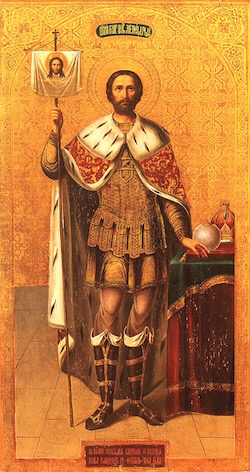
24th SUNDAY AFTER PENTECOST — Tone 7. Afterfeast of the Entry into the Temple. Repose of Rt. Blv. Great Prince Alexander Nevsky, in schema Aleksy (1263).
Tone 7 Troparion (Resurrection)
By Your Cross You destroyed death. To the thief You opened Paradise. For the Myrrhbearers You changed weeping into joy. And You commanded Your disciples, O Christ God, to proclaim that You are risen,// granting the world great mercy.
Tone 4 Troparion (Feast)
Today is the prelude of the good will of God, of the preaching of the salvation of mankind. The Virgin appears in the Temple of God, in anticipation proclaiming Christ to all. Let us rejoice and sing to her: “Rejoice, O Fulfillment//of the Creator’s dispensation!“
Tone 4 Troparion (St. Nicholas)
The truth of your deeds has revealed you to your flock as a rule of faith, an image of meekness and a teacher of self-control; your humility exalted you; your poverty enriched you.// O Father Bishop Nicholas, pray to Christ God that our souls may be saved.
Tone 4 Troparion (St. Alexander)
Christ revealed you, blessed Alexander, as a new and glorious worker of wonders; a man and a prince well pleasing to God and a divine treasure of the Russian land. Today we assemble in faith and love to glorify the Lord by joyously remembering you. He granted you the grace of healing, therefore entreat Him to strengthen your spiritual children,// and to save all Orthodox Christians!
Tone 7 Kontakion (Resurrection)
The dominion of death can no longer hold men captive, for Christ descended, shattering and destroying its powers. Hell is bound, while the Prophets rejoice and cry: “The Savior has come to those in faith;// enter, you faithful, into the Resurrection!”
Tone 3 Kontakion (St. Nicholas)
You proved yourself to be be a holy priest, O Nicholas. You served God in Myra and lived the gospel of Christ. You offered your life for your people, And rescued the innocent from death. Therefore God has glorified you as a trustworthy guide of things divine.
Tone 8 Kontakion (St. Alexander)
We honor you as a most radiant, spiritual star, rising up from the east; going down in the west! As you enriched the Russian people with good works and miracles, so now enlighten us who remember you in faith, blessed Alexander! Today as we celebrate your falling asleep, we ask you to beseech the Lord// that He may strengthen His servants and save all Orthodox Christians!
Tone 4 Kontakion (Feast)
The most pure Temple of the Savior; the precious Chamber and Virgin; the sacred Treasure of the glory of God, is presented today to the house of the Lord. She brings with her the grace of the Spirit, therefore, the angels of God praise her:// “Truly this woman is the abode of Heaven!”
Tone 6 Prokeimenon (Resurrection)
The Lord shall give strength to His people. / The Lord shall bless His people with peace. (Ps. 28:11)
V. Offer to the Lord, O you sons of God! Offer young rams to the Lord! (Ps. 28:1a)
Tone 8 Prokeimenon (Song of the Theotokos)
My soul magnifies the Lord, / and my spirit rejoices in God my Savior. (Lk. 1:46-47)
Ephesians 2:14-22 (Epistle)
For He Himself is our peace, who has made both one, and has broken down the middle wall of separation, having abolished in His flesh the enmity, that is, the law of commandments contained in ordinances, so as to create in Himself one new man from the two, thus making peace, and that He might reconcile them both to God in one body through the cross, thereby putting to death the enmity. And He came and preached peace to you who were afar off and to those who were near. For through Him we both have access by one Spirit to the Father. Now, therefore, you are no longer strangers and foreigners, but fellow citizens with the saints and members of the household of God, having been built on the foundation of the apostles and prophets, Jesus Christ Himself being the chief cornerstone, in whom the whole building, being fitted together, grows into a holy temple in the Lord, in whom you also are being built together for a dwelling place of God in the Spirit.
Galatians 5:22-6:2 (Epistle, St. Alexander)
But the fruit of the Spirit is love, joy, peace, longsuffering, kindness, goodness, faithfulness, gentleness, self-control. Against such there is no law. And those who are Christ’s have crucified the flesh with its passions and desires. If we live in the Spirit, let us also walk in the Spirit. Let us not become conceited, provoking one another, envying one another. Brethren, if a man is overtaken in any trespass, you who are spiritual restore such a one in a spirit of gentleness, considering yourself lest you also be tempted. Bear one another’s burdens, and so fulfill the law of Christ.
Tone 7
Alleluia, Alleluia, Alleluia!
V. It is good to give thanks to the Lord, to sing praises to Your Name, O Most High. (Ps. 91:1)
V. To declare Your mercy in the morning, and Your truth by night. (Ps. 91:2a)
Tone 1
V Hearken, O daughter, and see, and incline your ear! (Ps. 44:9a)
Luke 12:16-21 (Gospel)
Then He spoke a parable to them, saying: “The ground of a certain rich man yielded plentifully. And he thought within himself, saying, ‘What shall I do, since I have no room to store my crops?’ So he said, ‘I will do this: I will pull down my barns and build greater, and there I will store all my crops and my goods. ‘And I will say to my soul, “Soul, you have many goods laid up for many years; take your ease; eat, drink, and be merry.”’ But God said to him, ‘Fool! This night your soul will be required of you; then whose will those things be which you have provided?’ So is he who lays up treasure for himself, and is not rich toward God.”
Matthew 11:27-30 (Gospel, St. Alexander)
All things have been delivered to Me by My Father, and no one knows the Son except the Father. Nor does anyone know the Father except the Son, and the one to whom the Son wills to reveal Him. Come to Me, all you who labor and are heavy laden, and I will give you rest. Take My yoke upon you and learn from Me, for I am gentle and lowly in heart, and you will find rest for your souls. For My yoke is easy and My burden is light.”
Repose of Saint Alexander Nevsky
The Holy Prince Alexander Nevsky was born on May 30, 1220 in the city of Pereslavl-Zalessk. His father Yaroslav II, Theodore in Baptism (+1246), “a gentle, kindly and genial prince”, was the younger son of Vsevolod III Large Nest (+ 1212), brother of the Holy Prince Yuri Vsevolodovich (February 4). Saint Alexander’s mother, Theodosia Igorevna, a Ryazan princess, was Yaroslav’s third wife. Their older son was the Holy Prince Theodore (June 5), who departed to the Lord at age fifteen. Saint Alexander was their second son.
His childhood was spent at Pereslavl-Zalessk, where his father was prince. The princely tonsure of the lad Alexander (a ceremony of initiation to be soldier) was done in the Savior Transfiguration Cathedral of Pereslavl by Saint Simon, Bishop of Suzdal (May 10), one of the compilers of the Kiev Caves Paterikon (Lives of the Fathers). From this Elder-hierarch, Saint Alexander received his first blessing for military service in the name of God, to defend the Russian Church and the Russian Land.
In 1227 Prince Yaroslav, at the request of the people of Novgorod, was sent by his brother Yuri, the Great Prince of Vladimir, to rule as prince in Novgorod the Great. He took with him his sons, Saints Theodore and Alexander. Dissatisfied with the Vladimir princes, the people of Novgorod soon invited Saint Michael of Chernigov (September 20), and in February 1229 Yaroslav with his sons departed to Pereslavl. The matter ended peacefully: in 1230 Yaroslav with his sons returned to Novgorod, and Saint Michael’s daughter Theodosia was betrothed to Saint Theodore, the elder brother of Saint Alexander. After the death of the bridegroom in 1233 the young princess went to a monastery and became famous in monastic exploits as the nun Saint Euphrosynē of Suzdal (September 25).
From his early years Saint Alexander went along on his father’s campaigns. In 1235 he participated in a battle at the River Emajogi (in present-day Estonia), where the forces of Yaroslav totally routed the Germans. In the following year Yaroslav went to Kiev, “settling” his son, Saint Alexander, to rule independently as prince at Novgorod. In 1239 Saint Alexander entered into marriage, taking as wife the daughter of the Polotsian prince Briacheslav. Some histories relate that the day the princess was baptized was the Name Day of her saintly spouse, and she was named Alexandra. His father, Yaroslav, blessed them at betrothal with the holy wonderworking icon of the Theodore Mother of God (the father was named Theodore in Baptism). Afterwards, Saint Alexander constantly prayed before this icon. Later, it was taken from the Gorodetsk Monastery, where he died, by his brother Basil of Kostroma (+1276), and transferred to Kostroma.
A very troublesome time had begun in Russian history: from the East came the Mongol Horde destroying everything in their path; from the West came the forces of the Teutonic Knights, which blasphemously and with the blessing of the Roman Pope, called itself “Cross-bearers” by wearing the Cross of the Lord. In this terrible hour the Providence of God raised up for the salvation of Russia holy Prince Alexander, a great warrior, man of prayer, ascetic and upholder of the Land of Russia. “Without the command of God there would not have been his prince.”
Where Does the Divine Liturgy Come From?
THE CULMINATION OF THE AGE-OLD TRADITION OF WORSHIP
Thy processionals have been seen, O God, the processionals of my God, of my King Who is in His sanctuary. Princes went before, and after them the chanters, in the midst of timbrel-playing maidens. In the congregations bless ye God, the Lord from the well-springs of Israel. (Ps. 67:25–27)
Immediately after the exile of our common ancestors, Adam and Eve, from the Eden of delight, men built altars and prayed to God, accompanied by sacrifices of various kinds. Noah built an altar after the great Deluge, as did Abraham and the patriarchs, our forefathers who received the first promises from God. Moses was instructed to build a specific tent of worship, the Tabernacle in the wilderness. Later, King David’s son, Solomon, received the command to build God a house of worship, the first temple in Jerusalem. All this was to teach man that liturgical worship, under the direction of the ministers duly appointed by God, comprises the highest form of prayer—the pinnacle of spiritual experience: I was glad because of them that said unto me: Let us go into the house of the Lord (Ps. 121:1). The Holy and Divine Liturgy is the product of two elements. First, our Liturgy is founded on the order of worship taught by God to Moses in the Old Testament. Later, under the ministry of Ezra the prophet (sixth century BC), the interpretation of Scripture was added to Mosaic tradition. Then finally, the Mystical Supper itself, the direct instruction given by Our Lord Jesus Christ on the eve of His Passion, was incorporated to complete the Holy and Divine Liturgy. On that night, He gave Himself to us mystically in the offered bread, His Body, and in the wine, His Blood.
After Christ’s glorious Resurrection “on the third day” (Sunday), He appeared many times to His Apostles and taught them “the things pertaining to the kingdom of God” (Acts 1:3). The Church has always understood this to mean, among other things, direct instruction to them concerning the Liturgy. In the Book of Acts, we learn about the sending forth of St. Paul on his apostolic journeys. He went out from Antioch, where the Church, inspired by the Holy Spirit, laid hands on him to commission him for that work. The text literally says “while they were celebrating the Liturgy [Greek leitourgountes, “liturgizing”] unto the Lord, and praying and fasting” (Acts 13:2, 3). So the Liturgy is the fundamental and most profound way in which the Church shows herself to be what she is: the New Israel, the Bride and Body of Christ.
Although the Liturgy can be served at any time of day or night, usually it is served in the morning (preceded by the service of Orthros, or the service of the Hours, depending upon local tradition). Therefore, faithful Orthodox Christians make it a habit to attend Vespers (or Vigil) on the night before the Liturgy and to keep a quiet evening with prayer and preparation, as strength enables. Early in the morning, the faithful return to the church temple for Orthros (or Hours) and remain for the Liturgy. We have seen that the Liturgy is, basically, a sacred meal. This meal needs preparation. So you can see how unprepared and ill-fitted each of us might be if we showed up late merely to “get Communion.”
We are not really present with full attentiveness; our heart and mind are still distracted by worldly cares. We have not been involved in the work of preparation. So try to observe the services on the eve of the Liturgy and come to church early to hear Orthros or the Hours before the Liturgy begins. Then your heart is warmed and your mind is attentive to the presence of the Lord. You have fully participated in the sacred work of prayer.
O’Grady, Patrick B.. Come, Let Us Worship: A Practical Guide to the Divine Liturgy for Orthodox Laity
Elder (now Saint) Ephraim of Katounakia
To a priest-monk who was a spiritual friend of the Elder, and to whom he confided many of his circumstances and dispositions, he said, “I want, my Father, to celebrate the Liturgy with a clear conscience, because from my first Liturgy, the mercy of God has counted me worthy to actually see Grace transforming the Divine Gifts. From that day on, the All-good God has not deprived me even once of this gift.” He further revealed to this priest-monk that many times, after the consecration of the Holy Gifts, Grace would “open his eyes,” and he saw Christ Himself on the diskos. And when it came time to cut the Body of Christ into pieces, it was impossible for him to hold back the tears. Divine Grace showed him Christ just as He is portrayed on the Epitaphion that we venerate.
— Pemptousia; of Vatopaidi, Elder Joseph. Obedience is Life: Elder Ephraim of Katounakia
 Sunday Bulletin November 16, 2025