

25th SUNDAY AFTER PENTECOST — Tone 8. Holy and All-praised Apostle Andrew the First-called (62). Ven. Sebastian Dabovich (1940).
Tone 8 Troparion (Resurrection)
You descended from on high, O Merciful One! You accepted the three day burial to free us from our sufferings!// O Lord, our Life and Resurrection, glory to You!
Tone 4 Troparion (St. Andrew)
O Andrew, first-called of the Apostles, and brother of the foremost disciple, entreat the Master of all to grant peace to the world,// and to our souls great mercy!
Tone 4 Troparion (St. Sebastian)
O God of our Fathers, always act with kindness towards us; take not Your mercy from us, but guide our lives in peace through the prayers of Saints Sebastian and Mardarije.
Tone 8 Kontakion (Resurrection)
By rising from the tomb, You raised the dead and resurrected Adam. Eve exults in Your Resurrection,// and the world celebrates Your rising from the dead, O greatly Merciful One!
Tone 3 Kontakion (St. Andrew)
Let us praise Andrew, the herald of God, the namesake of courage, the first-called of the Savior’s disciples and the brother of Peter! As he once called to his brother, he now cries out to us:// “Come, for we have found the One Whom the world desires!”
Tone 8 Kontakion (St. Sebastian)
Apostle and Enlightener of America, born in San Francisco, first one born in America to become a priest. Fiery preacher of Christ’s Word among the peoples of America, you traveled throughout the country preaching truth and love, confirming many souls in the Orthodox Faith, and building many churches to the glory of God; poor in body but rich in the Spirit, O Father Sebastian of Jackson and Apostle of All America, entreat the Lord Whom you served with your whole heart, to grant us your last spoken wish: the everlasting Kingdom of Heaven.
Tone 6 Kontakion (Steadfast Protectress)
Steadfast Protectress of Christians, Constant Advocate before the Creator; despise not the cry of us sinners, but in your goodness come speedily to help us who call on you in faith. Hasten to hear our petition and to intercede for us, O Theotokos, for you always protect those who honor you!
Tone 8 Prokeimenon (Resurrection)
Pray and make your vows / before the Lord, our God! (Ps. 75:10a)
V. In Judah God is known; His Name is great in Israel. (Ps. 75:1)
Tone 8 Prokeimenon (St. Andrew)
Their proclamation has gone out into all the earth, / and their words to the ends of the universe. (Ps. 18:4)
Ephesians 4:1-6 (Epistle)
I, therefore, the prisoner of the Lord, beseech you to walk worthy of the calling with which you were called, with all lowliness and gentleness, with longsuffering, bearing with one another in love, endeavoring to keep the unity of the Spirit in the bond of peace. There is one body and one Spirit, just as you were called in one hope of your calling; one Lord, one faith, one baptism; one God and Father of all, who is above all, and through all, and in you all.
1 Corinthians 4:9-16 (Epistle, Apostle)
For I think that God has displayed us, the apostles, last, as men condemned to death; for we have been made a spectacle to the world, both to angels and to men. We are fools for Christ’s sake, but you are wise in Christ! We are weak, but you are strong! You are distinguished, but we are dishonored! To the present hour we both hunger and thirst, and we are poorly clothed, and beaten, and homeless. And we labor, working with our own hands. Being reviled, we bless; being persecuted, we endure; being defamed, we entreat. We have been made as the filth of the world, the offscouring of all things until now. I do not write these things to shame you, but as my beloved children I warn you. For though you might have ten thousand instructors in Christ, yet you do not have many fathers; for in Christ Jesus I have begotten you through the gospel. Therefore I urge you, imitate me.
Tone 8
Alleluia, Alleluia, Alleluia!
V. Come, let us rejoice in the Lord! Let us make a joyful noise to God our Savior! (Ps. 94:1)
V. Let us come before His face with thanksgiving; let us make a joyful noise to Him with songs of praise! (Ps. 94:2)
Tone 1
V. The heavens will praise Your wonders, O Lord; and Your truth in the congregation of the saints. (Ps. 88:5)
Luke 13:10-17 (Gospel)
Now He was teaching in one of the synagogues on the Sabbath. And behold, there was a woman who had a spirit of infirmity eighteen years, and was bent over and could in no way raise herself up. But when Jesus saw her, He called her to Him and said to her, “Woman, you are loosed from your infirmity.” And He laid His hands on her, and immediately she was made straight, and glorified God. But the ruler of the synagogue answered with indignation, because Jesus had healed on the Sabbath; and he said to the crowd, “There are six days on which men ought to work; therefore come and be healed on them, and not on the Sabbath day.” The Lord then answered him and said, “Hypocrite! Does not each one of you on the Sabbath loose his ox or donkey from the stall, and lead it away to water it? So ought not this woman, being a daughter of Abraham, whom Satan has bound – think of it – for eighteen years, be loosed from this bond on the Sabbath?” And when He said these things, all His adversaries were put to shame; and all the multitude rejoiced for all the glorious things that were done by Him.
John 1:35-51 (Gospel, Apostle)
Again, the next day, John stood with two of his disciples. And looking at Jesus as He walked, he said, “Behold the Lamb of God!” The two disciples heard him speak, and they followed Jesus. Then Jesus turned, and seeing them following, said to them, “What do you seek?” They said to Him, “Rabbi,” (which is to say, when translated, Teacher) “where are You staying?” He said to them, “Come and see.” They came and saw where He was staying, and remained with Him that day (now it was about the tenth hour). One of the two who heard John speak, and followed Him, was Andrew, Simon Peter’s brother. He first found his own brother Simon, and said to him, “We have found the Messiah” (which is translated, the Christ). And he brought him to Jesus. Now when Jesus looked at him, He said, “You are Simon the son of Jonah. You shall be called Cephas” (which is translated, A Stone). The following day Jesus wanted to go to Galilee, and He found Philip and said to him, “Follow Me.” Now Philip was from Bethsaida, the city of Andrew and Peter. Philip found Nathanael and said to him, “We have found Him of whom Moses in the law, and also the prophets, wrote – Jesus of Nazareth, the son of Joseph.” And Nathanael said to him, “Can anything good come out of Nazareth?” Philip said to him, “Come and see.” Jesus saw Nathanael coming toward Him, and said of him, “Behold, an Israelite indeed, in whom is no deceit!” Nathanael said to Him, “How do You know me?” Jesus answered and said to him, “Before Philip called you, when you were under the fig tree, I saw you.” Nathanael answered and said to Him, “Rabbi, You are the Son of God! You are the King of Israel!” Jesus answered and said to him, “Because I said to you, ‘I saw you under the fig tree,’ do you believe? You will see greater things than these.” And He said to him, “Most assuredly, I say to you, hereafter you shall see heaven open, and the angels of God ascending and descending upon the Son of Man.”
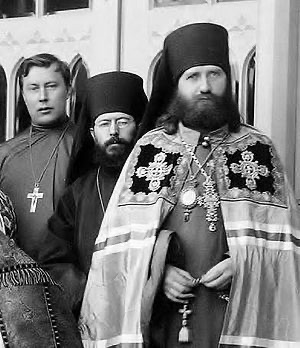
Venerable Sebastian Dabovich
Venerable Sebastian (Dabovich) of Jackson, California was born on June 9, 1863 in San Francisco to Serbian emigrés. Jovan Dabovich studied at the Kiev and St. Petersburg Theological Academies. In 1887, while pursuing his studies at the St. Petersburg Theological Academy, he was tonsured as a monk, and then ordained as a Hierodeacon.
After completing his education, Father Sebastian returned to the United States, where he began to serve at Saint Alexander Nevsky church in San Francisco. On August 16, 1892 he was ordained as a Hieromonk by Bishop Nicholas (Ziorov) of the Diocese of the Aleutians and Alaska, who sent him to Minneapolis to replace Saint Alexis Toth as the priest of Saint Mary’s Church. Under Bishop Nicholas’s omophorion he carried out a program of educational, missionary, and pastoral work in Washington, (Oregon – he started OUR PARISH!) California, and Minneapolis. Then he worked in the administration of the North American mission under Saint Tikhon (Belavin), the future Patriarch of Moscow and All Russia, preaching in English, Serbian, and Russian.
In 1894 he built a church for the Serbian community in Jackson, California in honor of Saint Sava of Serbia, which was the first Serbian parish in America. He was assigned to assist at Saint Michael’s Cathedral in Sitka, Alaska.
During his lifetime, the missionary priest crossed the Atlantic Ocean fifteen times and the Pacific Ocean nine times, when he needed to visit Serbia and Russia, and also his missionary journeys to Japan, where Father Sebastian met Saint Nicholas (Kasatkin) of Japan.
In 1905 Igoumen Sebastian was appointed to the post of Dean of Serbian churches, and in that same year, by decree of the Synod, he became the head of the Serbian mission. Archbishop Tikhon asked Father Sebastian to head a Serbian Mission in the North American diocese. On August 15, 1905, Archbishop Tikhon elevated him to the rank of Archimandrite for his zealous labors for the Church.
In 1910, Father Sebastian went to Serbia, serving as a chaplain in the Serbian Army during the Second Balkan War (1912-1913), and also during World War I (1914-1918). From 1936 until the end of his earthly life, he lived in retirement at the Saint Sava of Serbia Monastery in Žića. He reposed there on November 17/30, 1940, and Saint Nicholas (Nikolai Velimirovich) presided at his funeral. In 2007, Venerable Sebastian’s relics were reburied in the church of Saint Sava in Jackson, California, which he had founded.
On May 29, 2015 by the decision of the Bishops’ Council of the Serbian Orthodox Church, Archimandrite Sebastian was glorified as a Saint. His formal canonization took place on September 4, 2015, and Patriarch Irinej of Serbia presided at the service in Saint Stephen’s Cathedral, Alhambra, California.
REFLECTION
St. John Chrysostom says: “All is given to the Apostles.” That is, all gifts, all power, all the fullness of grace which God gives to the faithful. We see this in the life of the great apostle, St. Andrew the First-called: He was an apostle, evangelist, prophet, pastor and teacher (Ephesians 4:11). As an evangelist, he carried the good news of the Gospel to the four corners of the earth; as a prophet, he prophesied the baptism of the Russian people and the greatness of Kiev as a city and a Christian center; as a pastor, he established and organized many churches; as a teacher, he tirelessly taught people right up to and during his crucifixion, when he taught from the cross until his last breath. In addition to this, he was a martyr, which is also according to the gift of the Holy Spirit, and is not given to everyone. And so we see in this apostle, as in the others, the fullness of the grace of the Spirit of God. And every great work that a follower of Christ performs must be ascribed to that grace. St. Frumentius testifies this to us. When he returned from Alexandria to Abyssinia as a consecrated bishop, he began to perform the greatest miracles, thus converting great masses of people to the Faith. Then the amazed king asked him:“So many years have you lived among us and never have we seen you perform such miracles. How is it that you do so now?” To this, the Blessed Frumentius replied to the emperor: “This is not my work, but the work of the grace of the priesthood.” The saint then explained to the king how he had forsaken parents and marriage and the whole world for the sake of Christ, and how he had—by the laying on of hands by St. Athanasius—received the grace of the priesthood: miracle-working grace.
— Velimirovic, Saint Nikolai. The Prologue of Ohrid
He Who is Sinless May Cast The First Stone
We wretched people—of whom I am first—criticize with ease. If we see or hear of someone who has sinned, or if others accuse someone to us, we immediately, without a second thought, without a worry, without further examination, cast the stone of anathema and strike the person, thus implementing the Mosaic Law. We are plagued with so many sins, we are so heavily burdened, we have so many personal faults, and yet we continue to make countless erroneous judgments. Even though we constantly discover that we have made incorrect assessments in the past, we persist. At the slightest opportunity and excuse, we immediately move our tongues, start making phone calls, and begin criticizing and gossiping. Thus, the devil opens his books and records our sin within our criminal record. Why should we allow this to happen when our Christ very clearly teaches us not to judge?
The Apostle Paul, the mouth of Christ, says, “Why do you judge your brother? Or why do you show contempt for your brother? We shall all stand before the judgment seat of Christ … therefore, let us not judge one another anymore” (Rom. 14:10-13). Even if we witness something with our own eyes, we should question if it is actually true.
— Ephraim, Elder. The Art of Salvation
Words of Wisdom
Thus, the importance of the ascetic struggle in this world must be an Orthodox Christian’s primary concern, not for the sake of placating God, but for healing our hearts, being purified of the passions and sins that bring death. Christianity without the Cross of the ascetic life is utopianism. To re-enter Paradise, one must follow Christ to the Cross personally experiencing the suffering and death of the old man which, though momentary, leads us to an exceeding and “eternal weight of glory” (II Cor. 4:17). Adam in his refusal to fast and in his search for pleasure, brought about his expulsion from Paradise, while Christ’s sufferings and death brought about healing and eternal life. Therefore we too must willingly and thankfully endure the sufferings of the flesh and disdain its pleasures; for the first restores God’s blessings while the second separate us from those blessings.
— Archimandrite Sergius Bowyer: Acquiring the Mind of Christ
 Sunday Bulletin November 23, 2025