
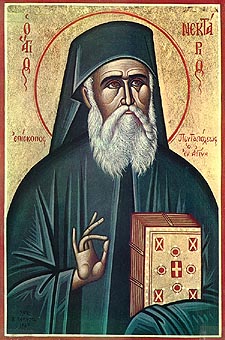
22nd SUNDAY AFTER PENTECOST — Tone 5. St. Nectarios Kephalas, Metropolitan of Pentapolis (1920).Martyrs Onesiphorus and Porphyrius of Ephesus (3rd-4th c.).
Tone 5 Troparion (Resurrection)
Let us, the faithful, praise and worship the Word, co-eternal with the Father and the Spirit, born for our salvation from the Virgin; for He willed to be lifted up on the Cross in the flesh, to endure death, and to raise the dead// by His glorious Resurrection.
Tone 4 Troparion (St. Nicholas)
The truth of your deeds has revealed you to your flock as a rule of faith, an image of meekness and a teacher of self-control; your humility exalted you; your poverty enriched you.// O Father Bishop Nicholas, pray to Christ God that our souls may be saved.
Tone 1 Troparion (St. Nectarios)
O faithful, let us honor Nectarios the divine servant of Christ, offspring of Silyvria and guardian of Aegina, who appeared as a true friend of virtue, pouring forth all manner of healing upon those who rev’rently cry: Glory to Him who gave you strength! Glory to Him who granted you a crown! // Glory to Him who through you grants healing to all!
Tone 5 Kontakion (Resurrection)
You descended into hell, O my Savior, shattering its gates as Almighty, resurrecting the dead as Creator, and destroying the sting of death. You have delivered Adam from the curse, O Lover of man,// and we cry to You: “O Lord, save us!”
Tone 3 Kontakion (St. Nicholas)
You proved yourself to be be a holy priest, O Nicholas. You served God in Myra and lived the gospel of Christ. You offered your life for your people, And rescued the innocent from death. Therefore God has glorified you as a trustworthy guide of things divine.
Tone 4 Kontakion (St. Nectarios)
Let us sing praises with gladness of heart to the newly-shining star of Orthodoxy, the newly-built rampart of the Church. Being glorified by the power if the Spirit, he pours forth the abundant grace of healings upon those who cry: Rejoice, Father Nectarios!
Tone 6 Kontakion (Steadfast Protectress)
Steadfast Protectress of Christians, Constant Advocate before the Creator; despise not the cry of us sinners, but in your goodness come speedily to help us who call on you in faith. Hasten to hear our petition and to intercede for us, O Theotokos, for you always protect those who honor you!
Tone 5 Prokeimenon (Resurrection)
You, O Lord, shall protect us / and preserve us from this generation forever. (Ps. 11:7)
V. Save me, O Lord, for there is no longer any that is godly! (Ps. 11:1a)
Tone 7 Prokeimenon (St. Nectarios)
V. Precious in the sight of the Lord is the death of His saints!
Galatians 6:11-18 (Epistle)
See with what large letters I have written to you with my own hand! As many as desire to make a good showing in the flesh, these would compel you to be circumcised, only that they may not suffer persecution for the cross of Christ. For not even those who are circumcised keep the law, but they desire to have you circumcised that they may boast in your flesh. But God forbid that I should boast except in the cross of our Lord Jesus Christ, by whom the world has been crucified to me, and I to the world. For in Christ Jesus neither circumcision nor uncircumcision avails anything, but a new creation. And as many as walk according to this rule, peace and mercy be upon them, and upon the Israel of God. From now on let no one trouble me, for I bear in my body the marks of the Lord Jesus. Brethren, the grace of our Lord Jesus Christ be with your spirit. Amen.
Ephesians 5: 8-19 (Saint)
For you were once darkness, but now you are light in the Lord. Walk as children of light(for the fruit of the Spirit is in all goodness, righteousness, and truth), finding out what is acceptable to the Lord. And have no fellowship with the unfruitful works of darkness, but rather expose them. For it is shameful even to speak of those things which are done by them in secret. But all things that are exposed are made manifest by the light, for whatever makes manifest is light. Therefore He says: “Awake, you who sleep, arise from the dead, and Christ will give you light.” See then that you walk circumspectly, not as fools but as wise, redeeming the time, because the days are evil. Therefore do not be unwise, but understand what the will of the Lord is. And do not be drunk with wine, in which is dissipation; but be filled with the Spirit, speaking to one another in psalms and hymns and spiritual songs, singing and making melody in your heart to the Lord,
Tone 5
Alleluia, Alleluia, Alleluia!
V. I will sing of Your mercies, O Lord, forever; with my mouth I will proclaim Your truth from generation to generation. (Ps. 88:1-2)
V. For You have said: Mercy will be established forever; Your truth will be prepared in the heavens. (Ps. 88:3)
Tone 2
V. Your priests shall be clothed with righteousness, and Your righteous shall rejoice.
Luke 8:41-56 (Gospel)
And behold, there came a man named Jairus, and he was a ruler of the synagogue. And he fell down at Jesus’ feet and begged Him to come to his house, for he had an only daughter about twelve years of age, and she was dying. But as He went, the multitudes thronged Him. Now a woman, having a flow of blood for twelve years, who had spent all her livelihood on physicians and could not be healed by any, came from behind and touched the border of His garment. And immediately her flow of blood stopped. And Jesus said, “Who touched Me?” When all denied it, Peter and those with him said, “Master, the multitudes throng and press You, and You say, ‘Who touched Me?’” But Jesus said, “Somebody touched Me, for I perceived power going out from Me.” Now when the woman saw that she was not hidden, she came trembling; and falling down before Him, she declared to Him in the presence of all the people the reason she had touched Him and how she was healed immediately. And He said to her, “Daughter, be of good cheer; your faith has made you well. Go in peace.” While He was still speaking, someone came from the ruler of the synagogue’s house, saying to him, “Your daughter is dead. Do not trouble the Teacher.” But when Jesus heard it, He answered him, saying, “Do not be afraid; only believe, and she will be made well.” When He came into the house, He permitted no one to go in except Peter, James, and John, and the father and mother of the girl. Now all wept and mourned for her; but He said, “Do not weep; she is not dead, but sleeping.” And they ridiculed Him, knowing that she was dead. But He put them all outside, took her by the hand and called, saying, “Little girl, arise.” Then her spirit returned, and she arose immediately. And He commanded that she be given something to eat. And her parents were astonished, but He charged them to tell no one what had happened.
Matthew 4: 25, 5: 1-12 (Saint)
Great multitudes followed Him – from Galilee, and from Decapolis, Jerusalem, Judea, and beyond the Jordan. And seeing the multitudes, He went up on a mountain, and when He was seated His disciples came to Him. Then He opened His mouth and taught them, saying: “Blessed are the poor in spirit, for theirs is the kingdom of heaven. Blessed are those who mourn, for they shall be comforted. Blessed are the meek, for they shall inherit the earth. Blessed are those who hunger and thirst for righteousness, for they shall be filled. Blessed are the merciful, for they shall obtain mercy. Blessed are the pure in heart, for they shall see God. Blessed are the peacemakers, for they shall be called sons of God. Blessed are those who are persecuted for righteousness’ sake, for theirs is the kingdom of heaven. Blessed are you when they revile and persecute you, and say all kinds of evil against you falsely for My sake. Rejoice and be exceedingly glad, for great is your reward in heaven, for so they persecuted the prophets who were before you.
St. Nektarios: Concerning the invitation to sinners by God the Lover of mankind
Through all of the prophets, God has invited all people who have sinned to repentance. Through the prophet Malachi He summons them thus: “Return to Me, and I will return to you, saith the Lord Almighty” (Mal. 3:7). Through the Prophet Jeremiah He admonishes: “Return ye now every one from his evil way, and make your ways and your doings good” ( Jer. 18:11). Through the Prophet Isaiah He affirms: “I am God, and there is not another beside Me: a just God and a Savior: there is none but Me. Turn ye to Me, and ye shall be saved, ye that come from the end of the earth” (Isa. 45:21–22). God summons us to repentance through the Prophet Joel saying: “Turn to Me with all your heart, and with fasting, and with weeping, and with lamentation; and rend your hearts, and not your garments, and turn to the Lord your God. For He is merciful and compassionate, longsuffering and plenteous in mercy, and repents of evils” ( Joel 2: 12–13). Through the Prophet Zechariah, God invites the sinner, saying: “Turn to Me, and I will turn to you, saith the Lord Almighty” (Zch. 1:2). And through the Prophet Ezekiel He declares: “For I desire not the death of him that dies. Be converted, and turn from all your ungodliness; for why should ye die, O house of Israel?” (Ezk. 18:30–31). The Forerunner was the herald of repentance (cf. Mt. 3:2). The Savior Himself came preaching repentance and forgiveness of sins: “Come unto Me, all ye that labor and are heavy laden, and I will give you rest” (Mt. 11:28). The divine Chrysostom, interpreting this verse, says: “Come, not some person, but everyone who has worries, who has sorrows, who has sins. Come, not so that I may demand accountability, but so that I may loosen your sins. Come, not because I am in need of your praise, but because I desire your salvation; for I will give you rest. He did not say ‘I will save’ only, but even much more: ‘so that I may make everyone secure.’ Moreover, in order to show the profound loving-kindness of God toward mankind and so that He may render sinners more fervent toward repentance, He reveals to them the mysteries of Heaven: ‘joy (He says) shall be in heaven over one sinner that repenteth, more than over ninety-nine just persons, who need no repentance’ (Lk. 15:7).” “God does not immediately go after them who sin, but He grants time for repentance and for the healing and rectification of the mistake,” says St. Neilos. The preaching of the Apostles had as its purpose that repentance may be preached to all the nations, starting from Jerusalem: “Thus it is written, and thus it behooved Christ to suffer, and to rise from the dead the third day; and that repentance and remission of sins should be preached in His name among all nations, beginning at Jerusalem” (Lk. 24:47).
— St. Nektarios. Repentance and Confession
Excerpt from The Art of Salvation The Christian Way of Life
Do you want to harm your enemy? The Fathers say that you must pray for him, because your prayer will force God to intervene. He will step in according to His justice, but you will be justified for your love.
Wives should pray for their husbands and their children. Husbands should pray for their wives and their children.
Similarly, children should pray for their parents. United by prayer in this way, we will advance toward a spiritual harvest.
We will say our prayers in the morning. We will do the prostrations that our spiritual father has appointed, and, if we are physically healthy, we should offer even more. What are prostrations? The worship of God. We worship God, something that our enemy, the devil, does not do. He does not bow his head, he does not kneel, he does not worship. Everyone who worships God is an enemy of the devil, and hence a person of God. This is why prostrations have great significance. If we do extra prostrations, this is an ascetical effort and will be rewarded by God. The few prostrations we do are slowly deposited in God’s bank in Heaven above, and when we make our way upward, we will discover that they have become a large sum. This will help us when we give an account during the frightful moment we are judged.
If we pray in the morning as we are obligated, prayer will enlighten us and shine like a light ahead of us all day long. In following, some of us head out for work, others for school, others for a certain task. Whichever path we set out on, we should not let go of the memory of God. When we pray in the morning, we receive grace from God, we receive strength, we receive blessings, we receive our angel at our right side, and we proceed to our daily work. Wherever we go, we should hold on to the memory of God. What is the memory of God? It is the phrase “Lord Jesus Christ, have mercy on me.”
When we ask for forgiveness as we commemorate God, He will allow us to return to our home unharmed. We should be careful at our workplace. Many different people work with us, and each person spews their own inappropriate nonsense. People make terribly vulgar and indecent remarks because they live in a state of vice, and they think of nothing other than the ephemeral and temporary pleasures of life. When the person of prayer is attentive, he does not participate and does not follow the example of such people; rather, he feels sorry for them and prays for God to enlighten them. If we pray for them to cease living in such an asphyxiating spiritual environment, one day they will step into a sunlit atmosphere and breathe clean air.
Later on in the evening before going to sleep, we should again kneel and offer our prayers to God. Moreover, at some point during the day or night, we should open the New Testament and read at least one chapter. Saint John Chrysostom teaches that the devil flees from any home where the Holy Gospel is found…
Negligence for our spiritual obligations will incrementally lead us to a perilous position. Negligence reintroduces everything that our zeal had temporarily pushed away. A certain elder teaches that God has no need of prayers, prayer ropes, prostrations, fasting, and all such things—we do! When these are absent, evil finds the opportunity to enter our soul. When a person does not take his medicine, he suffers a more severe relapse. When these spiritual duties are absent, we allow the demons to reappear and re-enter our life, to create new wounds, injuries, pain, and complications. This is why we positively need zeal to be saved. We should not be indifferent because we do not know if we will live tomorrow. Not even a single moment is in our control. All things are extremely transient and uncertain—including our life, our parents, our children, and all our relatives. Likewise, our health, our finances, and whatever else we have are uncertain, and it is possible to lose them in an instant.
— Ephraim, Elder. The Art of Salvation
Saint Nectarius Kephalas, Metropolitan of Pentapolis
Saint Nectarius, the great wonderworker of modern times, was born Anastasius Kephalas in Selebria, Thrace on October 1, 1846.
Since his family was poor, Anastasius went to Constantinople when he was fourteen in order to find work. Although he had no money, he asked the captain of a boat to take him. The captain told him to take a walk and then come back. Anastasius understood, and sadly walked away.
The captain gave the order to start the engines, but nothing happened. After several unsuccessful attempts, he looked up into the eyes of Anastasius who stood on the dock. Taking pity on the boy, the captain told him to come aboard. Immediately, the engines started and the boat began to move.
Anastasius found a job with a tobacco merchant in Constantinople, who did not pay him very much. In his desire to share useful information with others, Anastasius wrote down short maxims from spiritual books on the paper bags and packages of the tobacco shop. The customers would read them out of curiosity, and might perhaps derive some benefit from them.
The boy went about barefoot and in ragged clothing, but he trusted in God. Seeing that the merchant received many letters, Anastasius also wanted to write a letter. To whom could he write? Not to his parents, because there were no mail deliveries to his village. Not to his friends, because he had none. Therefore, he decided to write to Christ to tell Him of his needs.
“My little Christ,” he wrote. “I do not have an apron or shoes. You send them to me. You know how much I love you.”
Anastasius sealed the letter and wrote on the outside: “To the Lord Jesus Christ in Heaven.” On his way to mail the letter, he ran into the man who owned a shop opposite the one in which he worked. The man asked him where he was going, and Anastasius whispered something in reply. Seeing the letter in his hands, the man offered to mail it for him, since he was on his way to the post office.
The merchant put the letter in his pocket and assured Anastasius that he would mail it with his own letters. The boy returned to the tobacco shop, filled with happiness. When he took the letter from his pocket to mail it, the merchant happened to notice the address. Astonished and curious, the man could not resist opening the letter to read it. Touched by the boy’s simple faith, the merchant placed some money in an envelope and sent it to him anonymously. Anastasius was filled with joy, and he gave thanks to God.
A few days later, seeing Anastasius dressed somewhat better than usual, his employer thought he had stolen money from him and began to beat him. Anastasius cried out, “I have never stolen anything. My little Christ sent me the money.”
Hearing the commotion, the other merchant came and took the tobacco seller aside and explained the situation to him.
When he was still a young man, Anastasius made a pilgrimage to the Holy Land. During the voyage, the ship was in danger of sinking in a storm. Anastasius looked at the raging sea, and then at the captain. He went and stood beside the captain and took the helm, praying for God to save them. Then he took off the cross his grandmother had given him (containing a piece of the Cross of Christ) and tied it to his belt. Leaning over the side, he dipped the cross into the water three times and commanded the sea, “Silence! Be still.” At once, the wind died down and the sea became calm.
Anastasius was saddened, however, because his cross had fallen into the sea and was lost. As the boat sailed on, sounds of knocking seemed to come from the hull below the water line. When the ship docked, the young man got off and started to walk away.
Suddenly, the captain began shouting, “Kephalas, Kephalas, come back here.” The captain had ordered some men into a small boat to examine the hull in order to discover the source of the knocking, and they discovered the cross stuck to the hull. Anastasius was elated to receive his “Treasure,” and always wore it from that time forward. There is a photograph taken many years later, showing the saint in his monastic skufia. The cross is clearly visible in the photo.
On November 7, 1875, Anastasius received monastic tonsure at the Nea Moni Monastery on Chios, and the new name Lazarus. Two years later, he was ordained a deacon. On that occasion, his name was changed to Nectarius.
Later, when he was a priest, Father Nectarius left Chios and went to Egypt. There he was elected Metropolitan of Pentapolis. Some of his colleagues became jealous of him because of his great virtues, because of his inspiring sermons, and because of everything else which distinguished Saint Nectarius from them.
Other Metropolitans and bishops of the Patriarchate of Alexandria became filled with malice toward the saint, so they told Patriarch Sophronius that Nectarius was plotting to become patriarch himself. They told the patriarch that the Metropolitan of Pentapolis merely made an outward show of piety in order to win favor with the people. So the patriarch and his synod removed Saint Nectarius from his See. Patriarch Sophronius wrote an ambiguous letter of suspension which provoked scandal and speculation about the true reasons for the saint’s removal from his position.
Saint Nectarius was not deposed from his rank, however. He was still allowed to function as a bishop. If anyone invited him to perform a wedding or a baptism he could do so, as long as he obtained permission from the local bishop.
Saint Nectarius bore his trials with great patience, but those who loved him began to demand to know why he had been removed. Seeing that this was causing a disturbance in the Church of Alexandria, he decided to go to Greece. He arrived in Athens to find that false rumors about him had already reached that city. His letter of suspension said only that he had been removed “for reasons known to the Patriarchate,” and so all the slanders about him were believed.
Since the state and ecclesiastical authorities would not give him a position, the former Metropolitan was left with no means of support, and no place to live. Every day he went to the Minister of Religion asking for assistance. They soon tired of him and began to mistreat him.
One day, as he was leaving the Minister’s office, Saint Nectarius met a friend whom he had known in Egypt. Surprised to find the beloved bishop in such a condition, the man spoke to the Minister of Religion and Education and asked that something be found for him. So, Saint Nectarius was appointed to be a humble preacher in the diocese of Vitineia and Euboea. The saint did not regard this as humiliating for him, even though a simple monk could have filled that position. He went to Euboea to preach in the churches, eagerly embracing his duties.
Yet even here, the rumors of scandal followed him. Sometimes, while he was preaching, people began to laugh and whisper. Therefore, the blameless one resigned his position and returned to Athens. By then some people had begun to realize that the rumors were untrue, because they saw nothing in his life or conversation to suggest that he was guilty of anything. With their help and influence, Saint Nectarius was appointed Director of the Rizarios Seminary in Athens on March 8, 1894. He was to remain in that position until December of 1908.
The saint celebrated the services in the seminary church, taught the students, and wrote several edifying and useful books. Since he was a quiet man, Saint Nectarius did not care for the noise and bustle of Athens. He wanted to retire somewhere where he could pray. On the island of Aegina he found an abandoned monastery dedicated to the Holy Trinity, which he began to repair with his own hands.
He gathered a community of nuns, appointing the blind nun Xenia as abbess, while he himself served as Father Confessor. Since he had a gift for spiritual direction, many people came to Aegina to confess to him. Eventually, the community grew to thirty nuns. He used to tell them, “I am building a lighthouse for you, and God shall put a light in it that will shine forth to the world. Many will see this light and come to Aegina.” They did not understand what he was telling them, that he himself would be that beacon, and that people would come there to venerate his holy relics.
On September 20, 1920 the nun Euphemia brought an old man in black robes, who was obviously in pain, to the Aretaieion Hospital in Athens. This was a state hospital for the poor. The intern asked the nun for information about the patient.
“Is he a monk?” he asked.
“No, he is a bishop.”
The intern laughed and said, “Stop joking and tell me his name, Mother, so that I can enter it in the register.”
“He is indeed a bishop, my child. He is the Most Reverend Metropolitan of Pentapolis.”
The intern muttered, “For the first time in my life I see a bishop without a panagia or cross, and more significantly, without money.”
Then the nun showed the saint’s credentials to the astonished intern who then admitted him. For two months Saint Nectarius suffered from a disease of the bladder. At ten thirty on the evening of November 8, 1920, he surrendered his holy soul to God. He died in peace at the age of seventy-four.
In the bed next to Saint Nectarius was a man who was paralyzed. As soon as the saint had breathed his last, the nurse and the nun who sat with him began to dress him in clean clothing to prepare him for burial at Aegina. They removed his sweater and placed it on the paralyzed man’s bed. Immediately, the paralytic got up from his bed, glorifying God.
Saint Nectarius was buried at the Holy Trinity Monastery on Aegina. Several years later, his grave was opened to remove his bones (as is the custom in Greece). His body was found whole and incorrupt, as if he had been buried that very day.
Word was sent to the Archbishop of Athens, who came to see the relics for himself. Archbishop Chrysostomos told the nuns to leave them out in the sun for a few days, then to rebury them so that they would decay. A month or two after this, they opened the grave again and found the saint incorrupt. Then the relics were placed in a marble sarcophagus.
Several years later, the holy relics dissolved, leaving only the bones. The saint’s head was placed in a bishop’s mitre, and the top was opened to allow people to kiss his head.
Saint Nectarius was glorified by God, since his whole life was a continuous doxology to the Lord. Both during his life and after his death, Saint Nectarius has performed thousands of miracles, especially for those suffering from cancer. There are more churches dedicated to Saint Nectarius than to any other modern Orthodox saint.
Steward Sunday: Supporting the Well-Being of Clergy and Families
SPRINGFIELD, VA [OCA]
Financial Health Initiative Completes First Program Cycle
The generous stewardship of the faithful makes possible the ongoing work of the Orthodox Church in America to care for her clergy and their families. Through the programs of the Office of Pastoral Life, the Church seeks to strengthen the spiritual, emotional, and financial well-being of those who serve at her altars and in her parish communities.
A 2023 national survey of clergy across the Orthodox Church in America revealed that over 60% of clergy families experience moderate to severe financial stress. In response, the Office of Pastoral Life launched the Financial Health Initiative (FHI) in May 2025, funded by the Lilly Endowment. This program helps clergy families build financial stability, reduce financial strain, and grow in faithful stewardship of their resources.
The first FHI cohort—comprising twenty-five priest families from across the Orthodox Church in America—has now completed the program. Each participant gained access to SmartDollar, a comprehensive personal finance program developed by Ramsey Solutions. Through its nine-lesson course, financial coaching, budgeting tools, and practical resources, participants learned strategies to strengthen their financial health. Ongoing access to SmartDollar continues through 2028.
Graduates of the first cohort have already received grants through the Financial Health Initiative Fund—each providing up to $5,000 to help clergy families build emergency savings, reduce debt, or invest in retirement. To date, more than $120,000 in grants have been distributed. The Fund was established through the generosity of the Lilly Endowment and is sustained through the matching gifts of the institutions, parishes, and faithful of the Orthodox Church in America.
Early results are encouraging. Collectively, participants have reported over $500,000 in financial turnaround through debt reduction and increased savings. One priest shared, “My wife and I went from living paycheck-to-paycheck to actively saving for both our immediate and long-term goals.”
Applications for the next FHI cohort will open in May 2026. To learn more about the program—or to contribute to this vital ministry—please visit the Office of Pastoral Life website.
Join Us in Supporting Our Clergy
The Financial Health Initiative is one way your stewardship strengthens the life of the Church. By becoming a Steward of the Orthodox Church in America, you help provide the resources that sustain clergy families, build healthy parishes, and nurture the faithful across North America.
Your gift—large or small—makes a direct difference in the lives of those who serve Christ and His Church. On this Stewards Sunday, please consider offering your support to the Stewards of the Orthodox Church in America and to the ongoing work of the Office of Pastoral Life.
Together, we can ensure that every priest and deacon has the support they need to flourish in ministry.
About the Office of Pastoral Life
The Orthodox Church in America’s Office of Pastoral Life supports the well-being of clergy and their families, the foundation of parish life across North America. Believing the health of the Church is inseparable from the health of her clergy, the Office offers programs that build resilience, connection and pastoral joy. Programs include Thriving in Ministry peer-learning groups, Financial Health Initiatives, quarterly Synaxis Gatherings, National Clergy Retreats and Clergy Wives Ministry. In partnership with bishops, dioceses, parishes and our generous donors, the Office of Pastoral Life helps create sustainable conditions in which priests, deacons and their families of the Orthodox Church in America can flourish spiritually, vocationally and personally through every season of parish ministry.
 Sunday Bulletin November 2, 2025