
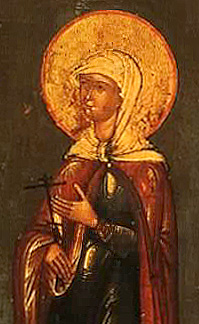
17th SUNDAY AFTER PENTECOST — Tone 8. Martyr Charitina of Amisos (304).
Tone 8 Troparion (Resurrection)
You descended from on high, O Merciful One! You accepted the three day burial to free us from our sufferings!// O Lord, our Life and Resurrection, glory to You!
Tone 4 Troparion (St. Nicholas)
The truth of your deeds has revealed you to your flock as a rule of faith, an image of meekness and a teacher of self-control; your humility exalted you; your poverty enriched you.// O Father Bishop Nicholas, pray to Christ God that our souls may be saved.
Tone 4 Troparion (St. Charitina)
Your lamb Charitina calls out to You, O Jesus, in a loud voice: “I love You, my Bridegroom, and in seeking You I endure suffering. In baptism I was crucified so that I might reign in You, and I died so that I might live with You. Accept me as a pure sacrifice, for I have offered myself in love.”// Through her prayers save our souls, since You are merciful!
Tone 8 Kontakion (Resurrection)
By rising from the tomb, You raised the dead and resurrected Adam. Eve exults in Your Resurrection,// and the world celebrates Your rising from the dead, O greatly Merciful One!
Tone 3 Kontakion (St. Nicholas)
You proved yourself to be be a holy priest, O Nicholas. You served God in Myra and lived the gospel of Christ. You offered your life for your people, And rescued the innocent from death. Therefore God has glorified you as a trustworthy guide of things divine.
Tone 3 Kontakion (St. Charitina)
Having fortified your soul with faith and strengthened by understanding you openly put the enemy to shame, O Charitina; you stood before Christ wearing a robe empurpled by your blood, All-blessed One, and now you rejoice with the Angels,// praying for us, O passionbearer.
Tone 6 Kontakion (Steadfast Protectress)
Steadfast Protectress of Christians, Constant Advocate before the Creator; despise not the cry of us sinners, but in your goodness come speedily to help us who call on you in faith. Hasten to hear our petition and to intercede for us, O Theotokos, for you always protect those who honor you!
Tone 8 Prokeimenon (Resurrection)
Pray and make your vows / before the Lord, our God! (Ps. 75:10a)
V. In Judah God is known; His Name is great in Israel. (Ps. 75:1)
2 Corinthians 6:16-7:1 (Epistle)
And what agreement has the temple of God with idols? For you are the temple of the living God. As God has said: “I will dwell in them and walk among them. I will be their God, and they shall be My people.”
Therefore “Come out from among them and be separate, says the Lord. Do not touch what is unclean, and I will receive you.” “I will be a Father to you, and you shall be My sons and daughters, says the LORD Almighty.” Therefore, having these promises, beloved, let us cleanse ourselves from all filthiness of the flesh and spirit, perfecting holiness in the fear of God.
Tone 7
Alleluia, Alleluia, Alleluia!
V. Come, let us rejoice in the Lord! Let us make a joyful noise to God our Savior! (Ps. 94:1)
V. Let us come before His face with thanksgiving; let us make a joyful noise to Him with songs of praise! (Ps. 94:2)
Luke 6:31-36 (Gospel)
And just as you want men to do to you, you also do to them likewise. But if you love those who love you, what credit is that to you? For even sinners love those who love them. And if you do good to those who do good to you, what credit is that to you? For even sinners do the same. And if you lend to those from whom you hope to receive back, what credit is that to you? For even sinners lend to sinners to receive as much back. But love your enemies, do good, and lend, hoping for nothing in return; and your reward will be great, and you will be sons of the Most High. For He is kind to the unthankful and evil. Therefore be merciful, just as your Father also is merciful.
Venerable Eudokimos of Vatopedi Monastery on Mount Athos
Commemorated on October 5
Nothing is known about the life and deeds of Venerable Eudokimos (Eudókimos) of Vatopedi.
On October 5, 1840, the monks of the Athonite Monastery of Vatopedi were renovating the burial vault for the brethren. Suddenly, the roof collapsed, covering one of the corners of the vault. The monks began to clear the blocked corner and suddenly they smelled a wondrous fragrance.
After clearing the rubble from the vault, the monks found a human skeleton clothed in a cloth chiton. The skeleton was in a kneeling position, his hands were folded on his chest and held an icon of the Most Holy Theotokos. His holy relics exuded such a fragrance that it filled everything around. The brethren of the monastery considered this as a sign that the Saint had pleased the Lord.2 Judging by his clothes, he reposed during the first half of the XVII century.
Archbishop Chrysanthos of Smyrna (who was living in retirement at the Monastery), addressed Metropolitan Gregory of Adrianople and the brethren, saying: “With the dissolution of the flesh, our very bones give a certain tribute to the earth with a stench; but the relics of this unknown Saint exude a paradisiacal fragrance. Should we not conclude from this that the Spirit of God, Who dwelt in this Saint during his lifetime, has not forsaken him after his death? Therefore, let us glorify God, Who is wondrous in His Saints, and let us honor His holy servant.”
The fragrant relics were transferred to the katholikon on the evening of October 4, and soon healings took place from them. With the blessing of the Patriarch of Constantinople, the brethren gave the Saint the symbolic name of Eudokimos. it was decided that if he did not wish to be glorified with that name, he would appear to the monks and reveal his true name.
It remained a mystery exactly how the relics of the unknown monk got into the tomb, because a deceased monk is first buried; and after three years, only his bones are placed in the vault. According to one version, the Saint foresaw the hour of his death, but he said nothing to anyone and, taking an icon of the Mother of God, he hid in a remote place in the burial vault, where he departed quietly and humbly to the Lord.
Since then, the Venerable Newly-Appeared Eudokimos has been honored on Mount Athos. His relics continue to emit a fragrance, and they are renowned for their numerous miraculous healings. By praying to the Saint, one of the monks on the Holy Mountain, who suffered from consumption and was near death, was healed. Another monk, Gabriel, was also healed by praying to the Saint, and in gratitude he donated a precious silver reliquary for the venerable head of Venerable Eudokimos.
Some time after the discovery of the relics, a certain monk from Vatopedi had a vision, in which the Saint said that his true name was Savva. Monastic tradition continues to identify Saint Eudokimos with a monk who lived during the XIV century: Saint Savva of Vatopedi. However, doubts were expressed about this, and the Church did not pronounce its judgment on this occasion.
Through the prayers of our Venerable Father Eudokimos, may we all be delivered from the afflictions of body and soul which we may encounter, and may we also inherit the Heavenly Kingdom. Amen.
On the good that is shown
There be many who say, Who will show us any good? (Psalm 4:6)
My brethren, great is God’s goodness. What words can express that goodness? Great is the goodness of the Heavenly Kingdom with its fiery angels, wonderful saints, and the sweetness of Paradise. Who can describe this goodness? Immortal life, close to God and the angels of God, in the company of the saints and the righteous, is a great good. Another great good will be our meeting with our kinsmen and friends in the heavenly world; with our parents, our children, and our most beloved ones, who by their departure left us in sadness and grief. Who will show us all that good? Many asked this in King David’s time, and many ask even today. Who will show it to us, so that we may believe and hope? That good is shown to us Christians, and we wait for nothing higher, for no one but the Lord Christ—the true Witness to all this good, the true Witness and Lord, brethren, of all this good. The compassionate Lord showed this good to His chosen prophets even before His coming to earth. That is why David says to God: Lord, lift up the light of Thy countenance upon us (Psalms 4:6). This is the reply to those who ask: Who will show us any good? God Himself showed us that good. The light of the Lord’s countenance is marked upon us, inscribed and etched in our hearts, and in that light we recognize that good which only heaven can give. Brethren, is there a cure for those who have heard about the coming of Christ on earth, but nevertheless asked: Who will show us any good? If Christ had not shown and revealed all that is good by His glorious birth, His glorious miracles, His glorious Resurrection, and His Holy Church, the dark earth would not show it, for it cannot; men would not show it, for they do not know. However, there is a cure for everyone—even for the most incorrigible unbelievers—up to the moment of death. This cure is in repentance of one’s evil, in the cleansing of one’s heart, and in the fulfilling of Christ’s commandments. The healthy can see the light of the countenance of the Lord; but not the sick in soul, the impure in heart or the wrong-minded. O our Lord God, light of angels and men; help us that we not darken the light that Thou hast given us—and by which we see the heavenly good—by the darkness of our sin. Do not deprive us of these good things, O Most-merciful One. To Thee be glory and praise forever. Amen.
— Velimirovic, Saint Nikolai. The Prologue of Ohrid
Almsgiving & Mercy
Therefore, let us pay special attention to this immensely significant virtue. Let us give alms with a cheerful face, with joy, and with pleasure. Depending on how we show mercy, God will reciprocate His mercy on us. We must envisage the spiritual profit we will accrue. With two cents, the widow became worthy of God’s Kingdom and was extolled by the Holy Gospel. This serves as a golden example for all generations. The benefit that ensues from her example of almsgiving continuously multiplies and ascends to meet her in Heaven. So many people are edified by her example, and the benefit they receive returns with a profit to her soul. Let us pray for God to count us worthy of exercising mercy, both internally (with our disposition) and externally (with our actions), so that we too have the hope of finding mercy and forgiveness during the great Judgment Day of God. Amen.
— Ephraim, Elder. The Art of Salvation
 Sunday Bulletin September 28, 2025