
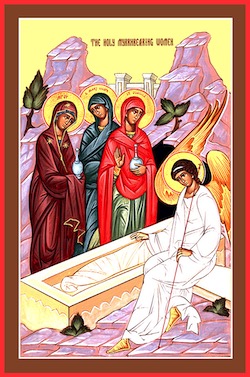
3rd SUNDAY OF PASCHA — Tone 2. Myrrhbearing Women.
Tone 2 Troparion (Resurrection)
When You descended to death, O Life Immortal, You slew hell with the splendor of Your Godhead. And when from the depths You raised the dead, all the powers of heaven cried out:// “O Giver of life, Christ our God, glory to You!”
Tone 2 Troparion (Pentecostarion)
The noble Joseph, when he had taken down Your most pure Body from the Tree, wrapped it in fine linen and anointed it with spices, and placed it in a new tomb. But You rose on the third day, O Lord,// granting the world great mercy.
Tone 2 Troparion (Pentecostarion)
The Angel came to the myrrhbearing women at the tomb and said: “Myrrh is fitting for the dead; but Christ has shown Himself a stranger to corruption! So proclaim: ‘The Lord is risen,// granting the world great mercy.’”
Tone 2 Kontakion (Pentecostarion)
You commanded the Myrrhbearers to rejoice, O Christ God. By Your Resurrection, You stopped the lamentation of Eve, the first mother. You commanded them to preach to Your Apostles:// “The Savior is risen from the tomb!”
Tone 8 Kontakion (Pascha)
You descended into the tomb, O Immortal, You destroyed the power of death. In victory You arose, O Christ God, proclaiming: “Rejoice!” to the Myrrhbearing Women,// granting peace to Your Apostles, and bestowing Resurrection on the fallen.
Tone 6 Prokeimenon
O Lord, save Your people, / and bless Your inheritance! (Ps. 27:9a)
V. To You, O Lord, will I call. O my God, be not silent to me! (Ps. 27:1a)
Acts 6:1-7 (Epistle)
Now in those days, when the number of the disciples was multiplying, there arose a complaint against the Hebrews by the Hellenists, because their widows were neglected in the daily distribution. Then the twelve summoned the multitude of the disciples and said, “It is not desirable that we should leave the word of God and serve tables. Therefore, brethren, seek out from among you seven men of good reputation, full of the Holy Spirit and wisdom, whom we may appoint over this business; but we will give ourselves continually to prayer and to the ministry of the word.” And the saying pleased the whole multitude. And they chose Stephen, a man full of faith and the Holy Spirit, and Philip, Prochorus, Nicanor, Timon, Parmenas, and Nicolas, a proselyte from Antioch, whom they set before the apostles; and when they had prayed, they laid hands on them. Then the word of God spread, and the number of the disciples multiplied greatly in Jerusalem, and a great many of the priests were obedient to the faith.
Tone 8
Alleluia, Alleluia, Alleluia!
V. O Lord, You have been gracious to Your land; You have turned back the captivity of Jacob. (Ps. 84:1)
V. Mercy and truth are met together, righteousness and peace have kissed each other. (Ps. 84:10)
Mark 15:43-16:8 (Gospel)
Joseph of Arimathea, a prominent council member, who was himself waiting for the kingdom of God, coming and taking courage, went in to Pilate and asked for the body of Jesus. Pilate marveled that He was already dead; and summoning the centurion, he asked him if He had been dead for some time. So when he found out from the centurion, he granted the body to Joseph. Then he bought fine linen, took Him down, and wrapped Him in the linen. And he laid Him in a tomb which had been hewn out of the rock, and rolled a stone against the door of the tomb. And Mary Magdalene and Mary the mother of Joses observed where He was laid. Now when the Sabbath was past, Mary Magdalene, Mary the mother of James, and Salome bought spices, that they might come and anoint Him. Very early in the morning, on the first day of the week, they came to the tomb when the sun had risen. And they said among themselves, “Who will roll away the stone from the door of the tomb for us?” But when they looked up, they saw that the stone had been rolled away – for it was very large. And entering the tomb, they saw a young man clothed in a long white robe sitting on the right side; and they were alarmed. But he said to them, “Do not be alarmed. You seek Jesus of Nazareth, who was crucified. He is risen! He is not here. See the place where they laid Him. But go, tell His disciples – and Peter – that He is going before you into Galilee; there you will see Him, as He said to you.” So they went out quickly and fled from the tomb, for they trembled and were amazed. And they said nothing to anyone, for they were afraid.
Sunday of the Holy Myrrhbearing Women with the Noble Joseph
The Myrrh-bearing women are those women who followed the Lord, along with His Mother. They remained with her during the time of the saving Passion, and anointed the Lord’s body with myrrh. Joseph and Νikόdēmos asked for and received the Lord’s body from Pilate. They took it down from the Cross, wrapped it in linen cloths and spices, then they laid it in a tomb, and then they placed a great stone over the entrance of the tomb.
According to the Evangelist Matthew (27:57-61) Mary Magdalene and Mary the mother of James and Joses (Mark 15:40) were there sitting opposite the sepulchre, and they saw where He had been laid. This other Mary was the Mother of God. Not only were these present, but also many other women, as Saint Luke says (24:10).
Today the Church honors Saints Mary Magdalene (July 22), Mary the wife of Cleopas (May 23), Joanna (June 27), Salome, mother of the sons of Zebedee (August 3), Martha and Mary, sisters of Lazarus (June 4), and the Most Holy Theotokos and Ever-Virgin Mary, who was the stepmother of her husband Joseph’s sons James (October 23) and Joses (October 30). Today we also remember Saint Joseph of Arimathea (July 31), who was a secret disciple (John 19:38), and Saint Νikόdēmos, who was a disciple by night (John 3:3; 19:38).
The holy right-believing Queen Tamara of Georgia is honored twice during the year: on May 1, the day of her repose, and also on the Sunday of the Myrrh-Bearing Women.
On this day the Church also remembers All Saints of Thessalonica, Saint Seraphim Bishop of Phanar (December 4,1610), the New Martyr Elias Ardunis (January 31, 1686), and the New Martyr Demetrios of the Peloponnesos (April 13, 1803).
6,000 Martyrs of Saint David Gareji Monastery, Georgia
In 1616 the Persian shah Abbas I led his enormous army in an attack on Georgia. Having quenched his thirst for the blood of the Christians, he arranged a hunt in the valley of Gare (Outer) Kakheti. He encamped with his escorts in the mountains of Gareji and spent the night in that place.
At midnight the shah’s attention was drawn to a flaming column of lights advancing up the mountain. At first he took it to be an apparition. He was soon informed, however, that a famous monastery was situated in that place and on that night the monks were circling their church three times with lighted candles in celebration of Christ’s Holy Resurrection. Immediately the shah commanded his army to march to the monastery and destroy all those found celebrating.
That same night an angel of the Lord appeared to Abbot Arsenius of David-Gareji and told him, “Our Lord Jesus Christ is calling the brothers to His Heavenly Kingdom. On this night great suffering awaits you—you will be killed by the sword. He who desires to prolong his earthly life, let him flee, but he who thirsts to purify his soul for eternity, let him perish by the sword, and the Lord God will adorn him with the crown of immortality. Tell this to all who dwell in the monastery, and let each man choose for himself!”
The abbot informed the monks about his vision, and they began to prepare for their imminent sufferings. Only two young monks feared death and fled to a mountain not far from the monastery. At the chanting of the Lord’s Prayer near the end of the Paschal Liturgy, the monastery was completely surrounded by Persian warriors. Abbot Arsenius stepped out of the church and approached their leader to request that the monks be given a bit more time to finish the service and for all the brothers to receive Holy Communion. The Persians consulted among themselves and agreed to honor this request. The fathers partook of the Holy Gifts, encouraged one another, and presented themselves clad in festive garments before the unbelievers.
First the Persians beheaded Abbot Arsenius; then they massacred his brothers in Christ without mercy. After the Persians finished killing the monks, they were organized into several regiments and made their way towards the other monasteries of the Gareji Wilderness. Halfway between the Chichkhituri and Saint John the Baptist Monasteries the Muslims captured the two young monks who had earlier fled and demanded that they convert to Islam.
The monks refused to abandon the Christian Faith and for this they were killed. A rose bush grew up in the place where they were killed and continued to fragrantly blossom through the 19th century, despite the dry and rocky soil.
At the end of the 17th century, King Archil gathered the bones of the martyrs with great reverence and buried them in a large stone reliquary to the left of the altar in the Transfiguration Church of David-Gareji Monastery. Their holy relics continue to stream myrrh to this day.
The brothers of the Monasteries of Saint David of Gareji and Saint John the Baptist received a blessing from Catholicos Anton I to compose a commemorative service for the martyrs and to designate their feast day as Bright Tuesday, or the third day of Holy Pascha.
Excerpt from Unseen Warfare
Some reminders that can impel our will toward the desire to please God in every activity.
In order that you may move your will more easily to this one desire in everything – to please God and to work for His glory alone – remind yourself often that He has granted you many favors in the past and has shown you His love. He has created you out of nothing in His own likeness and image and has made all other creatures your servants; He has delivered you from your slavery to the devil, sending down not one of the angels but His Only-Begotten Son to redeem you, not at the price of corruptible gold and silver, but by His priceless Blood and His most painful and degrading death. Having done all this, He protects you, every hour and every moment, from your enemies; He fights your battles by His divine grace; in His immaculate Mysteries, He prepares the Body and Blood of His beloved Son for your food and protection.
All this is a sign of God’s great favor and love for you, a favor so great that it is inconceivable how the great Lord of hosts could grant such favors to our nothingness and worthlessness. Judge from this what honor and devotion we must offer to the boundless majesty of Him who has done such wonderful things for us.
If we cannot help offering thanks, honor, glory, and obedience to earthly kings for their favors, how much more – immeasurably more – must we worthless ones offer to the Almighty Lord of Hosts, who loves us and bestows upon us favors beyond counting.
But more than all we have just said, keep always in your memory the realization that God’s greatness is in itself worthy of all honor, worship, and wholehearted service acceptable to Him.
— St. Nicodemus and St. Theophan the Recluse: Unseen Warfare
REFLECTION by St. Nikolai
The saints are alive and their God-given power does not diminish in time. St. Janićije of Devič works miracles today, even as he did during his life on earth some five hundred years ago. A certain Miloš from Hercegovina prepared to travel to Jerusalem on a pilgrimage to the holy shrines. As he was about to depart on his way, St. Janićije appeared to him in a dream and told him not to go to Jerusalem. “Rather than go to Jerusalem, it would be better for you to go to Devič,” explained the saint, “and there, to restore my church and put it in order.” Miloš obeyed the saint and went to the neglected Devič, cleaned it, put it in order, and made it possible to sing praises to God there again. Miloš became a monk there and remained until the end of his life. During the First World War and the Austrian occupation, a Hungarian officer with a detachment of soldiers came to Devič.The officer ushered Damaskin, the abbot of the monastery, before the reliquary of St. Janićije and asked him what was under the slab. “Holy things,” replied the abbot. “What kind of holy things?” the officer laughed. “You have something hidden under there.” He then ordered the soldiers to strike the slab with pickaxes and overturn it. While this was being done, the officer was seized with pain in his abdomen. He lay down in bed and, before evening of the same day, died. The frightened soldiers left their work undone and fled the monastery.
— Velimirovic, Saint Nikolai. The Prologue of Ohrid
 Sunday Bulletin April 19, 2026