
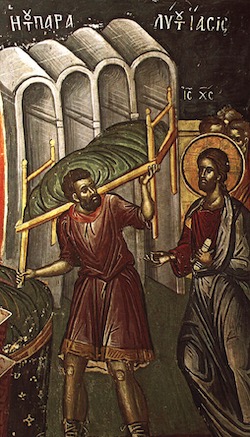
4th SUNDAY OF PASCHA — Tone 3. Paralytic. Ven. Theodosius, Abbot of the Kiev Caves Monastery and Founder of Cœnobitic Monasticism in Russia (1074).
Tone 3 Troparion (Resurrection)
Let the heavens rejoice! Let the earth be glad! For the Lord has shown strength with His arm. He has trampled down death by death. He has become the first born of the dead. He has delivered us from the depths of hell, and has granted to the world// great mercy.
Tone 3 Troparion (Pentecostarion)
By Your divine intercession, O Lord, as You raised up the Paralytic of old, so raise up my soul, paralyzed by sins and thoughtless acts; so that being saved I may sing to You:// “Glory to Your power, O compassionate Christ!”
Tone 3 Kontakion (Pentecostarion)
By Your divine intercession, O Lord, as You raised up the Paralytic of old, so raise up my soul, paralyzed by sins and thoughtless acts; so that being saved I may sing to You:// “Glory to Your power, O compassionate Christ!”
Tone 8 Kontakion (Pascha)
You descended into the tomb, O Immortal, You destroyed the power of death. In victory You arose, O Christ God, proclaiming: “Rejoice!” to the Myrrhbearing Women,// granting peace to Your Apostles, and bestowing Resurrection on the fallen.
Tone 1 Prokeimenon (Pentecostarion)
Let Your mercy, O Lord, be upon us /as we have set our hope on You! (Ps. 32:22)
V. Rejoice in the Lord, O you righteous! Praise befits the just! (Ps. 32:1)
Acts 9:32-42 (Epistle)
Now it came to pass, as Peter went through all parts of the country, that he also came down to the saints who dwelt in Lydda. There he found a certain man named Aeneas, who had been bedridden eight years and was paralyzed. And Peter said to him, “Aeneas, Jesus the Christ heals you. Arise and make your bed.” Then he arose immediately. So all who dwelt at Lydda and Sharon saw him and turned to the Lord.
At Joppa there was a certain disciple named Tabitha, which is translated Dorcas. This woman was full of good works and charitable deeds which she did. But it happened in those days that she became sick and died. When they had washed her, they laid her in an upper room. And since Lydda was near Joppa, and the disciples had heard that Peter was there, they sent two men to him, imploring him not to delay in coming to them. Then Peter arose and went with them. When he had come, they brought him to the upper room. And all the widows stood by him weeping, showing the tunics and garments which Dorcas had made while she was with them. But Peter put them all out, and knelt down and prayed. And turning to the body he said, “Tabitha, arise.” And she opened her eyes, and when she saw Peter she sat up. Then he gave her his hand and lifted her up; and when he had called the saints and widows, he presented her alive. And it became known throughout all Joppa, and many believed on the Lord.
Hebrews 13:7-16 (Epistle, Saint)
Remember those who rule over you, who have spoken the word of God to you, whose faith follow, considering the outcome of their conduct. Jesus Christ is the same yesterday, today, and forever. Do not be carried about with various and strange doctrines. For it is good that the heart be established by grace, not with foods which have not profited those who have been occupied with them. We have an altar from which those who serve the tabernacle have no right to eat. For the bodies of those animals, whose blood is brought into the sanctuary by the high priest for sin, are burned outside the camp. Therefore Jesus also, that He might sanctify the people with His own blood, suffered outside the gate. Therefore let us go forth to Him, outside the camp, bearing His reproach. For here we have no continuing city, but we seek the one to come. Therefore by Him let us continually offer the sacrifice of praise to God, that is, the fruit of our lips, giving thanks to His name. But do not forget to do good and to share, for with such sacrifices God is well pleased.
Tone 5
Alleluia, Alleluia, Alleluia!
V. I will sing of Your mercies, O Lord, forever; with my mouth I will proclaim Your truth from generation to generation. (Ps. 88:1-2)
V. For You have said: Mercy will be established forever; Your truth will be prepared in the heavens. (Ps. 88:3)
John 5:1-15 (Gospel)
After this there was a feast of the Jews, and Jesus went up to Jerusalem. Now there is in Jerusalem by the Sheep Gate a pool, which is called in Hebrew, Bethesda, having five porches. In these lay a great multitude of sick people, blind, lame, paralyzed, waiting for the moving of the water. For an angel went down at a certain time into the pool and stirred up the water; then whoever stepped in first, after the stirring of the water, was made well of whatever disease he had. Now a certain man was there who had an infirmity thirty-eight years. When Jesus saw him lying there, and knew that he already had been in that condition a long time, He said to him, “Do you want to be made well?” The sick man answered Him, “Sir, I have no man to put me into the pool when the water is stirred up; but while I am coming, another steps down before me.” Jesus said to him, “Rise, take up your bed and walk.” And immediately the man was made well, took up his bed, and walked. And that day was the Sabbath. The Jews therefore said to him who was cured, “It is the Sabbath; it is not lawful for you to carry your bed.” He answered them, “He who made me well said to me, ‘Take up your bed and walk.’” Then they asked him, “Who is the Man who said to you, ‘Take up your bed and walk’?” But the one who was healed did not know who it was, for Jesus had withdrawn, a multitude being in that place. Afterward Jesus found him in the temple, and said to him, “See, you have been made well. Sin no more, lest a worse thing come upon you.” The man departed and told the Jews that it was Jesus who had made him well.
Matthew 11:27-30 (Gospel, Saint)
All things have been delivered to Me by My Father, and no one knows the Son except the Father. Nor does anyone know the Father except the Son, and the one to whom the Son wills to reveal Him. Come to Me, all you who labor and are heavy laden, and I will give you rest. Take My yoke upon you and learn from Me, for I am gentle and lowly in heart, and you will find rest for your souls. For My yoke is easy and My burden is light.”
Sunday of the Paralytic
Many miracles in the Old Testament involve water. To name but a few, the water of the Nile turned to blood after Moses lifted his rod and struck the water before Pharaoh and His servants (Exodus 7:20). Not only was the Nile turned to blood, but also “their rivers, their canals, their ponds, and all their pools of water, that they may become blood; and there shall be blood throughout the land of Egypt, both in vessels of wood and in vessels of stone” (Exodus 7:19).
In chapter 14 of Exodus, Moses divided the waters of the Red Sea, and the Hebrews passed over as if on dry land. When they were safely across, the waters came together, and their Egyptian pursuers were drowned.
On their forty year journey to the Promised Land, the Hebrews camped at Rephidem, but there was no water for them to drink. The people murmured against Moses, asking him why he had led them out of Egypt. God told Moses to strike the rock at Horeb. Then water came out of it so that everyone could drink (Exodus 17:6).
In Judges 6:36-40 we read about Gideon and the dew on the fleece. When Gideon squeezed the fleece, there was enough to fill a bowl with water.
On the Fourth Sunday of Pascha, the Church remembers the man who lay paralyzed at the Sheep Pool in Jerusalem for thirty-eight years, waiting for someone to put him into the pool. The first person to enter the pool after an Angel troubled the water would be healed of his infirmities, but someone always entered the pool before him. Seeing the man, the Lord felt compassion for him and healed him.
The Lord healed the paralytic during the days of the Passover, when He had gone to Jerusalem for the Feast, and He remained there teaching and working miracles. According to Saint John the Theologian, this miracle took place on the Sabbath.
Like some Old Testament miracles, many of Christ’s miracles also involved water, and they prefigure the Church’s Baptism, which cleanses us of every sin. In the Sheep Pool, once a year, only one person was healed, but Christ saves endless multitudes by divine Baptism. Sometimes, as in the case of Saint Vladimir (July 15), Baptism can also heal our bodily infirmities.
In the Canon for the Paralytic, the Angel who stirred the water in the Sheep Pool is identified as the Archangel Michael. Some of the Troparia call him “Leader of the Angels,” and “Supreme Commander” (Ode 1). In Ode 3 we ask him to “protect us from falling into the passions of life.” In Ode 6, we ask Saint Michael to guide us on the paths of life.” In Ode 8, we ask him to pray with all the Bodiless Hosts, that we may be granted deliverance from our offenses, correction of our life, and the enjoyment of eternal blessings.
As we remember the paralytic, let us ask Christ to “raise up our souls, paralyzed by sins and thoughtless acts” (Kontakion of the paralytic).
On the source of living water and the dry cistern
Be amazed at this, O heavens, and shudder with sheer horror, says the Lord. Two evils have my people done: they have forsaken Me, the source of living waters. They have dug themselves cisterns, broken cisterns that hold no water (Jeremiah 2:12–13).
Was this spoken only for that time or also for us today? Certainly for us today. Is this spoken only for the Jewish people or also for our people? Certainly for our people also. When it was said, Do not kill, do not steal, do not bear false witness, it was said not only for that time but also for all times, and not only for the Jewish people but also for all peoples. And so is it true for us as well. This is valid today, at all times, for every people, and for every man who turns his back on the Source of living water in his own courtyard and digs a cistern from which to drink rainwater. The Source of living water is the Lord Himself: inexhaustible, copious and sweet. The cistern is every man’s work which is performed in opposition to God and God’s law, and from which men expect progress, happiness and satisfaction for their hunger and thirst. Such is the cistern of godlessness, avarice, gluttony, immorality, love of power, vanity, idolatry, soothsaying, and all the other things that have the devil as their advisor, sin as their digger, and false hope for their water-carrier. Be astonished, O ye heavens, at this, and be horribly afraid, be ye very desolate, says the Lord. Be astonished at how man could become so senseless, forsaking the living water and digging a cistern in live coals that inflame his thirst even more! O brethren, our people have also committed two evils: they have forgotten the Lord as the Source of every good and they have gone to seek for themselves good in evil and good through evil. Can water be found in fire? Or wheat in sand? It cannot; no, brethren, it cannot. Even less can peace, happiness, joy, life or any other good be found in the cisterns of sin and godlessness. O Lord, Immortal Source of every good that the heart of man can desire and the mind of man can imagine, have mercy on us sinners and unworthy ones. With Thy powerful right hand, turn us away from our godless and vain works and quench our thirst with Thy sweet and living water. To Thee be glory and praise forever. Amen.
— Velimirovic, Saint Nikolai. The Prologue of Ohrid
 Sunday Bulletin April 26, 2026