
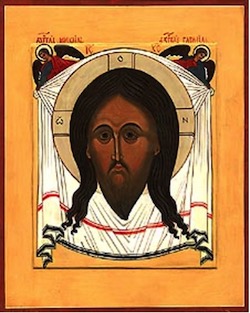
11th SUNDAY AFTER PENTECOST — Tone 2. Afterfeast of the Dormition. Translation of the Image “Not-made-by-hands” of our Lord Jesus Christ from Edessa to Constantinople (944). (Third “Feast of the Savior in August”).
Tone 2 Troparion (Resurrection)
When You descended to death, O Life Immortal, You slew hell with the splendor of Your Godhead. And when from the depths You raised the dead, all the powers of heaven cried out:// “O Giver of life, Christ our God, glory to You!”
Tone 2 Troparion (Image)
We venerate Your most pure image, O Good One; and ask forgiveness of our transgressions, O Christ our God. Of Your own will You were pleased to ascend the Cross in the flesh and deliver Your creatures from bondage to the Enemy. Therefore with thankfulness we cry aloud to You: “You have filled all with joy, O our Savior,// by coming to save the world.”
Tone 1 Troparion (Dormition)
In giving birth you preserved your virginity. In falling asleep you did not forsake the world, O Theotokos. You were translated to life O Mother of Life,// and by your prayers you deliver our souls from death.
Tone 2 Kontakion (Resurrection)
Hell became afraid, O almighty Savior, seeing the miracle of Your Resurrection from the tomb! The dead arose! Creation, with Adam, beheld this and rejoiced with You,// and the world, my Savior, praises You forever.
Tone 2 Kontakion (Image)
Uncircumscribed Word of the Father, as we behold the victorious image of Your true incarnation, not made by hands, but divinely wrought in Your ineffable and divine dispensation towards us,// we honor it with veneration.
Tone 2 Kontakion (Dormition)
Neither the tomb, nor death, could hold the Theotokos, who is constant in prayer and our firm hope in her intercessions. For being the Mother of Life,// she was translated to life by the One Who dwelt in her virginal womb.
Tone 2 Prokeimenon (Resurrection)
The Lord is my strength and my song; / He has become my salvation. (Ps. 117:14)
V. The Lord has chastened me sorely, but He has not given me over to death. (Ps. 117:18)
Tone 4 Prokeimenon (Image)
Sing to the Lord a new song, / for the Lord hath done marvelous things! (Ps. 97:1)
1 Corinthians 9:2-12 (Epistle)
If I am not an apostle to others, yet doubtless I am to you. For you are the seal of my apostleship in the Lord. My defense to those who examine me is this: Do we have no right to eat and drink? Do we have no right to take along a believing wife, as do also the other apostles, the brothers of the Lord, and Cephas? Or is it only Barnabas and I who have no right to refrain from working? Who ever goes to war at his own expense? Who plants a vineyard and does not eat of its fruit? Or who tends a flock and does not drink of the milk of the flock? Do I say these things as a mere man? Or does not the law say the same also? For it is written in the law of Moses, “You shall not muzzle an ox while it treads out the grain.” Is it oxen God is concerned about? Or does He say it altogether for our sakes? For our sakes, no doubt, this is written, that he who plows should plow in hope, and he who threshes in hope should be partaker of his hope. If we have sown spiritual things for you, is it a great thing if we reap your material things? If others are partakers of this right over you, are we not even more? Nevertheless we have not used this right, but endure all things lest we hinder the gospel of Christ.
Colossians 1:12-18 (Epistle, Image)
Giving thanks to the Father who has qualified us to be partakers of the inheritance of the saints in the light. He has delivered us from the power of darkness and conveyed us into the kingdom of the Son of His love, in whom we have redemption through His blood, the forgiveness of sins. He is the image of the invisible God, the firstborn over all creation. For by Him all things were created that are in heaven and that are on earth, visible and invisible, whether thrones or dominions or principalities or powers. All things were created through Him and for Him. And He is before all things, and in Him all things consist. And He is the head of the body, the church, who is the beginning, the firstborn from the dead, that in all things He may have the preeminence.
Tone 1
Alleluia, Alleluia, Alleluia!
V. May the Lord hear you in the day of trouble! May the name of the God of Jacob protect you! (Ps. 19:1)
V. Save the King, O Lord, and hear us on the day we call! (Ps. 19:9)
Tone 4
V. O Lord, we will walk in the light of Your countenance, and will exult in Your Name forever. (Ps. 88:15)
Matthew 18:23-35 (Gospel)
Therefore the kingdom of heaven is like a certain king who wanted to settle accounts with his servants. And when he had begun to settle accounts, one was brought to him who owed him ten thousand talents. But as he was not able to pay, his master commanded that he be sold, with his wife and children and all that he had, and that payment be made. The servant therefore fell down before him, saying, ‘Master, have patience with me, and I will pay you all.’ Then the master of that servant was moved with compassion, released him, and forgave him the debt. But that servant went out and found one of his fellow servants who owed him a hundred denarii; and he laid hands on him and took him by the throat, saying, ‘Pay me what you owe!’ So his fellow servant fell down at his feet and begged him, saying, ‘Have patience with me, and I will pay you all.’ And he would not, but went and threw him into prison till he should pay the debt. So when his fellow servants saw what had been done, they were very grieved, and came and told their master all that had been done. Then his master, after he had called him, said to him, ‘You wicked servant! I forgave you all that debt because you begged me. Should you not also have had compassion on your fellow servant, just as I had pity on you?’ And his master was angry, and delivered him to the torturers until he should pay all that was due to him. So My heavenly Father also will do to you if each of you, from his heart, does not forgive his brother his trespasses.”
Luke 9:51-56; 10:22-24 (Gospel, Image)
Now it came to pass, when the time had come for Him to be received up, that He steadfastly set His face to go to Jerusalem, and sent messengers before His face. And as they went, they entered a village of the Samaritans, to prepare for Him. But they did not receive Him, because His face was set for the journey to Jerusalem. And when His disciples James and John saw this, they said, “Lord, do You want us to command fire to come down from heaven and consume them, just as Elijah did?” But He turned and rebuked them, and said, “You do not know what manner of spirit you are of. For the Son of Man did not come to destroy men’s lives but to save them.” And they went to another village. “All things have been delivered to Me by My Father, and no one knows who the Son is except the Father, and who the Father is except the Son, and the one to whom the Son wills to reveal Him.” Then He turned to His disciples and said privately, “Blessed are the eyes which see the things you see; for I tell you that many prophets and kings have desired to see what you see, and have not seen it, and to hear what you hear, and have not heard it.”
Translation of the Image “Not-Made-By-Hands” of our Lord Jesus Christ from Edessa to Constantinople, the Third “Feast of the Savior in August”
The Transfer of the Icon of our Lord Jesus Christ Not-Made-by-Hands from Edessa to Constantinople occurred in the year 944. Eusebius, in his History of the Church (I:13), relates that when the Savior was preaching, Abgar was the ruler of Edessa. He was stricken with leprosy all over his body. Reports of the great miracles performed by the Lord spread throughout Syria (Mt.4:24) and even reached Abgar. Without having seen the Savior, Abgar believed in Him as the Son of God. He wrote a letter requesting Him to come and heal him. He sent his own portrait painter Ananias to Palestine with this letter, and commissioned him to paint a likeness of the Divine Teacher.
Ananias arrived in Jerusalem and saw the Lord surrounded by many people. He was not able to get close to Him because of the large crowd which had gathered to hear the Savior. Then he stood on a high rock and tried to paint Christ’s portrait from afar, but this attempt did not succeed. Then the Savior saw him, called him by name, and gave him a short letter for Abgar in which He praised the ruler’s faith. He also promised to send His disciple to heal him of his leprosy and guide him to salvation.
Then the Lord asked for some water and a cloth to be brought to Him. After washing His Face, He dried it with the cloth, and His Divine countenence was imprinted upon it. Ananias brought the cloth and the Savior’s letter to Edessa. Reverently, Abgar pressed the holy object to his face and received partial healing. Only a small trace of the terrible affliction remained until the arrival of the disciple promised by the Lord. This was Saint Thaddeus, an Apostle of the Seventy (August 21), who preached the Gospel and baptized Abgar and all the people of Edessa. Abgar attached the Holy Napkin to a board and placed it in a gold frame adorned with pearls. Then he placed it in a niche above the city gates. On the gateway over the Icon he inscribed the words, “O Christ God, let no one who hopes on Thee be put to shame.”
For many years the inhabitants had the pious custom of bowing down before the Icon whenever they went forth from the gates. Later, one of Abgar’s great-grandsons, who ruled Edessa, fell into idolatry, and decided to remove the Icon from the city wall and to replace it with an idol. In a vision the Lord ordered the Bishop of Edessa to hide His Icon. The bishop came by night with his clergy, lit a lampada before the Icon, and placed a ceramic tile in front of the Icon to protect it, and then he sealed the niche with bricks.
As time passed, the people forgot about the Icon. But in the year 545, when the Persian emperor Chozroes I besieged Edessa and the city’s position seemed hopeless, the Most Holy Theotokos appeared to Bishop Eulabios and ordered him to remove the Icon from the sealed niche, saying that it would save the city from the enemy. When he opened the niche, the bishop found the Holy Mandylion, and the lampada was still burning before the Icon, and an exact copy was produced upon the tile protecting the Icon.
The Persians lit a huge fire outside the city walls. Bishop Eulabios carried the Icon Not-Made-by-Hands around the city walls, and a violent wind turned the flames back on the Persians. The defeated Persian army retreated from the city.
In his Church History, the sixth century writer Evagrios Scholastikos refers to the Holy Mandylion (or Napkin) as The Icon made by God (Η θεοτεύκος εἰκών).
In the year 630 Arabs seized Edessa, but they did not hinder the veneration of the Holy Napkin, the fame of which had spread throughout the entire East. In the year 944, the emperor Constantine Porphyrogenitos (912-959) wanted to transfer the Icon to Constantinople, so he paid a ransom to the emir of the city for it. With great reverence the Icon of the Savior Not-Made-by-Hands and the letter which He had written to Abgar, were brought to Constantinople by clergy.
On August 16, the icon of the Savior was placed in the Pharos church of the Most Holy Theotokos. There are several traditions concerning what happened later to the Icon Not-Made-by-Hands. According to one, Crusaders stole it during occupation of Constantinople (1204-1261), but the ship on which the sacred object was taken, perished in the waters of the Sea of Marmora.
According to another tradition, the Icon Not-Made-by-Hands was transported to Genoa in 1362, where it is preserved in a monastery dedicated to the Apostle Bartholomew. It is known that the Icon Not-Made-by-Hands repeatedly produced exact copies of itself. One of these, named “On the tile,” was made when Ananias hid the Icon in the wall on his way to Edessa. Another, imprinted on a cloak, wound up in Georgia. Possibly, the various traditions about the original Icon Is explained by the existence of several exact copies.
During the time of the Iconoclast heresy, the defenders of the holy icons, who shed their blood for them, sang the Troparion to the Icon Not-Made-by-Hands. In proof of the validity of venerating icons, Pope Gregory II (715-731) sent a letter to the Byzantine Enperor, in which he mentioned Abgar’s healing, and the sojourn of the Icon Not-Made-by-Hands at Edessa as a commonly known fact.
The Icon Not-Made-by-Hands was put on the standards of the Russian army, in order to protect them from the enemy. In the Russian Orthodox Church it is a pious custom for a believer to read the Troparion for the Icon of the Savior Not-Made-by-Hands when entering the temple, together with other prayers.
According to the Prologue, there are four known Icons of the Savior Not-Made-by-Hands:
- Abgar’s original Icon at Edessa (August 16).
- The one at Kamuliana (Καμουλιανά), which is mentioned by Saint Gregory of Nyssa (January 10).
- According to Saint Νikόdēmos of the Holy Mountain (July 14), the Kamuliana Icon appeared in the year 392, but it resembled an icon of the Mother of God (August 9).
- During the reign of Emperor Tiberius (578-582), Saint Mary Synklitike (August 11) was healed by the Icon on the tile (August 16).
The Feast of the Transfer of the Icon Not-Made-by-Hands is observed along with the Afterfeast of the Dormition. The commemoration of the third Icon Not-Made-by-Hands mentioned above is called the “The Savior on Linen Cloth.” The particular reverence for this Feast in the Russian Orthodox Church is also expressed in iconography, and the Icon Not-Made-by-Hands was one of the most widely distributed.
On the words of the Jesus Prayer, by St. Mark of Ephesus
How much power is possessed by the Prayer ‘Lord Jesus Christ, Son of God, have mercy on me’, and what gifts it confers on those who practice it, and to what spiritual state it leads them, it lies beyond our power to say. The words which constitute this Prayer were initially formulated by our Holy Fathers. They did not, however, themselves make up these words, but took them originally from Holy Scripture and from the chief disciples of Christ. Or, to express it better, they received them as an inheritance from the Fathers who were before them, and passed this inheritance on to us. Thus from this alone, for those who have not learnt it from experience, it is clear that this holy Prayer is something divinely inspired and is as it were a sacred oracle. For we believe that Christ spoke through the holy Apostles, and that everything He entrusted to them – either to repeat verbally or to write down – constitutes divine oracles, spiritual revelations and the words of God. Thus St Paul, addressing us from the third heaven (cf. 2 Cor. 12:2), states: ‘No one can say “Lord Jesus” except through the Holy Spirit’ (1 Cor. 12:3). By using the negative words ‘no one’, St Paul admirably reveals that the invocation of the Lord Jesus is very sublime and beyond the power of most people. In addition, St John the Theologian, who speaks of things spiritual ‘with a voice of thunder’, begins with one of the words that St Paul provides, and then gives us the continuation of the Prayer, as follows: ‘Every spirit that confesses Jesus Christ is come in the flesh is from God’ (1 John 4:2). Here certainly he makes an affirmative statement, but attributes, as does St Paul, the invocation and the confession of Jesus Christ to the grace of the Holy Spirit. Then, thirdly, St Peter, the chief of the Apostles, completes the Prayer. Thus, when our Lord asked His disciples, ‘Whom do you say that I am?’, St Peter, as usual in his enthusiasm forestalling the other disciples, answered, ‘Thou art the Christ, the Son of the living God’, this being revealed to him, as the Saviour Himself testified, by the same heavenly Father or – which is the same thing – by the Holy Spirit (cf. Matt. 16:15–17).
Palmer, G.E.H.. The Philokalia Vol 5
 Sunday Bulletin August 9, 2026