
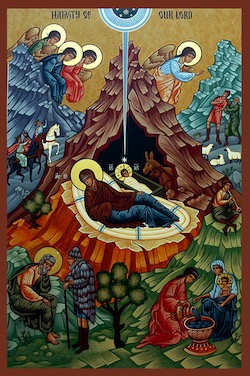
29th SUNDAY AFTER PENTECOST — Tone 4. Holy Righteous Ones: Joseph the Betrothed, David the King, and James the Brother of the Lord. Afterfeast of the Nativity. Sunday after Nativity.
Tone 4 Troparion (Resurrection)
When the women disciples of the Lord learned from the angel the joyous message of Your Resurrection, they cast away the ancestral curse and elatedly told the apostles: “Death is overthrown! Christ God is risen,// granting the world great mercy!”
Tone 4 Troparion (Feast)
Your Nativity, O Christ our God, has shone to the world the light of wisdom! For by it, those who worshipped the stars, were taught by a star to adore You, the Sun of Righteousness, and to know You, the Orient from on high.// O Lord, glory to You!
Tone 2 Troparion (Righteous Ones)
Proclaim the wonder, O Joseph, to David, the ancestor of God; you have seen a Virgin great with child; and you gave glory with the shepherds; you worshipped with the Magi, and received the news from the Angel.// Pray to Christ God to save our souls!
Tone 3 Kontakion (Righteous Ones)
Today godly David is filled with joy; Joseph and James offer praise. The glorious crown of their kinship with Christ fills them with great joy. They sing praises to the One ineffably born on earth,// and they cry out: “O Compassionate One, save those who honor You!”
Tone 3 Kontakion (Feast)
Today the Virgin gives birth to the Transcendent One, and the earth offers a cave to the Unapproachable One! Angels with shepherds glorify Him! The Wise Men journey with the star,// since for our sake the eternal God was born as a little Child
Tone 4 Prokeimenon (Resurrection)
O Lord, how manifold are Your works; / in wisdom have You made them all. (Ps. 103:26)
V. Bless the Lord, O my soul! O Lord, my God, You are very great! (Ps.103:1)
Tone 4 Prokeimenon (Righteous Ones)
God is wonderful in His saints, / the God of Israel. (Ps. 67:35a)
Galatians 1:11-19 (Epistle, Sunday After)
But I make known to you, brethren, that the gospel which was preached by me is not according to man. For I neither received it from man, nor was I taught it, but it came through the revelation of Jesus Christ. For you have heard of my former conduct in Judaism, how I persecuted the church of God beyond measure and tried to destroy it. And I advanced in Judaism beyond many of my contemporaries in my own nation, being more exceedingly zealous for the traditions of my fathers. But when it pleased God, who separated me from my mother’s womb and called me through His grace, to reveal His Son in me, that I might preach Him among the Gentiles, I did not immediately confer with flesh and blood, nor did I go up to Jerusalem to those who were apostles before me; but I went to Arabia, and returned again to Damascus. Then after three years I went up to Jerusalem to see Peter, and remained with him fifteen days. But I saw none of the other apostles except James, the Lord’s brother.
Tone 4
Alleluia, Alleluia, Alleluia!
V. Go forth, prosper and reign, for the sake of meekness, righteousness and truth! (Ps. 44:3b)
V. For You love righteousness, and hate iniquity. (Ps. 44:6)
Tone 4
V. Remember, O Lord, David and all his meekness! (Ps. 131:1)
Matthew 2:13-23 (Gospel, Sunday After)
“Now when they had departed, behold, an angel of the Lord appeared to Joseph in a dream, saying, “Arise, take the young Child and His mother, flee to Egypt, and stay there until I bring you word; for Herod will seek the young Child to destroy Him.” When he arose, he took the young Child and His mother by night and departed for Egypt, and was there until the death of Herod, that it might be fulfilled which was spoken by the Lord through the prophet, saying, Out of Egypt I called My Son.” Then Herod, when he saw that he was deceived by the wise men, was exceedingly angry; and he sent forth and put to death all the male children who were in Bethlehem and in all its districts, from two years old and under, according to the time which he had determined from the wise men. Then was fulfilled what was spoken by Jeremiah the prophet, saying: “A voice was heard in Ramah, lamentation, weeping, and great mourning, Rachel weeping for her children, refusing to be comforted, because they are no more.” Now when Herod was dead, behold, an angel of the Lord appeared in a dream to Joseph in Egypt, saying, “Arise, take the young Child and His mother, and go to the land of Israel, for those who sought the young Child’s life are dead.” Then he arose, took the young Child and His mother, and came into the land of Israel. But when he heard that Archelaus was reigning over Judea instead of his father Herod, he was afraid to go there. And being warned by God in a dream, he turned aside into the region of Galilee. And he came and dwelt in a city called Nazareth, that it might be fulfilled which was spoken by the prophets, “He shall be called a Nazarene.”
Commemoration of the Holy Righteous David the King, Joseph the Betrothed, and James the Brother of the Lord
The Holy Prophet-King David, Saint Joseph the Betrothed, and Saint James the Brother of the Lord are commemorated on the Sunday after the Nativity. If there is no Sunday between December 25 and January 1, their commemoration is moved to December 26. At an early date, some churches in the East began to commemorate certain important figures of the New Testament at the time of Theophany, and later during the Nativity season. In Syria, for example, Saint Stephen (December 27), Saints James (April 30) and John (September 26), and Saints Peter and Paul (June 29) were commemorated near the end of December. In Jerusalem, the saints mentioned above were combined with a feast that the Jews of Hebron celebrated on December 25 or 26 in honor of the Old Testament Patriarch Jacob. Later on, the Christians substituted Saint James (October 23) for Jacob, and then the commemoration of the Brother of the Lord became associated with his ancestor King David. In time, Saint Joseph was linked with Saints David and James. Saint Joseph had four sons from his previous marriage: James, Judah, Joses, and Simon (or Symeon), and three daughters: Esther, Martha, and Salome, who was the mother of Saint John the Theologian.
REFLECTION — St Nikolai Velimirovich
A story of the Divine Christ-child: When the Most-holy Virgin, with her Divine Child and the righteous Joseph, drew near to the city of Hermopolis [Cairo], they saw a tree before the gate of the city. The travelers from afar were weary from their journey and approached this tree to rest a while, even though the tree was very tall and did not offer adequate shade. The Egyptians called this tree “Persea” and worshiped it as a god, for they believed that some divinity was hidden in the tree. In reality, an evil spirit dwelt in this tree. As the holy family approached the tree, the tree shook fiercely, and the evil spirit, terrified by the approaching Christ-child, fled. Then the tree bent its top down to the ground and worshiped its Creator like a rational creature. Thus the bent tree cast a great shadow, under which the weary travelers rested. From that day, the tree received miraculous healing powers from Christ the Lord to heal every infirmity of men. Afterward, the holy sojourners went to the village of Matarea. Near the village they saw a fig tree, and, while Joseph went into the village on business, the Most-holy Virgin took refuge under the fig tree with the Lord. And, oh, what a miracle: the tree lowered its crown down to the ground to create a shadow for the travelers, and its lower half split open in such a way that the Mother with the Child could enter and rest. And what is even more miraculous: a living spring of water suddenly opened up near the fig tree. Joseph found a hut in the vicinity, where they settled. There they lived and drank water from that miraculous spring. This was the only spring of living water to be found in Egypt, for all the other water in Egypt comes from the Nile River, which branches off into innumerable canals. And thus, like brought forth like: the Lord Jesus, the Immortal and Heavenly Spring of living water, by His presence called forth this spring of living water from the earth.
— Velimirovic, Saint Nikolai. The Prologue of Ohrid
On the Most-holy Virgin, the Theotokos — St. Nikolai Velimirovich
His mother saith unto the servants, Whatsoever He saith unto you, do it (John 2:5)
Here is joy for all the faithful: she who is closest to Christ the Savior in heaven, as she had been on earth, cares for the faithful, appears to them, helps them and advises them, Whatsoever He, my Son and my God, saith unto you, do it. Thus, she advised the servants at the marriage in Cana, and the servants obeyed her and saw a miracle. From those few words of the Most-holy Virgin, God’s Bride, recorded in the Gospel, we receive a precious instruction, truly the one and only Gospel instruction that she gave to mankind during her life on earth. Whatsoever He saith unto you, do it! As though she wanted to say: “He knows all; He can do all; He loves you all; therefore, you should look neither here nor there, but hear Him and obey Him.” She comprehended the responsibility in this world of living for Him and directing others to Him as the Source of life, and she voluntarily continues carrying out this responsibility even from heaven. Throughout the Church’s entire history, she has taught the faithful to do whatsoever He said. And even today, from her heavenly glory, she mystically descends among the faithful to counsel them to do that which He has commanded. That is her Gospel—the Gospel of the Most-holy Virgin, the Theotokos. It consists not of the Four Gospels but of four words: Do whatsoever He saith. O my brethren, let us obey her! Let us obey her as a mother and more than our mother, for she desires the greatest good for us—to reign in the Eternal Kingdom of her Son. O Most-holy Virgin, help us to fulfill His words. To Thee and to Him be glory and praise forever. Amen.
— Velimirovic, Saint Nikolai. The Prologue of Ohrid
Seeds of Heaven and Hell: Passions, Virtues, and Life After Death
From the biblical perspective, it is not God Who punishes man, but man who reaps what he has sown. The Apostle Paul tells us that [God] will render to every man according to his deeds: To them who by patient continuance in doing well seek for glory and honor and immortality, eternal life: But unto them that are contentious: … indignation and wrath, tribulation and anguish, upon every soul of man that does evil, of the Jew first, and also of the Gentile; but glory, honor, and peace, to every man that works good, to the Jew first, and also to the Gentile (Rom. 2:6-10). In the patristic understanding of the Orthodox Church, God’s grace is one and the same, for God does not change. Yet how man relates to the uncreated grace of God in this world is the determining factor of his state in the afterlife. In the Gospel account of the rich man and Lazarus, we recall that the rich man was separated from Abraham’s bosom “by a great chasm” that could not be spanned (Luke 16:26). Interestingly, Abraham still spoke with the rich man. Hell then cannot be seen as a place as we understand it, for St. John Chrysostom tells us that it is outside the created world. Concerning this issue, St. John says we do not need to know where it is as we will not understand anyway. Rather our concern should be how to avoid it. The Eastern patristic consensus generally has a different focus from that of even the pre-schism Western Orthodox saints. Although both use the imagery of hell in the familiar fire-and-brimstone accounts, the Eastern focus tends to be more concerned with how heaven and hell is experienced in the heart of man through the virtues and the passions. St. Isaac the Syrian explains that Paradise is the love of God; the uncreated energy of God. Yet, at the same time, this love is experienced as a scourge by unrepentant souls who cannot bear the pure glory of God. From the patristic perspective, God Himself is heaven for the saints and hell for the sinners. We recall in the third chapter of the Book of Daniel the account of the three children in the fiery furnace. They serve as a type for this understanding of the afterlife. The three children who kept the commandments of God were not burnt by the fire but danced in the flames with the Angel of God, while those who heated the furnace out of malice and in wickedness were consumed by that very same fire. Thus eternal life is light to those who have followed the commandments of the Lord and purified their heart and nous, whereas this same light will be darkness and misery to those who are living in a state contrary to the will of God. St. Maximus the Confessor explains that “the inheritance of the saints is God Himself, [and] he who is found worthy of this grace will be beyond all ages, times, and places: he will have God Himself as his place.” In this life we are free, but after death, the potential tragedy that exists with human freedom will be honored: our choice is set. St. John Chrysostom explains that there is a universal rule that we can use to discern the reality of heaven and hell: no one from among those who strive to please God and live a virtuous life according to the commandments will ever doubt the teaching about the judgment and hell. From their own experience, they come to know and understand, to varying degrees, the death that sin causes and the life that virtue brings. St. Gregory of Sinai tells us that “passion-embroiled states are foretastes of hell’s torments, just as the activity of the virtues is a foretaste of the kingdom of heaven.” In our life, we place the different ‘ingredients’ within our souls, either the virtues or passions and sins. Once we encounter the uncreated flame of God’s presence outside this world, these ingredients are indelibly ‘baked’ into our souls.
— Bowyer, Sergius. Acquiring the Mind of Christ: Embracing the Vision of the Orthodox Church
She Who is Wider than the Heavens
When our Panagia met with Saint Elizabeth, the mother of the Honorable Forerunner, amongst other things, she also foretold the following: “From henceforth, all the generations will call me blessed” (Lk. 1:48). In other words, from this point forward all the generations of people who will believe in the Lord will bless me because God the Father gave me the honor of becoming the Mother of His Son. What an extraordinary honor for a woman! In our days there is much talk concerning equality of men and women. However, the struggles for this equality and the so-called feminist movement have appeared quite late. For twenty centuries now, Christianity has resolved the problem. How? It abolished discrimination. It honored the female gender with value equal to that of man. Furthermore, it honored a particular woman with acclaim that no man ever had, has, or will have. This woman is the Most-Holy Theotokos. Christianity, and the Church, does not use gender, social status, education, material wealth, or intelligence as criteria to rate and assess people. It grades and evaluates them using a single criterion: holiness. In the eyes of God there is no male and female. There are only people who are sinful and repentant, impious and pious, holy and holier.
— Ephraim, Elder. The Art of Salvation
 Sunday Bulletin December 21, 2025