
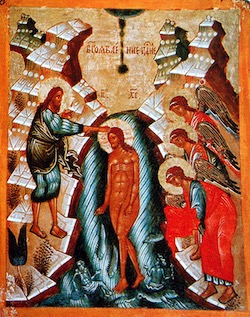
30th SUNDAY AFTER PENTECOST — Tone Forefeast of the Theophany. Sunday before Theophany. Synaxis of the Seventy Apostles.
Tone 5 Troparion (Resurrection)
Let us, the faithful, praise and worship the Word, co-eternal with the Father and the Spirit, born for our salvation from the Virgin; for He willed to be lifted up on the Cross in the flesh, to endure death, and to raise the dead// by His glorious Resurrection.
Tone 4 Troparion (Forefeast)
Prepare, O Zebulon, and adorn yourself, O Naphtali! River Jordan, cease flowing, and receive with joy the Master coming to be baptized! Adam, rejoice with our first Mother, and do not hide yourselves as you did of old in Paradise; for having seen you naked, He has appeared to clothe you with the first garment.//Christ has appeared to renew all creation.
Tone 4 Troparion (St. Nicholas)
The truth of your deeds has revealed you to your flock as a rule of faith, an image of meekness and a teacher of self-control; your humility exalted you; your poverty enriched you.// O Father Bishop Nicholas, pray to Christ God that our souls may be saved.
Tone 3 Troparion (Apostles)
Holy Apostles of the Seventy entreat the merciful God // to grant our souls forgiveness of transgressions!
Tone 5 Kontakion (Resurrection)
You descended into hell, O my Savior, shattering its gates as Almighty, resurrecting the dead as Creator, and destroying the sting of death. You have delivered Adam from the curse, O Lover of man,// and we cry to You: “O Lord, save us!”
Tone 2 Kontakion (Apostles)
O faithful, let us praise with hymns the choir of the seventy disciples of Christ. They have taught us all to worship the undivided Trinity, for they are divine lamps of the faith.
Tone 4 Kontakion (Forefeast)
Today the Lord enters the Jordan and cries out to John: “Do not be afraid to baptize Me.// For I have come to save Adam, the first-formed man.”
Tone 6 Prokeimenon (Sunday Before)
O Lord, save Your people, / and bless Your inheritance! (Ps. 27:9a)
V. To You, O Lord, will I call. O my God, be not silent to me! (Ps. 27:1a)
Tone 4 Prokeimenon (Righteous Ones)
God is wonderful in His saints, / the God of Israel. (Ps. 67:35a)
2 Timothy 4:5-8 (Epistle, Sunday Before)
But you be watchful in all things, endure afflictions, do the work of an evangelist, fulfill your ministry. For I am already being poured out as a drink offering, and the time of my departure is at hand. I have fought the good fight, I have finished the race, I have kept the faith. Finally, there is laid up for me the crown of righteousness, which the Lord, the righteous Judge, will give to me on that Day, and not to me only but also to all who have loved His appearing.
Tone 8
Alleluia, Alleluia, Alleluia!
V. O God, be bountiful to us and bless us, show the light of Your countenance upon us, and have mercy on us. (Ps. 66:1)
V. That we may know Your way upon the earth, and Your salvation among all the nations. (Ps. 66:2)
Mark 1:1-8 (Gospel, Sunday Before)
The beginning of the gospel of Jesus Christ, the Son of God. As it is written in the Prophets: “Behold, I send My messenger before Your face, Who will prepare Your way before You. The voice of one crying in the wilderness: ‘Prepare the way of the LORD; make His paths straight.’” John came baptizing in the wilderness and preaching a baptism of repentance for the remission of sins. Then all the land of Judea, and those from Jerusalem, went out to him and were all baptized by him in the Jordan River, confessing their sins. Now John was clothed with camel’s hair and with a leather belt around his waist, and he ate locusts and wild honey. And he preached, saying, “There comes One after me who is mightier than I, whose sandal strap I am not worthy to stoop down and loose. I indeed baptized you with water, but He will baptize you with the Holy Spirit.”
Forefeast of the Theophany of our Lord and Savior Jesus Christ
The third day of the Forefeast of Theophany falls on January 4. The hymns compare the Feast of the Nativity with the coming Feast. “There shepherds saw the Child and were amazed; here the voice of the Father proclaims the only-begotten Son.”
Synaxis of the Seventy Apostles
The Synaxis of the Seventy Apostles was established by the Orthodox Church to indicate the equal honor of each of the Seventy. They were sent two by two by the Lord Jesus Christ to go before Him into the cities He would visit (Luke 10:1).
Besides the celebration of the Synaxis of the Holy Disciples, the Church celebrates the memory of each of them during the course of the year:
Saint James the Brother of the Lord (October 23); Mark the Evangelist (April 25); Luke the Evangelist (October 18); Cleopas (October 30), brother of Saint Joseph the Betrothed, and Simeon his son (April 27); Barnabas (June 11); Joses, or Joseph, named Barsabas or Justus (October 30); Thaddeus (August 21); Ananias (October 1); Protomartyr Stephen the Archdeacon (December 27); Philip the Deacon (October 11); Prochorus the Deacon (July 28); Nicanor the Deacon (July 28 and December 28); Timon the Deacon (July 28 and December 30); Parmenas the Deacon (July 28); Timothy (January 22); Titus (August 25); Philemon (November 22 and February 19); Onesimus (February 15); Epaphras and Archippus (November 22 and February 19); Silas, Silvanus, Crescens or Criscus (July 30); Crispus and Epaenetos (July 30); Andronicus (May 17 and July 30); Stachys, Amplias, Urban, Narcissus, Apelles (October 31); Aristobulus (October 31 and March 16); Herodion or Rodion (April 8 and November 10); Agabus, Rufus, Asyncritus, Phlegon (April 8 ); Hermas (November 5, November 30 and May 31); Patrobas (November 5); Hermes (April 8); Linus, Gaius, Philologus (November 5); Lucius (September 10); Jason (April 28); Sosipater (April 28 and November 10); Olympas or Olympanus (November 10 ); Tertius (October 30 and November 10 ); Erastos (November 30), Quartus (November 10 ); Euodius (September 7); Onesiphorus (September 7 and December 8); Clement (November 25); Sosthenes (December 8); Apollos (March 30 and December 8); Tychicus, Epaphroditus (December 8); Carpus (May 26); Quadratus (September 21); Mark (September 27), called John, Zeno (September 27); Aristarchus (April 15 and September 27); Pudens and Trophimus (April 15); Mark nephew of Barnabas, Artemas (October 30); Aquila (July 14); Fortunatus (June 15) and Achaicus (January 4).
With the Descent of the Holy Spirit the Seventy Apostles preached in various lands. Some accompanied the Twelve Apostles, like the holy Evangelists Mark and Luke, or Saint Paul’s companion Timothy, or Prochorus, the disciple of the holy Evangelist John the Theologian, and others. Many of them were thrown into prison for Christ, and many received the crown of martyrdom.
There are two more Apostles of the Seventy: Saint Cephas, to whom the Lord appeared after the Resurrection (1 Cor. 15:5-6), and Simeon, called Niger (Acts 13:1). They also were glorified by apostolic preaching.
There are discrepancies and errors in some lists of the Seventy Apostles. In a list attributed to Saint Dorotheus of Tyre (June 5) some names are repeated (Rodion, or Herodion, Apollos, Tychicus, Aristarchus), while others are omitted (Timothy, Titus, Epaphras, Archippus, Aquila, Olympas). Saint Demetrius of Rostov consulted the Holy Scripture, the traditions passed down by the Fathers, and the accounts of trustworthy historians when he attempted to correct the mistakes and uncertainties in the list in compiling his collection of Lives of the Saints.
The Church in particular venerates and praises the Seventy Apostles because they taught us to honor the Trinity One in Essence and Undivided.
In the ninth century Saint Joseph the Hymnographer composed the Canon for the Synaxis of the Seventy Apostles of Christ.
Epiphany
The sixth of January is the feast of the Epiphany (Theophany). Originally it was the one Christian feast of the “shining forth” of God to the world in the human form of Jesus of Nazareth. It included the celebration of Christ’s birth, the adoration of the Wisemen, and all of the childhood events of Christ such as His circumcision and presentation to the temple as well as His baptism by John in the Jordan. There seems to be little doubt that this feast, like Easter and Pentecost, was understood as the fulfillment of a previous Jewish festival, in this case the Feast of Lights.
Epiphany means shining forth or manifestation. The feast is often called, as it is in the Orthodox service books, Theophany, which means the shining forth and manifestation of God. The emphasis in the present day celebration is on the appearance of Jesus as the human Messiah of Israel and the divine Son of God, One of the Holy Trinity with the Father and the Holy Spirit.
Thus, in the baptism by John in the Jordan, Jesus identifies Himself with sinners as the “Lamb of God who takes away the sin of the world” (Jn 1.29), the “Beloved” of the Father whose messianic task it is to redeem men from their sins (Lk 3.21, Mk 1.35). And he is revealed as well as One of the Divine Trinity, testified to by the voice of the Father, and by the Spirit in the form of a dove. This is the central epiphany glorified in the main hymns of the feast:
When Thou, O Lord, wast baptized in the Jordan the worship of the Trinity was made manifest! For the voice of the Father bare witness to Thee, calling Thee his Beloved Son. And the Spirit, in the form of a dove, confirmed the truthfulness of his Word. O Christ our God, who hast revealed Thyself and hast enlightened the world, glory to Thee (Troparion).
Today Thou hast appeared to the universe, and Thy Light, O Lord, has shone on us, who with understanding praise Thee: Thou hast come and revealed Thyself, O Light Unapproachable! (Kontakion).
The services of Epiphany are set up exactly as those of Christmas, although historically it was most certainly Christmas which was made to imitate Epiphany since it was established later. Once again the Royal Hours and the Liturgy of Saint Basil are celebrated together with Vespers on the eve of the feast; and the Vigil is made up of Great Compline and Matins.
The prophecies of Epiphany repeat the God is with us from Isaiah and stress the foretelling of the Messiah as well as the coming of His forerunner, John the Baptist:
The voice of one crying in the wilderness: Prepare the way of the Lord, make His path straight. Every valley shall be filled and every mountain and hill brought low, and the crooked shall be made straight, and the rough ways shall be made smooth; and all flesh shall see the salvation of God (Is 40.3–5; Lk 3.4–6).
Once more special psalms are sung to begin the Divine Liturgy of the feast, and the baptismal line of Galatians 3.27 replaces the song of the Thrice-Holy. The gospel readings of all the Epiphany services tell of the Lord’s baptism by John in the Jordan River. The epistle reading of the Divine Liturgy tells of the consequences of the Lord’s appearing which is the divine epiphany.
For the grace of God has appeared for the salvation of all men, training us to renounce irreligion and worldly passions, and to live sober, upright and godly lives in this world, awaiting our blessed hope, the appearing of the glory of our great God and Saviour Jesus Christ, who gave himself for us to redeem us from all iniquity and to purify for himself a people of his own who are zealous for good deeds (Titus 2.11–14).
The main feature of the feast of the Epiphany is the Great Blessing of Water. It is prescribed to follow both the Divine Liturgy of the eve of the feast and the Divine Liturgy of the day itself. Usually it is done just once in parish churches at the time when most people can be present. It begins with the singing of special hymns and the censing of the water which has been placed in the center of the church building. Surrounded by candles and flowers, this water stands for the beautiful world of God’s original creation and ultimate glorification by Christ in the Kingdom of God. Sometimes this service of blessing is done out of doors at a place where the water is flowing naturally.
The voice of the Lord cries over the waters, saying: Come all ye, receive the Spirit of wisdom, the Spirit of understanding, the Spirit of the fear of God, even Christ who is made manifest.
Today the nature of water is sanctified. Jordan is divided in two, and turns back the stream of its waters, beholding the Master being baptized.
As a man Thou didst come to that river, O Christ our King, and dost hasten O Good One, to receive the baptism of a servant at the hands of the Forerunner [John], because of our sins, O Lover of Man (Hymns of the Great Blessing of Waters).
Following are three readings from the Prophecy of Isaiah concerning the messianic age:
Let the thirsty wilderness be glad, let the desert rejoice, let it blossom as a rose, let it blossom abundantly, let everything rejoice . . . (Is 35.1–10). Go to that water, O you who thirst, and as many as have no money, let them eat and drink without price, both wine and fat . . . (Is 55.1–13).
With joy draw the water out of the wells of salvation. And in that day shall you say: Confess ye unto the Lord and call upon his Name; declare his glorious deeds . . . his Name is exalted . . . Hymn the Name of the Lord . . . Rejoice and exult . . . (Is 12.3.6). After the epistle (1 Cor 1.10–14) and the gospel reading (Mk 1.9–11) the special great litany is chanted invoking the grace of the Holy Spirit upon the water and upon those who will partake of it. It ends with the great prayer of the cosmic glorification of God in which Christ is called upon to sanctify the water, and all men and all creation, by the manifestation of his saving and sanctifying divine presence by the indwelling of the Holy and Good and Life-creating Spirit. As the troparion of the feast is sung, the celebrant immerses the Cross into the water three times and then proceeds to sprinkle the water in the four directions of the world. He then blesses the people and their homes with the sanctified water which stands for the salvation of all men and all creation which Christ has effected by his “epiphany” in the flesh for the life of the world. It is the faith of Christians that since the Son of God has taken human flesh and has been immersed in the streams of the Jordan, all matter is sanctified and made pure in Him, purged of its death-dealing qualities inherited from the devil and the wickedness of men. In the Lord’s epiphany all creation becomes good again, indeed “very good,” the way that God Himself made it and proclaimed it to be in the beginning when “the Spirit of God was moving over the face of the waters” (Gen 1.2) and when the “Breath of Life” was breathing in man and in everything that God made (Gen 1.30; 2.7).
 Sunday Bulletin December 28, 2025