
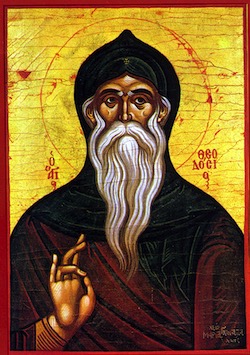
31st SUNDAY AFTER PENTECOST — Tone 6. Afterfeast of the Theophany. Ven. Theodosius the Great, the Cenobiarch (529). Sunday after Theophany.
Tone 6 Troparion (Resurrection)
The Angelic Powers were at Your tomb; the guards became as dead men. Mary stood by Your grave, seeking Your most pure body. You captured hell, not being tempted by it. You came to the Virgin, granting life. O Lord, Who rose from the dead,// glory to You.
Tone 1 Troparion (Feast)
When You, O Lord, were baptized in the Jordan, the worship of the Trinity was made manifest. For the voice of the Father bore witness to You, and called You His beloved Son; and the Spirit in the form of a dove confirmed the truthfulness of His word. O Christ our God, You have revealed Yourself//and have enlightened the world, glory to You.
Tone 8 Troparion (Ven. Theodosius)
By a flood of tears you made the desert fertile, and your longing for God brought forth fruits in abundance. By the radiance of miracles you illumined the whole universe.// Our Father Theodosius, pray to Christ God to save our souls!
Tone 6 Kontakion (Resurrection)
When Christ God, the Giver of Life, raised all of the dead from the valleys of misery with His mighty hand, He bestowed resurrection on the human race.// He is the Savior of all, the Resurrection, the Life, and the God of all.
Tone 8 Kontakion (Ven. Theodosius)
Planted in the courts of your Lord, you blossomed beautifully with virtue, and increased your children in the desert, showering them with streams of your tears, O chief shepherd of the divine flock of God. Therefore, we cry to you: Rejoice, O Father Theodosius!
Tone 4 Kontakion (Feast)
Today You have shone forth to the world, O Lord, and the light of Your countenance has been marked on us. Knowing You, we sing Your praises: “You have come and revealed Yourself,// O unapproachable Light.”
Tone 1 Prokeimenon (Sunday After)
Let Your mercy, O Lord, be upon us / as we have set our hope on You! (Ps. 32:22)
V. Rejoice in the Lord, O you righteous! Praise befits the just! (Ps. 32:1)
Tone 7 Prokeimenon (Ven. Theodosius)
Precious in the sight of the Lord / is the death of His saints. (Ps. 115:6)
Ephesians 4:7-13 (Epistle, Sunday After)
But to each one of us grace was given according to the measure of Christ’s gift. Therefore He says: “When He ascended on high, He led captivity captive, and gave gifts to men.” (Now this, “He ascended” – what does it mean but that He also first descended into the lower parts of the earth? He who descended is also the One who ascended far above all the heavens, that He might fill all things.) And He Himself gave some to be apostles, some prophets, some evangelists, and some pastors and teachers, for the equipping of the saints for the work of ministry, for the edifying of the body of Christ, till we all come to the unity of the faith and of the knowledge of the Son of God, to a perfect man, to the measure of the stature of the fullness of Christ;
2 Corinthians 4:6-15 (Epistle, Saint)
For it is the God who commanded light to shine out of darkness, who has shone in our hearts to give the light of the knowledge of the glory of God in the face of Jesus Christ. But we have this treasure in earthen vessels, that the excellence of the power may be of God and not of us. We are hard-pressed on every side, yet not crushed; we are perplexed, but not in despair; persecuted, but not forsaken; struck down, but not destroyed – always carrying about in the body the dying of the Lord Jesus, that the life of Jesus also may be manifested in our body. For we who live are always delivered to death for Jesus’ sake, that the life of Jesus also may be manifested in our mortal flesh. So then death is working in us, but life in you. And since we have the same spirit of faith, according to what is written, “I believed and therefore I spoke,” we also believe and therefore speak, knowing that He who raised up the Lord Jesus will also raise us up with Jesus, and will present us with you. For all things are for your sakes, that grace, having spread through the many, may cause thanksgiving to abound to the glory of God.
Tone 5
Alleluia, Alleluia, Alleluia!
V. I will sing of Your mercies, O Lord, forever; with my mouth I will proclaim Your truth from generation to generation. (Ps. 88:1-2)
V. For You have said: Mercy will be established forever; Your truth will be prepared in the heavens. (Ps. 88:3)
Tone 6
V. Blessed is the man who fears the Lord, who greatly delights in His commandments. (Ps. 111:1)
Matthew 4:12-17 (Gospel, Sunday After)
Now when Jesus heard that John had been put in prison, He departed to Galilee. And leaving Nazareth, He came and dwelt in Capernaum, which is by the sea, in the regions of Zebulun and Naphtali, that it might be fulfilled which was spoken by Isaiah the prophet, saying: “The land of Zebulun and the land of Naphtali, by the way of the sea, beyond the Jordan, Galilee of the Gentiles: The people who sat in darkness have seen a great light, and upon those who sat in the region and shadow of death Light has dawned.” From that time Jesus began to preach and to say, “Repent, for the kingdom of heaven is at hand.”
Matthew 11:27-30 (Gospel, Saint)
All things have been delivered to Me by My Father, and no one knows the Son except the Father. Nor does anyone know the Father except the Son, and the one to whom the Son wills to reveal Him. Come to Me, all you who labor and are heavy laden, and I will give you rest. Take My yoke upon you and learn from Me, for I am gentle and lowly in heart, and you will find rest for your souls. For My yoke is easy and My burden is light.”
Venerable Theodosius the Great, the Cenobiarch
Saint Theodosius the Great lived during the fifth-sixth centuries, and was the founder of cenobitic monasticism. He was born in Cappadocia of pious parents. Endowed with a splendid voice, he zealously toiled at church reading and singing. Saint Theodosius prayed fervently that the Lord would guide him on the way to salvation. In his early years he visited the Holy Land and met with Saint Simeon the Stylite (September 1), who blessed him and predicted future pastoral service for him.
Yearning for the solitary life, Saint Theodosius settled in Palestine into a desolate cave, in which, according to Tradition, the three Magi had spent the night, having come to worship the Savior after His Nativity. He lived there for thirty years in great abstinence and unceasing prayer. People flocked to the ascetic, wishing to live under his guidance. When the cave could no longer hold all the monks, Saint Theodosius prayed that the Lord Himself would indicate a place for the monks. Taking a censer with cold charcoal and incense, the monk started walking into the desert.
At a certain spot the charcoal ignited by itself and the incense smoke began to rise. Here the monk established the first cenobitic monastery, or Lavra (meaning “broad” or “populous”). Soon the Lavra of Saint Theodosius became renowned, and up to 700 monks gathered at it. According to the final testament of Saint Theodosius, the Lavra rendered service to neighbor, giving aid to the poor and providing shelter for wanderers.
Saint Theodosius was extremely compassionate. Once, when there was a famine in Palestine and a multitude of people gathered at the monastery, the monk gave orders to allow everyone into the monastery enclosure. His disciples were annoyed, knowing that the monastery did not have the means to feed all those who had come. But when they went into the bakery, they saw that through the prayers of the abba, it was filled with bread. This miracle was repeated every time Saint Theodosius wanted to help the destitute.
At the monastery, Saint Theodosius built a home for taking in strangers, separate infirmaries for monks and laymen, and also a shelter for the dying. Seeing that people from various lands gathered at the Lavra, the saint arranged for services in the various languages: Greek, Georgian and Armenian. All gathered to receive the Holy Mysteries in the large church, where divine services were chanted in Greek.
During the reign of the Byzantine Emperor Anastasius (491-518) there arose the heresy of Eutychius and Severus, which recognized neither the sacraments nor the clergy. The emperor accepted the false teaching, and the Orthodox began to suffer persecution. Saint Theodosius stood firmly in defense of Orthodoxy and wrote a letter to the emperor on behalf of the monks, in which they denounced him and refuted the heresy with the teachings of the Ecumenical Councils. He affirmed moreover, that the desert-dwellers and monks would firmly support the Orthodox teaching. The emperor showed restraint for a short while, but then he renewed his persecution of the Orthodox. The holy Elder then showed great zeal for the truth. Leaving the monastery, he came to Jerusalem and in the church, he stood at the high place and cried out for all to hear: “Whoever does not honor the four Ecumenical Councils, let him be anathema!” For this bold deed the monk was sent to prison, but soon returned after the death of the emperor.
Saint Theodosius accomplished many healings and other miracles during his life, coming to the aid of the needy. Through his prayers he once destroyed the locusts devastating the fields in Palestine. Also by his intercession, soldiers were saved from death, and he also saved those perishing in shipwrecks and those lost in the desert.
Once, the saint gave orders to strike the semandron (a piece of wood hit with a mallet), so that the brethren would gather at prayer. He told them, “The wrath of God draws near the East.” After several days it became known that a strong earthquake had destroyed the city of Antioch at the very hour when the saint had summoned the brethren to prayer.
Before his death, Saint Theodosius summoned to him three beloved bishops and revealed to them that he would soon depart to the Lord. After three days, he died at the age of 105. The saint’s body was buried with reverence in the cave in which he lived at the beginning of his ascetic deeds.
On how man is most dear to God and God to man
For I seek not yours, but you. (II Corinthians 12:14).
These words, which could have only been spoken by fiery apostolic love toward one’s neighbor, express the essence of the relationship of the Christian toward God, and of God toward the Christian. The love of God could very well say: “Thou, O Christian, fastest for My sake; for My sake thou dost distribute alms; for My sake thou dost lift up heartfelt prayers; for My sake thou buildest churches; for My sake thou offerest sacrifices and performest many other good deeds. All of this is good, and all of this is pleasing to Me, but thou art more precious to Me than all of this. In the end, I seek nothing of all of this; rather, I seek thee, only thee.” The love of a Christian could very well say: “O Lord, Thou gavest me health and that is good. Thou kindlest the light; Thou permittest the rain to fall; Thou dost refresh the air by Thy thunder, and that is good. Thou bestowest wealth, wisdom, many years, offspring and many other good things, which Thou dost bountifully set on the table of this life. All of this is good and most good. I receive all of this with gratitude. But, in the ultimate end, this is only the hem of Thy garment. Ultimately, I do not seek anything of that, but Thee, O Lord—Thee alone do I seek.” O my brethren, that which is seen with the physical eyes is not God, and that which is seen with the physical eyes is not man. That which is seen in the whole of nature is only something of God; and that which is seen in the physical garment is only something of man. Brethren, God is Love that lowers heaven to earth. Brethren, man is love that raises earth to heaven. O Lord, Lover of mankind, Creator and Almighty, take up Thine abode more and ever more within us, with Thy Life-giving Spirit, that we may live; that we may be alive in Thy Kingdom without death. To Thee be glory and praise forever. Amen.
— Velimirovic, Saint Nikolai. The Prologue of Ohrid
Let Every Breath Praise the Lord
…when Saint Nektarios of Pentapolis was still alive…while at his monastery in Aegina, the nuns asked him to explain the meaning of the verse, “Let every breath praise the Lord.” “I will tell you,” he replied, “just be patient.” One night while they were all holding vigil outside, the saint distanced himself a little to pray alone. Suddenly, the nuns heard, felt, and sensed—through a supernatural event that they were unable to explain—that all of creation exhaled simultaneously, voicing a mystical sound. At that moment, they were informed that this is the meaning of, “May every breath praise the Lord.” All of creation was praising the Lord and Creator in unison, with one breath.
— Ephraim, Elder. The Art of Salvation
 Sunday Bulletin January 4, 2026