
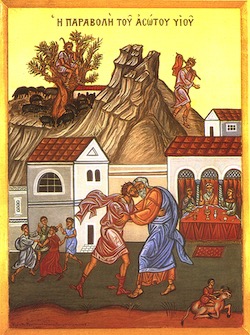
SUNDAY OF THE PRODIGAL SON — Tone 2. Afterfeast of the Meeting. Greatmartyr Theodore Stratelates (“the General”—319). Prophet Zachariah (ca. 520 B.C.). St. Sava II, Archbishop of Serbia (1269).
Tone 2 Troparion (Resurrection)
When You descended to death, O Life Immortal, You slew hell with the splendor of Your Godhead. And when from the depths You raised the dead, all the powers of heaven cried out:// “O Giver of life, Christ our God, glory to You!”
Tone 1 Troparion (Feast)
Rejoice, O Virgin Theotokos, Full of Grace! From you shone the Sun of Righteousness, Christ our God, enlightening those who sat in darkness. Rejoice and be glad, O righteous Elder, you accepted in your arms the Redeemer of our souls,// Who grants us the Resurrection!
Tone 3 Kontakion (from the Lenten Triodion)
I have recklessly forgotten Your glory, O Father; and among sinners I have scattered the riches which You had given me. Therefore I cry to You like the Prodigal: “I have sinned before You, O compassionate Father; // receive me a penitent, and make me as one of Your hired servants!”
Tone 1 Kontakion (Feast)
By Your Nativity You sanctified the Virgin’s womb and blessed Simeon’s hands, O Christ God. Now You have come and saved us through love. Grant peace to all Orthodox Christians,// O only Lover of Man!
Tone 2 Prokeimenon (Resurrection)
The Lord is my strength and my song; / He has become my salvation. (Ps. 117:14)
V. The Lord has chastened me sorely, but He has not given me over to death. (Ps. 117:18)
Tone 3 Prokeimenon (Song of the Theotokos)
My soul magnifies the Lord, / and my spirit rejoices in God my Savior. (Lk. 1:46-47)
1 Corinthians 6:12-20 (Epistle)
All things are lawful for me, but all things are not helpful. All things are lawful for me, but I will not be brought under the power of any. Foods for the stomach and the stomach for foods, but God will destroy both it and them. Now the body is not for sexual immorality but for the Lord, and the Lord for the body. And God both raised up the Lord and will also raise us up by His power. Do you not know that your bodies are members of Christ? Shall I then take the members of Christ and make them members of a harlot? Certainly not! Or do you not know that he who is joined to a harlot is one body with her? For “the two,” He says, “shall become one flesh.” But he who is joined to the Lord is one spirit with Him. Flee sexual immorality. Every sin that a man does is outside the body, but he who commits sexual immorality sins against his own body. Or do you not know that your body is the temple of the Holy Spirit who is in you, whom you have from God, and you are not your own? For you were bought at a price; therefore glorify God in your body and in your spirit, which are God’s.
Tone 2
Alleluia, Alleluia, Alleluia!
V. May the Lord hear you in the day of trouble! May the name of the God of Jacob protect you! (Ps. 19:1)
V. Save the King, O Lord, and hear us on the day we call! (Ps. 19:9)
Tone 8
V. Lord, now let Your servant depart in peace, according to Your word, for my eyes have seen Your salvation! (Luke 2:29)
Luke 15:11-32 (Gospel)
Then He said: “A certain man had two sons. And the younger of them said to his father, ‘Father, give me the portion of goods that falls to me.’ So he divided to them his livelihood. And not many days after, the younger son gathered all together, journeyed to a far country, and there wasted his possessions with prodigal living. But when he had spent all, there arose a severe famine in that land, and he began to be in want. Then he went and joined himself to a citizen of that country, and he sent him into his fields to feed swine. And he would gladly have filled his stomach with the pods that the swine ate, and no one gave him anything. But when he came to himself, he said, ‘How many of my father’s hired servants have bread enough and to spare, and I perish with hunger! I will arise and go to my father, and will say to him, “Father, I have sinned against heaven and before you, and I am no longer worthy to be called your son. Make me like one of your hired servants.”’ And he arose and came to his father. But when he was still a great way off, his father saw him and had compassion, and ran and fell on his neck and kissed him. And the son said to him, ‘Father, I have sinned against heaven and in your sight, and am no longer worthy to be called your son.’ But the father said to his servants, ‘Bring out the best robe and put it on him, and put a ring on his hand and sandals on his feet. And bring the fatted calf here and kill it, and let us eat and be merry; for this my son was dead and is alive again; he was lost and is found.’ And they began to be merry. Now his older son was in the field. And as he came and drew near to the house, he heard music and dancing. So he called one of the servants and asked what these things meant. And he said to him, ‘Your brother has come, and because he has received him safe and sound, your father has killed the fatted calf.’ But he was angry and would not go in. Therefore his father came out and pleaded with him. So he answered and said to his father, ‘Lo, these many years I have been serving you; I never transgressed your commandment at any time; and yet you never gave me a young goat, that I might make merry with my friends. But as soon as this son of yours came, who has devoured your livelihood with harlots, you killed the fatted calf for him.’ And he said to him, ‘Son, you are always with me, and all that I have is yours. It was right that we should make merry and be glad, for your brother was dead and is alive again, and was lost and is found.’”
Sunday of the Prodigal Son
The Sunday after the Sunday of the Publican and the Pharisee is the Sunday of the Prodigal Son. This parable of God’s forgiveness calls us to “come to ourselves” as did the prodigal son, to see ourselves as being “in a far country” far from the Father’s house, and to make the journey of return to God. We are given every assurance by the Master that our heavenly Father will receive us with joy and gladness. We must only “arise and go,” confessing our self-inflicted and sinful separation from that “home” where we truly belong (Luke 15:11-24).
After the Polyeleion at Matins, we first hear the lenten hymn “By the Waters of Babylon.” It will be sung for the next two Sundays before Lent begins, and it serves to reinforce the theme of exile in today’s Gospel.
Starting tomorrow, the weekday readings summarize the events of Holy Week. On Monday we read Saint Mark’s account of the Entry into Jerusalem. On Tuesday we read how Judas went to the chief priests and offered to betray the Lord. On the night before His death Christ tells His disciples that one of them will betray Him. He also predicts that they will desert Him, and that Peter will deny Him three times. On Wednesday the Gospel describes how Judas betrayed the Savior with a kiss. Thursday’s Gospel tells how Jesus was questioned by Pilate. On Friday we read the narrative of Christ’s crucifixion and death.
Greatmartyr Theodore Stratelates “the General”
The Great Martyr Theodore Stratelates came from the city of Euchaita in Asia Minor. He was endowed with many talents, and was handsome in appearance. For his charity God enlightened him with the knowledge of Christian truth. The bravery of the saintly soldier was revealed after he, with the help of God, killed a giant serpent living on a precipice in the outskirts of Euchaita. The serpent had devoured many people and animals, terrorizing the countryside. Saint Theodore armed himself with a sword and vanquished it, glorifying the name of Christ among the people.
For his bravery Saint Theodore was appointed military commander [stratelatos] in the city of Heraclea, where he combined his military service with preaching the Gospel among the pagans subject to him. His gift of persuasion, reinforced by his personal example of Christian life, turned many from their false gods. Soon, nearly all of Heraclea had accepted Christianity.
During this time the emperor Licinius (311-324) began a fierce persecution against Christians. In an effort to stamp out the new faith, he persecuted the enlightened adherents of Christianity, who were perceived as a threat to paganism. Among these was Saint Theodore. Licinius tried to force Saint Theodore to offer sacrifice to the pagan gods. The saint invited Licinius to come to him with his idols so both of them could offer sacrifice before the people.
Blinded by his hatred for Christianity, Licinius trusted the words of the saint, but he was disappointed. Saint Theodore smashed the gold and silver statues into pieces, which he then distributed to the poor. Thus he demonstrated the vain faith in soulless idols, and also displayed Christian charity.
Saint Theodore was arrested and subjected to fierce and refined torture. He was dragged on the ground, beaten with iron rods, had his body pierced with sharp spikes, was burned with fire, and his eyes were plucked out. Finally, he was crucified. Varus, the servant of Saint Theodore, barely had the strength to write down the incredible torments of his master.
God, however, in His great mercy, willed that the death of Saint Theodore should be as fruitful for those near him as his life was. An angel healed the saint’s wounded body and took him down from the cross. In the morning, the imperial soldiers found him alive and unharmed. Seeing with their own eyes the infinite might of the Christian God, they were baptized not far from the place of the unsuccessful execution.
Thus Saint Theodore became “like a day of splendor” for those pagans dwelling in the darkness of idolatary, and he enlightened their souls “with the bright rays of his suffering.” Unwilling to escape martyrdom for Christ, Saint Theodore voluntarily surrendered himself to Licinius, and discouraged the Christians from rising up against the torturer, saying, “Beloved, halt! My Lord Jesus Christ, hanging upon the Cross, restrained the angels and did not permit them to take revenge on the race of man.”
Going to execution, the holy martyr opened up the prison doors with just a word and freed the prisoners from their bonds. People who touched his robe were healed instantly from sicknesses, and freed from demonic possession. By order of the emperor, Saint Theodore was beheaded by the sword. Before his death he told Varus, “ Do not fail to record the day of my death, and bury my body in Euchaita.” He also asked to be remembered each year on this date. Then he bent his neck beneath the sword, and received the crown of martyrdom which he had sought. This occurred on February 8, 319, on a Saturday, at the third hour of the day.
Saint Theodore is regarded as the patron saint of soldiers. He is also commemorated on June 8.
Let Every Breath Praise the Lord
Humility opens the door leading into God’s innermost chamber. As we pray with and utter the name of God externally, we are also in need of humility to steer us correctly and guide us unerringly, so that the Prayer becomes fruitful. The name of Christ itself will grant us humility; that is, the notion that we are sinful, guilty, full of passions and wounds, criminals with defiled souls. I am blind; therefore, I cry out to and beseech my Christ to grant me sight, to enlighten my eyes, to heal my wounds, to clear my criminal record, to restore my health—because I am sick—to cleanse me, and to render me fragrant. This is the reason I call upon the name of Christ—not because I’m something special. If I have achieved something good, how did I acquire it?
According to the Apostle Paul, “What do you have which you did not receive? Now if you did indeed receive it, why do you boast as if you had not received it?” (1 Cor. 4:7). If we have received everything from God, including our very existence, then we are nothing: we are a zero, and a non-entity. God the Creator brought us humans into existence with great ease; consequently, whatever we possess belongs to Him.
— Ephraim, Elder. The Art of Salvation
 Sunday Bulletin February 1, 2026