
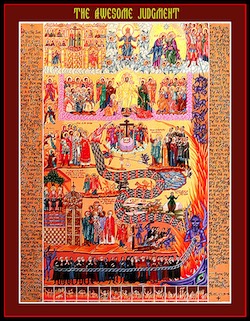
SUNDAY OF MEATFARE — Tone 3. Sunday of the Last Judgment. Apostle of the Seventy Onesimus (ca. 109).
Tone 3 Troparion (Resurrection)
Let the heavens rejoice! Let the earth be glad! For the Lord has shown strength with His arm. He has trampled down death by death. He has become the first born of the dead. He has delivered us from the depths of hell, and has granted to the world// great mercy.
Tone 4 Troparion (Feast)
The truth of your deeds has revealed you to your flock as a rule of faith, an image of meekness and a teacher of self-control; your humility exalted you; your poverty enriched you.// O Father Bishop Nicholas, pray to Christ God that our souls may be saved.
Tone 3 Kontakion (St. Nicholas)
You proved yourself to be be a holy priest, O Nicholas. You served God in Myra and lived the gospel of Christ. You offered your life for your people, And rescued the innocent from death. Therefore God has glorified you as a trustworthy guide of things divine.
Tone 1 Kontakion (from the Lenten Triodion)
When You, O God, shall come to earth with glory, all things shall tremble, and the river of fire shall flow before Your judgment seat; the books shall be opened, and the hidden things disclosed; then deliver me from the unquenchable fire,// and make me worthy to stand at Your right hand, O Righteous Judge!
Tone 3 Prokeimenon (from the Lenten Triodion)
Great is our Lord, and abundant in power, / His understanding is beyond measure. (Ps. 146:5)
V. Praise the Lord! For it is good to sing praises to our God! (Ps.146:1)
1 Corinthians 8:8-9:2 (Epistle)
But food does not commend us to God; for neither if we eat are we the better, nor if we do not eat are we the worse. But beware lest somehow this liberty of yours become a stumbling block to those who are weak. For if anyone sees you who have knowledge eating in an idol’s temple, will not the conscience of him who is weak be emboldened to eat those things offered to idols? And because of your knowledge shall the weak brother perish, for whom Christ died? But when you thus sin against the brethren, and wound their weak conscience, you sin against Christ. Therefore, if food makes my brother stumble, I will never again eat meat, lest I make my brother stumble. Am I not an apostle? Am I not free? Have I not seen Jesus Christ our Lord? Are you not my work in the Lord? If I am not an apostle to others, yet doubtless I am to you. For you are the seal of my apostleship in the Lord.
Tone 8
Alleluia, Alleluia, Alleluia!
V. Come, let us rejoice in the Lord! Let us make a joyful noise to God our Savior! (Ps. 94:1)
V. Let us come before His presence with thanksgiving; let us make a joyful noise to Him with songs of praise. (Ps. 94:2)
Matthew 25:31-46 (Gospel)
When the Son of Man comes in His glory, and all the holy angels with Him, then He will sit on the throne of His glory. All the nations will be gathered before Him, and He will separate them one from another, as a shepherd divides his sheep from the goats. And He will set the sheep on His right hand, but the goats on the left. Then the King will say to those on His right hand, ‘Come, you blessed of My Father, inherit the kingdom prepared for you from the foundation of the world: for I was hungry and you gave Me food; I was thirsty and you gave Me drink; I was a stranger and you took Me in; I was naked and you clothed Me; I was sick and you visited Me; I was in prison and you came to Me.’ Then the righteous will answer Him, saying, ‘Lord, when did we see You hungry and feed You, or thirsty and give You drink? When did we see You a stranger and take You in, or naked and clothe You? Or when did we see You sick, or in prison, and come to You?’ And the King will answer and say to them, ‘Assuredly, I say to you, inasmuch as you did it to one of the least of these My brethren, you did it to Me.’ Then He will also say to those on the left hand, ‘Depart from Me, you cursed, into the everlasting fire prepared for the devil and his angels: for I was hungry and you gave Me no food; I was thirsty and you gave Me no drink; I was a stranger and you did not take Me in, naked and you did not clothe Me, sick and in prison and you did not visit Me.’ Then they also will answer Him, saying, ‘Lord, when did we see You hungry or thirsty or a stranger or naked or sick or in prison, and did not minister to You?’ Then He will answer them, saying, ‘Assuredly, I say to you, inasmuch as you did not do it to one of the least of these, you did not do it to Me.’ And these will go away into everlasting punishment, but the righteous into eternal life.”
Sunday of Meatfare of the Last Judgment
Today’s Gospel reading is Matthew 25:31-46, the parable of the Last Judgment. It reminds us that while trusting in Christ’s love and mercy, we must not forget His righteous judgment when He comes again in glory. If our hearts remain hardened and unrepentant, we should not expect the Lord to overlook our transgressions simply because He is a good and loving God. Although He does not desire the death of a sinner, He also expects us to turn from our wickedness and live (Ezek. 33:11). This same idea is expressed in the prayer read by the priest after the penitent has confessed his or her sins (Slavic practice).
The time for repentance and forgiveness is now, in the present life. At the Second Coming, Christ will appear as the righteous Judge, “Who will render to every man according to his deeds” (Rom. 2:6). Then the time for entreating God’s mercy and forgiveness will have passed.
As Father Alexander Schmemann reminds us in his book GREAT LENT (Ch. 1:4), sin is the absence of love, it is separation and isolation. When Christ comes to judge the world, His criterion for judgment will be love. Christian love entails seeing Christ in other people, our family, our friends, and everyone else we may encounter in our lives. We shall be judged on whether we have loved, or not loved, our neighbor. We show Christian love when we feed the hungry, give drink to the thirsty, clothe the naked, visit those who are sick or in prison. If we did such things for the least of Christ’s brethren, then we also did them for Christ (Mt.25:40). If we did not do such things for the least of the brethren, neither did we do them for Christ (Mt.25:45).
Today is the last day for eating meat and meat products until Pascha, though eggs and dairy products are permitted every day during the coming week. This limited fasting prepares us gradually for the more intense fasting of Great Lent.
Saint Anthimus of Chios
Saint Anthimos (Argyrios K. Bagianos) was born on July 1, 1869 in the vicinity of Saint Luke at Livadion, Chios. His righteous and virtuous parents, Constantine and Argyro, took care to give their child a Christian education. The young Argyrios was endowed by the Holy Spirit with the spirit of wisdom; he was foreordained by God to shine forth as a chosen vessel and to become a great guide who would lead others to Christ. His entire childhood development and upbringing was apparently due to the strong and profound influence of his Christian family environment.
On Sundays Argyrios and his family attended services at the Monastery of Nea Moni.1 When he was eight years old he met Saint Nektarios, who was a Deacon at the time. After conversing with young Argyrios, he said to Igumen Pachomios, “Elder, do you see that child? Someday he will become a Saint.”
Argyrios had little formal education, and was limited to simple elementary school knowledge. So with no theoretical knowledge of worldly acclaim, but with a good disposition, spiritual discernment, and with a particularly intense desire for the spiritual life, he advanced unwaveringly in the virtuous life with the precious gift of unshakable faith.
Divine love led him to renounce the world and its noisy turmoil, and to enter the monastic state where his virtues shone forth. The starting point for him to follow the path of monasticism was his visit to the Skete of the Holy Fathers of Chios for the restoration of his own wonderworking icon of the All Holy Virgin the Helper (Παναγία Βοηθεία), which he had received from his mother. Since that time, this icon remained an integral part of his entire life. The Theotokos became a source of inexhaustible strength for him in his later difficult struggles, and she was also a fount of refreshment and respite.
His guide in the ascetical life was the venerable Elder Pachomios of Sketis, by whom he was tonsured into the small Schema, and who renamed him Anthimos.
He submitted to Elder Pachomios and through unceasing prayer and fasting, and by the harsh struggles which he undertook with God’s good will, he grew great in asceticism and in virtue. His physical and spiritual struggles left him exhausted and ill. So, with the blessing of Father Pachomios, he returned to his home in order to recuperate. Saint Anthimos, however, did not abandon his struggles. Once his health was partially restored he retired to a small isolated cell on his father’s estates in Livadia, Chios, and continued his spiritual contests. At the same time he worked as a shoemaker in order to help his poor parents, and to show mercy to those who were afflicted.
In his cell, by unceasing prayer, and by studying the lives of the great ascetics, he was strengthened and he made progress in his spiritual formation, but he also provoked the demonic rage of the Evil One. He struggled severely and effectively, conducting multifaceted and victorious contests against the Evil One with ardent prayer, and each day he ascended the blessed Ladder of virtues and holiness. In 1909, at the age of forty, he was tonsured into the Great Schema by Hieromonk Andronikos, the successor of Father Pachomios.
The virtuous ascetic Anthimos was a chosen vessel and was ready for the office of the priesthood, but the local bishop refused to ordain him because of his lack of education. In 1910, he was invited to Adramyttium in Asia Minor by his godfather, Stephen Diomataris, for this purpose. The saint’s ordination by the Bishop of Smyrna was not a typical event.
In his case, there were signs of divine approval following the ordination. Earthquake, lightning, thunder, and a cataclysmic rainfall occurred at that sacred hour. The vigil lamps swayed, and one of them fell down. After the ordination there was calm, stillness, and joy from God. These physical phenomena revealed and bore witness to the fact that God was pleased by his ordination.
As long as he remained in Adramyttium, he shone forth in a dazzling way because of his virtue and holiness, by which he healed those in the region who were possessed by demons, something his fellow priests were unable to do. His spiritual radiance stirred up the passion of jealousy in his concelebrants. Wishing to free them from this passion, the Saint left Adramyttium in 1911 and went to Mount Athos, where the Hagiorite monks freely bestowed many honors upon him.
Returning to Chios, he was assigned as the priest for the home for lepers, which became a new setting for his virtues and charitable activities. The icon of the Panagia Ypapanti (the Meeting of the Lord), the protectress of the hospital for lepers, focuses on all her acts of kindness.
The Lady Theotokos, through the prayers of Saint Anthimos, performed countless miracles of healing the infirmities of the faithful, both those whose names are known and those who remain anonymous. This institution for unfortunate lepers became a spiritual center of physical and mental health. His entire ministry at the home for lepers shows his deepest faith and his very valuable contributions.
Here the greatness of the Saint is revealed. As the priest of that church, Saint Anthimos was always found with the lepers: he ate with them, he talked to them, and he communed them with the Spotless Mysteries. After the Divine Liturgy he rested.
In that hallowed atmosphere, he envisioned the establishment of a Monastery to shelter nuns who had fled there from Asia Minor following the exchange of populations (1922-1924).2 So his dreams moved forward toward their fulfillment. In 1927, after he had a vision of the Theotokos, he received permission to build such a monastery. He also built the magnificent temple dedicated the icon of the Mother of God the Helper (Παναγία Βοηθεία) in 1930. From that time he settled in the Monastery filled with devotion to the Most Holy Theotokos, and there he advanced in his life of asceticism, filled with a multitude of virtues and holiness through the intercession and help of the Theotokos, and he shepherded his flock with great affection and love, strengthening and consoling them with his sweet and simple speech, healing the sicknesses and afflictions of those who had recourse to him.
After his life-long ministry, now at the age of 90, fully ripe and full of days, with a dignity which was reminiscent of the great ascetics of the desert, he celebrated his last Divine Liturgy on January 27, 1960. A few days later he reposed in peace.
Saint Anthimos was glorified by the Church of Constantinople on August 13, 1992.
1 The monastery was dedicated to Saints Nikḗtas, John, and Joseph.
2 At that time many Greeks in Asia Minor were sent to Greece, and many Turks in Greece went to Turkey.
Judgment of Love
Man was created with a great purpose to become a partaker of the endless life of his God and Creator. Precisely before speaking about His Second Coming, the Lord gives the Parable of the Talents, in order to remind man that all the things he thinks he has are the gifts of God, talents on loan, for which he will be accountable. He has received even his temporary life on loan from the Lord, Who expects it back, not mutilated, not even unimproved, but illumined and adorned. ‘The hands of the Lord have made man and fashioned him;’ they endowed him with wondrous gifts. By God’s mercy, he received a great capital of goodness, but he will have to give account for it, because he is not a horse without a master, abandoned in a fenceless field.
— Archimandrite Zacharias Zacharou. At the Doors of Holy Lent
 Sunday Bulletin February 8, 2026