
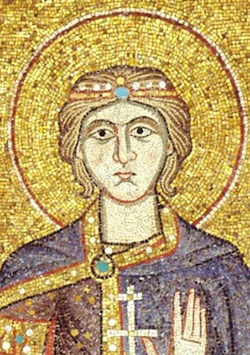
3rd SUNDAY AFTER PENTECOST — Tone 2. Martyr Julian of Tarsus in Cilicia (3rd-4th c.).
Tone 2 Troparion (Resurrection)
When You descended to death, O Life Immortal, You slew hell with the splendor of Your Godhead. And when from the depths You raised the dead, all the powers of heaven cried out:// “O Giver of life, Christ our God, glory to You!”
Tone 4 Troparion (St. Nicholas)
The truth of your deeds has revealed you to your flock as a rule of faith, an image of meekness and a teacher of self-control; your humility exalted you; your poverty enriched you.// O Father Bishop Nicholas, pray to Christ God that our souls may be saved.
Tone 4 Troparion (St. Julian)
Your holy martyr Julian, O Lord, through his sufferings has received an incorruptible crown from You, our God. For having Your strength, he laid low his adversaries, and shattered the powerless boldness of demons.// Through his intercession, save our souls!
Tone 2 Kontakion (Resurrection)
Hell became afraid, O almighty Savior, seeing the miracle of Your Resurrection from the tomb! The dead arose! Creation, with Adam, beheld this and rejoiced with You,// and the world, my Savior, praises You forever.
Tone 3 Kontakion (St. Nicholas)
You proved yourself to be be a holy priest, O Nicholas. You served God in Myra and lived the gospel of Christ. You offered your life for your people, And rescued the innocent from death. Therefore God has glorified you as a trustworthy guide of things divine.
Tone 2 Kontakion (St. Julian)
Let us all worthily praise Julian today, the unconquerable pious warrior and seeker of truth; To him let us cry out:// “Pray to Christ God for us all!”
Tone 6 Kontakion (Steadfast Protectress)
Steadfast Protectress of Christians, Constant Advocate before the Creator; despise not the cry of us sinners, but in your goodness come speedily to help us who call on you in faith. Hasten to hear our petition and to intercede for us, O Theotokos, for you always protect those who honor you!
Tone 2 Prokeimenon (Resurrection)
The Lord is my strength and my song; / He has become my salvation. (Ps. 117:14)
V. The Lord has chastened me sorely, but He has not given me over to death. (Ps. 117:18)
Romans 5:1-10 (Epistle)
Therefore, having been justified by faith, we have peace with God through our Lord Jesus Christ, through whom also we have access by faith into this grace in which we stand, and rejoice in hope of the glory of God. And not only that, but we also glory in tribulations, knowing that tribulation produces perseverance; and perseverance, character; and character, hope. Now hope does not disappoint, because the love of God has been poured out in our hearts by the Holy Spirit who was given to us. For when we were still without strength, in due time Christ died for the ungodly. For scarcely for a righteous man will one die; yet perhaps for a good man someone would even dare to die. But God demonstrates His own love toward us, in that while we were still sinners, Christ died for us. Much more then, having now been justified by His blood, we shall be saved from wrath through Him. For if when we were enemies we were reconciled to God through the death of His Son, much more, having been reconciled, we shall be saved by His life.
Tone 2
Alleluia, Alleluia, Alleluia!
V. May the Lord hear you in the day of trouble! May the name of the God of Jacob protect you! (Ps. 19:1)
V. Save the King, O Lord, and hear us on the day we call! (Ps. 19:9)
Matthew 6:22-33 (Gospel)
The lamp of the body is the eye. If therefore your eye is good, your whole body will be full of light. But if your eye is bad, your whole body will be full of darkness. If therefore the light that is in you is darkness, how great is that darkness! No one can serve two masters; for either he will hate the one and love the other, or else he will be loyal to the one and despise the other. You cannot serve God and mammon. Therefore I say to you, do not worry about your life, what you will eat or what you will drink; nor about your body, what you will put on. Is not life more than food and the body more than clothing? Look at the birds of the air, for they neither sow nor reap nor gather into barns; yet your heavenly Father feeds them. Are you not of more value than they? Which of you by worrying can add one cubit to his stature? So why do you worry about clothing? Consider the lilies of the field, how they grow: they neither toil nor spin; and yet I say to you that even Solomon in all his glory was not arrayed like one of these. Now if God so clothes the grass of the field, which today is, and tomorrow is thrown into the oven, will He not much more clothe you, O you of little faith? Therefore do not worry, saying, ‘What shall we eat?’ or ‘What shall we drink?’ or ‘What shall we wear?’ For after all these things the Gentiles seek. For your heavenly Father knows that you need all these things. But seek first the kingdom of God and His righteousness, and all these things shall be added to you.
Martyr Julian of Tarsus, in Cilicia
The Holy Martyr Julian of Tarsus was born at Diocesarea in the province of Cilicia. He was the son of a pagan senator, but his mother was a Christian. After the death of her husband, she and Julian moved to Tarsus, where her son was baptized and raised in Christian piety. When Julian reached the age of eighteen, Emperor Diocletian (284-305) began to persecute Christians, issuing a decree that everyone had to offer sacrifice to the idols. If they refused, they would be tortured. Among those arrested was Saint Julian. They brought him before the eparch Marcian to be tried, and for a long time they urged him to renounce Christ. Neither tortures nor threats, nor promises of gifts or honors could convince the devout young man to sacrifice to the idols and deny Christ, and so the holy confessor remained steadfast in his faith.
For a whole year they led the martyr through the cities of Cilicia, everywhere subjecting him to interrogation and torture, after which they threw him in prison. Saint Julian’s mother followed her son and prayed that the Lord would strengthen him. In the city of Aegea, she besought the eparch to let her to visit the prison, ostensibly to persuade her son to offer sacrifice to the idols. When she saw him, she did just the opposite. She spent three days in prison with Saint Julian, exhorting him to remain strong until the end.
Once again, Saint Julian was brought before the eparch. Thinking that his mother had persuaded her son to obey the imperial decree, Marcian tried to convince her to offer sacrifice, but she continued to confess Jesus Christ, and boldly denounced polytheism. Marcian then ordered that her feet be cut off, since she had followed her son from Tarsus.
Then Saint Julian was placed into a sack filled with sand and poisonous snakes, and it was thrown into the sea. The Martyr’s body was carried by the waves to the shores of Alexandria. There his body was buried by a certain pious Christian. Saint Julian’s death occurred around the year 305. Afterward, his relics were transferred to Antioch.
Saint John Chrysostom honored the holy Martyr Julian with an encomium, and fragments of the Saint’s relics are found in the Monasteries of Pantokrator and Saint Panteleimon on Mount Athos.
We pray to Saint Julian to protect gardens and fields from creeping things, snakes, and harmful insects.
REFLECTION from the Prologue
When a man begins to train himself in keeping silent, silence seems to him to be lesser than speech; but when he is trained in silence, then he knows that speech is lesser than silence.
A monk said to St. Sisoes: “I would like to preserve my heart but I cannot.”
The elder responded: “How can we preserve the heart when the gate to our heart—the tongue—stands open?”
Charillos, the nephew of Lycurgus, was once asked why his uncle issued so few laws. He replied: “For those who speak little, many laws are not needed.”
— Velimirovic, Saint Nikolai. The Prologue of Ohrid
On sowing and reaping
He who sows iniquity reaps misfortune (Proverbs 22:8).
If you commit iniquity, misfortune may pass you by on the very day you commit the iniquity, but misfortune has heard the voice of iniquity and will unavoidably come in its own time. Some sowing is sweet, but the harvest is bitter. Some sowing resembles life, but the fruit and harvest of that sowing is death.
Pay heed and learn from Holy Scripture: Eve sowed iniquity through disobedience, and pain in childbirth befell her.
Cain sowed iniquity through fratricide, and pain and sleepless wandering throughout the earth befell him. Sodom and Gomorrah sowed iniquity, and reaped the pain of a horrible death.
The sons of Eli the High Priest sowed iniquity, for they defiled themselves near the Ark of the Covenant, and they reaped suffering, for they bitterly lost their lives in battle.
Call to mind Saul, his iniquity and his sufferings.
And again, call to mind Ahab and Jezebel. And again, call to mind Herod and Judas.
And again, call to mind today and yesterday and the day before yesterday and every other day gone by, and listen to the words of every day: He who sows iniquity reaps misfortune! Is there a village in the world that does not have this teaching before its eyes? Is there a roof that does not conceal beneath it such knowledge? Is there any man living who has not witnessed this teaching in the living examples around him? O All-wise Lord, if we did not know Thy will we would be less responsible. But since Thou gavest us to know Thy will, O All-merciful One, grant us the strength to fulfill it throughout all the days of our lives. To Thee be glory and praise forever. Amen.
— Velimirovic, Saint Nikolai. The Prologue of Ohrid
St. John Chrysostom: “Children, obey your parents in the Lord, for this is right. ‘Honor your father and your mother that it may be well with you and that you may live long on the earth.’” Eph. 6: 1-3. Concern for spiritual things will unite the family. Do you want your child to be obedient? Then from the beginning bring him up in the discipline and instruction of the Lord. Don’t think that it isn’t necessary for a child to listen to the scriptures; the first thing he will hear from them will be, “Honor your father and your mother,” and immediately you will begin to reap your reward. Don’t say, “Bible-reading is for monks; am I turning my child into a monk?” No! It isn’t necessary for him to be a monk. Make him into a Christian!
”Why are you afraid of something so good? It is necessary for everyone to know Scriptural teachings, and this is especially true for children. Even at their age they are exposed to all sorts of folly and bad examples from popular entertainments. Our children need remedies for all these things! We are so concerned with our children’s schooling; if only we were equally zealous in bringing them up in the discipline and instruction of the Lord! …Don’t sharpen his tongue, but purify his soul. I don’t mean that worldly learning is worthless and to be ignored, but it should not be an exclusive preoccupation. Don’t think that only monks need to learn the Bible; children about to go out into the world stand in greater need of Scriptural knowledge. A man who never travels by sea doesn’t need to know how to equip a ship, or where to find a pilot or a crew, but a sailor has to know all these things. The same applies to the monk and the man of this world. The monk lives an untroubled life in a calm harbor, removed from every storm, while the worldly man is always sailing the ocean, battling innumerable tempests.
”…Therefore, let us be greatly concerned for our wives and our children, and for ourselves as well, and as we educate both ourselves and them let us beg God to help us in our task. If He sees that we care about this, He will help us; but if we are unconcerned, He will not give us His hand. God helps those who work, not those who are idle. No one helps an inactive person, but one who joins in the labor.”
— From On Marriage and Family Life
 Sunday Bulletin June 14, 2026