
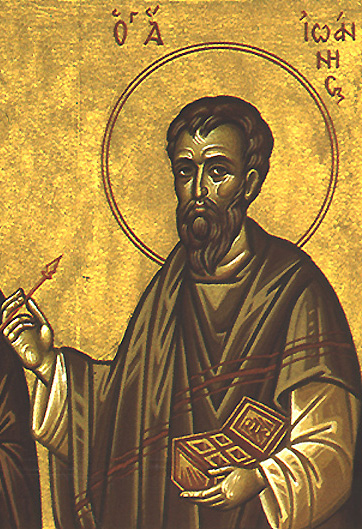
4th SUNDAY AFTER PENTECOST — Tone 3. Translation of the Relics of the holy and wonderworking Unmercenaries Cyrus and John (412).
Tone 3 Troparion (Resurrection)
Let the heavens rejoice! Let the earth be glad! For the Lord has shown strength with His arm. He has trampled down death by death. He has become the first born of the dead. He has delivered us from the depths of hell, and has granted to the world// great mercy.
Tone 4 Troparion (St. Nicholas)
The truth of your deeds has revealed you to your flock as a rule of faith, an image of meekness and a teacher of self-control; your humility exalted you; your poverty enriched you.// O Father Bishop Nicholas, pray to Christ God that our souls may be saved.
Tone 4 Troparion (Sts. Cyrus and John)
O Christ God, You have given given us the miracles of Your martyrs Cyrus and John, as an invincible rampart; through their prayers frustrate the plans of the heathens, and strengthen the faith of the Orthodox Christians, // for You alone are good and love mankind.
Tone 3 Kontakion (Resurrection)
On this day You rose from the tomb, O Merciful One, leading us from the gates of death. On this day Adam exults as Eve rejoices; with the Prophets and Patriarchs// they unceasingly praise the divine majesty of Your power.
Tone 3 Kontakion (St. Nicholas)
You proved yourself to be be a holy priest, O Nicholas. You served God in Myra and lived the gospel of Christ. You offered your life for your people, And rescued the innocent from death. Therefore God has glorified you as a trustworthy guide of things divine.
Tone 2 Kontakion (Sts. Cyrus and John)
Having received the gift of miracles through divine grace, O saints, you work wonders in the world unceasingly. You remove all of our passions through your invisible surgery, divinely-wise Cyrus and glorious John,// for you are truly divine physicians.
Tone 6 Kontakion (Steadfast Protectress)
Steadfast Protectress of Christians, Constant Advocate before the Creator; despise not the cry of us sinners, but in your goodness come speedily to help us who call on you in faith. Hasten to hear our petition and to intercede for us, O Theotokos, for you always protect those who honor you!
Tone 3 Prokeimenon (Resurrection)
Sing praises to our God, sing praises! / Sing praises to our King, sing praises! (Ps. 46:6)
V. Clap your hands, all peoples! Shout to God with loud songs of joy! (Ps. 46:1)
Romans 6:18-23 (Epistle)
And having been set free from sin, you became slaves of righteousness. I speak in human terms because of the weakness of your flesh. For just as you presented your members as slaves of uncleanness, and of lawlessness leading to more lawlessness, so now present your members as slaves of righteousness for holiness. For when you were slaves of sin, you were free in regard to righteousness. What fruit did you have then in the things of which you are now ashamed? For the end of those things is death. But now having been set free from sin, and having become slaves of God, you have your fruit to holiness, and the end, everlasting life. For the wages of sin is death, but the gift of God is eternal life in Christ Jesus our Lord.
Tone 2
Alleluia, Alleluia, Alleluia!
V. In You, O Lord, have I hoped; let me never be put to shame! (Ps. 30:1a)
V. Be a God of protection for me, a house of refuge in order to save me! (Ps. 30:2b)
Matthew 8:5-13 (Gospel)
Now when Jesus had entered Capernaum, a centurion came to Him, pleading with Him, saying, “Lord, my servant is lying at home paralyzed, dreadfully tormented.” And Jesus said to him, “I will come and heal him.” The centurion answered and said, “Lord, I am not worthy that You should come under my roof. But only speak a word, and my servant will be healed. For I also am a man under authority, having soldiers under me. And I say to this one, ‘Go,’ and he goes; and to another, ‘Come,’ and he comes; and to my servant, ‘Do this,’ and he does it.” When Jesus heard it, He marveled, and said to those who followed, “Assuredly, I say to you, I have not found such great faith, not even in Israel! And I say to you that many will come from east and west, and sit down with Abraham, Isaac, and Jacob in the kingdom of heaven. But the sons of the kingdom will be cast out into outer darkness. There will be weeping and gnashing of teeth.” Then Jesus said to the centurion, “Go your way; and as you have believed, so let it be done for you.” And his servant was healed that same hour.
Hours, Compline and Nocturne
In addition to the liturgical services of Vespers and Matins, there are also the services of the Hours, Compline, and Nocturne. These services are chanted in monasteries but are seldom used in parish churches except perhaps during Lent and Holy Week, and on special feast days.
The services of Hours are called the First, Third, Sixth and Ninth. These “hours” conform generally to the hours of six and nine in the morning, noon, and three in the afternoon. The services consist mostly of psalms which are generally related to the events in the passion of Christ which took place at that particular hour of the day. The Third Hour also refers to the coming of the Holy Spirit to the disciples on Pentecost.
The troparia of the given day or of the feast being celebrated are added to the Hours. During the first days of Holy Week as well as on certain major feasts, the Gospel is also read during the Hours. On days when there is no Divine Liturgy, the so-called Typical Psalms which include elements of the Divine Liturgy such as the liturgical psalms, the Beatitudes, and the Creed are read after the Ninth Hour.
Compline is called the “after-dinner” service of the Church. Its name, both in Greek and Slavonic, indicates this. It is a service of psalms and prayers to be read following the evening meal; after Vespers has been served. On days when Vespers is connected to the Divine Liturgy, such as the eves of Christmas and Epiphany, Great Compline is added to Matins to form a Vigil service. During the first week of Great Lent, the Penitential Canon of Saint Andrew of Crete is read at the Compline Service.
Nocturne is the midnight service of the Church. In monasteries it usually begins the all-night vigil of the monks. It contains a number of psalms together with the normal prayers found in other services, such as the call to worship, the Thrice-Holy, the Our Father, the Troparion, etc. Its theme is obviously the night and the need for vigilance. In the parishes, it is known almost exclusively as the service preceding Easter Matins at which the winding-sheet depicting the dead Saviour is taken from the tomb and is placed on the altar table.
Translation of the Relics of the holy and wonderworking Unmercenaries Cyrus and John
The Transfer of the Relics of the Holy Martyrs, Unmercenaries and Wonderworkers, Cyrus and John from the city of Konopa, near Alexandria (where they suffered in the year 311) to the nearby village of Manuphin, took place in the year 412. This Egyptian village prompted fear in everyone, since in a former time there was a pagan temple inhabited by evil spirits. Patriarch Theophilus (385-412) wanted to cleanse this place of demons, but he died. His wish was fulfilled by his successor in the See of Alexandria, the holy Patriarch Cyril (412-444). He prayed fervently in carrying out this project. An angel of the Lord appeared in a vision to the hierarch and commanded the venerable relics of Saints Cyrus and John be transferred to Manuphin. His Holiness Patriarch Cyril did the angel’s bidding and built a church at Manuphin in the name of the holy martyrs.
From that time this place was purified of the Enemy’s influence, and by the prayers of the holy Martyrs Cyrus and John there began to occur many miracles, healings of the sick and infirm. An account of Saints Cyrus and John is located under January 31.
From The Art of Salvation
When we commemorate the name of God and hold on tightly to the foundation of humility, we proceed directly toward the Divine Throne and the heavenly transposition of the mind and heart toward the other world… Our mindset must be humble, meek, and lowly. We should think as follows: “I am earth, ashes, and clay—nothing more.” What is the value of clay and mud? It is stepped on by humans and animals. From this mud, I became a human being: the invaluable creation of God, who is a synthesis of the spiritual and material worlds. With God, I become important and distinguished; without Him, I am dirt that is stepped on by humans and animals. Let the name of Christ reign within us. May this blessed and limitlessly graceful name become our food, our drink, our clothing, our oxygen, our life, our heart, and our nous—may it become everything. When it becomes everything to us, then we will acquire Him Who has created everything. When Christ reigns in our heart through His Divine name, then the peace that surpasses every mind (cf. Php. 4:7) will reign within us. When Christ rules, all things—including passions and weaknesses—surrender and subjugate themselves to Him. This constitutes a state of perfection that can never be perfected. We, however, will be quite satisfied if we manage to hold on tightly to the name of Christ, maintain a humble mindset, weep for our sins, and feel the peace of God in our souls. Let us struggle with all our might. If Christ prevails in our life, then things will fall into place on their own. Our thoughts, our works, our words, and our interaction with others, everything will be synchronized with the rhythm of salvation.
If Christ is absent, if Christ is not our life, if He is not present with us on our journey and does not enlighten us, everything will go wrong. It is either Christ or chaos; either light or darkness. There is nothing in between. This is the teaching of Christ and the holy Fathers. Let us always call upon the name of Christ. As the saying goes, “When the cat’s away, the mice will play.” When the name of Christ is not heard, the demons hurl evil thoughts into our mind and place words on our lips. They urge us to speak idly, to poke fun at each other, to joke and laugh uncontrollably.
— Ephraim, Elder. The Art of Salvation
On holiness
But as He which hath called you is holy, so be ye holy in all manner of conversation (I Peter 1:15). Brethren, holiness is the virtue which encompasses all other virtues. Hence, brethren, a saint is a man adorned with all the virtues. For if a man is prayerful but not compassionate, he cannot be called holy. Or if a man endures but is without faith and hope, he cannot be numbered among the saints. Or if a man is very compassionate but is without faith in God, in truth, such a man cannot be numbered among the saints.
A saint is a perfect man such as Adam was in Paradise; or even better, such as the New Adam, the Lord Jesus Christ, is. This is the Saint above the saints. This is the Sower of holiness on earth and the Nurturer of the saints in history.
He has called us to the dignity of the saints. He has showed us an example of a true saint. He is the prototype of the saints, as He is also the archetype of man. A true man, my brethren, is nothing else but a saint. A saint and a man—it is one and the same. He showed us what it means to be a man and what it means to be a saint. The Apostle Peter commands us: Be ye holy in all manner of conversation! A saint is not a saint in only one aspect of his life but rather in his entire life. We must be holy in every work of our life, large and small, in order to be numbered among the saints; that is, among people whose lives were in accordance with the prototype of the saints and the archetype of man, the Lord Jesus Christ. O All-holy Lord, to Thee be glory and praise forever. Amen.
—Velimirovic, Saint Nikolai. The Prologue of Ohrid
From Our thoughts Determine Our Lives
Every good and bad thing on earth has its origins in our thoughts. This is why we must struggle. We are a thought-apparatus that emits thoughts, that radiates thoughts by which we influence all beings: men, animals, and plants. The plants, too, have a nervous system. They expect peace, comfort, and love from us. Repentance is a change of life. One must go to a priest and confess, or tell a friend or relative if something disturbs one’s consciousness and shatters one’s inner peace. After confession a person always feels lighter. God has created us in such a manner that we all influence one another. When a neighbor or friend feels compassion for our suffering, we immediately feel comforted and stronger. Likewise, repentance is a change of life. We must change our way of thinking, for life has dealt us many blows. We see the entire world, not just our nation, suffering because of that. If we turn toward the Fountain of Life—God—then He will give us the strength to become rooted in good thoughts—quiet, peaceful, and kind thoughts, full of love. Our sincere repentance will shine through, for good thoughts, good wishes, and feelings of love radiate peace and give comfort to every being.
— Smiljanic, Ana. Our Thoughts Determine Our Lives: the Life and Teachings of Elder Thaddeus of Vitovnica
The Beauty-First Way on the Holy Mountain
and in Celebration of America’s 250th Anniversary
When I was fourteen years old my Sunday School teachers assigned us Metropolitan Anthony Bloom’s classic text on the inner life, Beginning to Pray. At the end of this jewel of a text come two or three appendices, which are, if possible, even more beautiful than the book itself.
One of them describes the prayer life of St. Silouan the Athonite (1866-1938), who in 1980 had not yet been canonized, and so was referred to simply as “Staretz Silouan.” In the passage, the other “steward monks” at the monastery are asking Silouan why his workers are so careful with their tasks, even though when the other stewards supervise workers in various workshops around the monastery they seem not to be working as carefully or as hard as they should be.
Staretz Silouan answers humbly (and I am paraphrasing from memory):
“I do not know why, but I can tell you my own practice. Every morning I call the workers together for short prayers. Then, I give them their assignments and my blessing, and I enter a dark room, not much bigger than a closet. I sit on a short stool, and I begin to pray.
“At first, I pray to God—confessing my sin, praising God, and thanking God, until I am brought to a place where my entire self and the entire world are completely forgotten. And I am enraptured by the divine presence.
“Eventually, as this prayer continues, I find within this first prayer, within the heart of God, each of my workers. And one by one I pray for them. I bring to God their needs, their families far away back home in Russia, and their pitiful circumstances. And this prayer of love for them continues on and one until, once again, I come solely to God. Now, my prayer returns to its first state of enraptured love for God, in which the entire world is completely forgotten.
“And so my day passes, each type of prayer fulfilled until it gives way to the other type, again and again. When the work hours have ended I stand up, call the workers together, pray for them, and send them away for their meal and evening rest.
“I don’t supervise my assigned workers directly. And yet I have never had a problem with their completing the needed tasks conscientiously and skillfully.”
 Sunday Bulletin June 21, 2026