
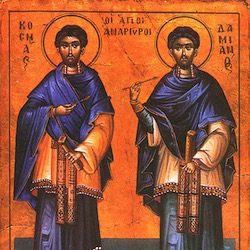
22nd SUNDAY AFTER PENTECOST — Tone 5. Holy Wonderworkers and Unmercenaries Cosmas and Damian of Mesopotamia, and their mother, St. Theodota.
Tone 5 Troparion (Resurrection)
Let us, the faithful, praise and worship the Word, co-eternal with the Father and the Spirit, born for our salvation from the Virgin; for He willed to be lifted up on the Cross in the flesh, to endure death, and to raise the dead// by His glorious Resurrection.
Tone 4 Troparion (St. Nicholas)
The truth of your deeds has revealed you to your flock as a rule of faith, an image of meekness and a teacher of self-control; your humility exalted you; your poverty enriched you.// O Father Bishop Nicholas, pray to Christ God that our souls may be saved.
Tone 8 Troparion (Unmercenaries)
Holy Unmercenaries and Wonderworkers, Cosmas and Damian, heal
our infirmities.// Freely you have received; freely you give to us.
Tone 5 Kontakion (Resurrection)
You descended into hell, O my Savior, shattering its gates as Almighty, resurrecting the dead as Creator, and destroying the sting of death. You have delivered Adam from the curse, O Lover of man,// and we cry to You: “O Lord, save us!”
Tone 3 Kontakion (St. Nicholas)
You proved yourself to be be a holy priest, O Nicholas. You served God in Myra and lived the gospel of Christ. You offered your life for your people, And rescued the innocent from death. Therefore God has glorified you as a trustworthy guide of things divine.
Tone 2 Kontakion (Unmercenaries)
Having received the grace of healing, you grant healing to those in need. Glorious wonder-workers and healers, Cosmas and Damian, visit us and put down the insolence of our enemies,// and bring healing to the world through your miracles!
Tone 6 Kontakion (Steadfast Protectress)
Steadfast Protectress of Christians, Constant Advocate before the Creator; despise not the cry of us sinners, but in your goodness come speedily to help us who call on you in faith. Hasten to hear our petition and to intercede for us, O Theotokos, for you always protect those who honor you!
Tone 5 Prokeimenon (Resurrection)
You, O Lord, shall protect us / and preserve us from this generation forever. (Ps. 11:7)
V. Save me, O Lord, for there is no longer any that is godly! (Ps. 11:1a)
Galatians 6:11-18 (Epistle)
See with what large letters I have written to you with my own hand! As many as desire to make a good showing in the flesh, these would compel you to be circumcised, only that they may not suffer persecution for the cross of Christ. For not even those who are circumcised keep the law, but they desire to have you circumcised that they may boast in your flesh. But God forbid that I should boast except in the cross of our Lord Jesus Christ, by whom the world has been crucified to me, and I to the world. For in Christ Jesus neither circumcision nor uncircumcision avails anything, but a new creation. And as many as walk according to this rule, peace and mercy be upon them, and upon the Israel of God. From now on let no one trouble me, for I bear in my body the marks of the Lord Jesus. Brethren, the grace of our Lord Jesus Christ be with your spirit. Amen.
Tone 5
Alleluia, Alleluia, Alleluia!
V. I will sing of Your mercies, O Lord, forever; with my mouth I will proclaim Your truth from generation to generation. (Ps. 88:1-2)
V. For You have said: Mercy will be established forever; Your truth will be prepared in the heavens. (Ps. 88:3)
Luke 8:26-39 (Gospel)
Then they sailed to the country of the Gadarenes, which is opposite Galilee. And when He stepped out on the land, there met Him a certain man from the city who had demons for a long time. And he wore no clothes, nor did he live in a house but in the tombs. When he saw Jesus, he cried out, fell down before Him, and with a loud voice said, “What have I to do with You, Jesus, Son of the Most High God? I beg You, do not torment me!” For He had commanded the unclean spirit to come out of the man. For it had often seized him, and he was kept under guard, bound with chains and shackles; and he broke the bonds and was driven by the demon into the wilderness. Jesus asked him, saying, “What is your name?” And he said, “Legion,” because many demons had entered him. And they begged Him that He would not command them to go out into the abyss. Now a herd of many swine was feeding there on the mountain. So they begged Him that He would permit them to enter them. And He permitted them. Then the demons went out of the man and entered the swine, and the herd ran violently down the steep place into the lake and drowned. When those who fed them saw what had happened, they fled and told it in the city and in the country. Then they went out to see what had happened, and came to Jesus, and found the man from whom the demons had departed, sitting at the feet of Jesus, clothed and in his right mind. And they were afraid. They also who had seen it told them by what means he who had been demon-possessed was healed. Then the whole multitude of the surrounding region of the Gadarenes asked Him to depart from them, for they were seized with great fear. And He got into the boat and returned. Now the man from whom the demons had departed begged Him that he might be with Him. But Jesus sent him away, saying, “Return to your own house, and tell what great things God has done for you.” And he went his way and proclaimed throughout the whole city what great things Jesus had done for him.
Holy Wonderworkers and Unmercenaries Cosmas and Damian of Mesopotamia
The Holy Wonderworkers and Unmercenary Physicians Cosmas and Damian and their mother Saint Theodota were natives of Asia Minor (some sources say Mesopotamia). Their pagan father died while they were still quite small children. Their mother raised them in Christian piety. Through her own example, and by reading holy books to them, Saint Theodota preserved her children in purity of life according to the command of the Lord, and Cosmas and Damian grew up into righteous and virtuous men.
Trained and skilled as physicians, they received from the Holy Spirit the gift of healing people’s illnesses of body and soul by the power of prayer. They even treated animals. With fervent love for both God and neighbor, they never took payment for their services. They strictly observed the command of our Lord Jesus Christ, “Freely have you received, freely give.” (Mt. 10:8). The fame of Saints Cosmas and Damian spread throughout all the surrounding region, and people called them unmercenary physicians.
Once, the saints were summoned to a grievously ill woman named Palladia, whom all the doctors had refused to treat because of her seemingly hopeless condition. Through faith and through the fervent prayer of the holy brothers, the Lord healed the deadly disease and Palladia got up from her bed perfectly healthy and giving praise to God. In gratitude for being healed and wishing to give them a small gift, Palladia went quietly to Damian. She presented him with three eggs and said, “Take this small gift in the Name of the Holy Life-Creating Trinity, the Father, Son, and Holy Spirit.” Hearing the Name of the Holy Trinity, the unmercenary one did not dare to refuse.
When Saint Cosmas learned what had happened, became very sad, for he thought that his brother had broken their strict vow. On his deathbed he gave instructions that his brother should not be buried beside him. Saint Damian also died shortly afterward, and everyone wondered where Saint Damian’s grave should be. But through the will of God a miracle occurred. A camel, which the saints had treated for its wildness, spoke with a human voice saying that they should have no doubts about whether to place Damian beside Cosmas, because Damian did not accept the eggs from the woman as payment, but out of respect for the Name of God. The venerable relics of the holy brothers were buried together at Thereman (Mesopotamia).
Many miracles were worked after the death of the holy unmercenaries. There lived at Thereman, near the church of Cosmas and Damian, a certain man by the name of Malchus. One day he went on a journey, leaving his wife all alone for what would be a long time. He prayerfully entrusted her to the heavenly protection of the holy brothers. But the Enemy of the race of mankind took on the appearance of one of Malchus’ friends, and planned to kill the woman. A certain time went by, and this man went to her at home and said that Malchus had sent him to bring her to him. The woman believed him and went along. He led her to a solitary place intending to kill her. The woman, seeing that disaster threatened her, called upon God with deep faith.
Two fierce-some men then appeared, and the devil let go of the woman and fled, falling off a cliff. The two men led the woman home. At her own home, bowing to them deeply she asked, “My rescuers, to whom I shall be grateful to the end of my days, what are your names?”
They replied, “We are the servants of Christ, Cosmas and Damian,” and became invisible. The woman with trembling and with joy told everyone about what had happened to her. Glorifying God, she went up to the icon of the holy brothers and tearfully offered prayers of thanksgiving for her deliverance. And from that time the holy brothers were venerated as protectors of the holiness and inviolability of Christian marriage, and as givers of harmony to conjugal life. From ancient times, their veneration spread also to Russia.
The Unmercenary Saints Cosmas and Damian of Asia Minor should not be confused with the Unmercenary Saints Cosmas and Damian of Rome (July 1), or the Unmercenary Saints Cosmas and Damian of Arabia (October 17).
On the call to all Christians to become saints
To the saints which are at Ephesus (Ephesians 1:1)
The Apostle calls the Christians in Ephesus saints. He does not call one or two of them saints, nor one group of them, but all of them. Is this not a wondrous miracle of God for people, not in the wilderness but in a city—and an idolatrous and corrupt city—to become saints? That married men who sire children, who trade and work, become saints! Indeed, such were the first Christians. Their dedication, fidelity and zeal in the Faith as well as their holiness and purity of life, completely justified their being called saints. If in latter times saints have become the exception, in those earlier times the unholy were the exception. Saints were the rule. Therefore, we must not wonder that the Apostle calls all baptized souls in Ephesus “saints” and that he has an even loftier name for all Christians, i.e., “sons,” the sons of God (Galatians 4:6). Christ the Lord Himself gave us the right to call ourselves such when He taught us to address God as Our Father (Matthew 6:9). O my brethren, do we not say to God every day: “Holy God?” Do we not call the angels holy? Do we not call the Mother of God holy? And the prophets, apostles, martyrs and the righteous? Do we not call heaven holy and the Kingdom of Heaven holy? Who then is able to enter into the holy Kingdom but the saints? Therefore, if we have hope for salvation, we also have hope for holiness. O Holy God, Who dwellest in the holy place and resteth among the saints and callest the holy to Thyself and showest mercy to them, help us also that we may become holy—in words, in thoughts and in deeds—to Thy glory and our salvation. To Thee be glory and praise forever. Amen.
— Velimirovic, Saint Nikolai. The Prologue of Ohrid
We Christians have put on Christ at Holy Baptism. We have put on God, and God is love. How is it that, having become one with God at Holy Baptism, we wage war with Him? How do we wage war? By our thoughts! We emit negative thoughts to our fellow men.
— Smiljanic, Ana. Our Thoughts Determine Our Lives: the Life and Teachings of Elder Thaddeus of Vitovnica
 Sunday Bulletin October 18, 2026
