
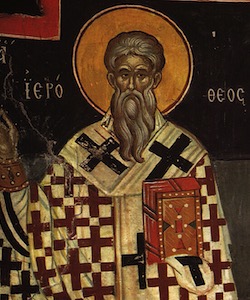
18th SUNDAY AFTER PENTECOST — Hieromartyr Hierotheus, Bishop of Athens (1st c.).
Tone 1 Troparion (Resurrection)
When the stone had been sealed by the Jews, while the soldiers were guarding Your most pure body, You rose on the third day, O Savior, granting life to the world. The powers of heaven therefore cried to You, O Giver of Life: “Glory to Your Resurrection, O Christ! Glory to Your Kingdom!// Glory to Your dispensation, O Lover of mankind!”
Tone 4 Troparion (St. Nicholas)
The truth of your deeds has revealed you to your flock as a rule of faith, an image of meekness and a teacher of self-control; your humility exalted you; your poverty enriched you.// O Father Bishop Nicholas, pray to Christ God that our souls may be saved.
Tone 1 Troparion (St. Hierotheus)
We the faithful all praise Hierotheus, the disciple of Paul, Hierarch of Athens, the world’s teacher and a preacher of the Faith, who revealed to us Christ’s Mysteries and poured forth streams of godly doctrine.// His life was well-pleasing to God, Who is greatly merciful.
Tone 1 Kontakion (Resurrection)
As God, You rose from the tomb in glory, raising the world with Yourself. Human nature praises You as God, for death has vanished. Adam exults, O Master! Eve rejoices, for she is freed from bondage and cries to You:// “You are the Giver of Resurrection to all, O Christ!”
Tone 3 Kontakion (St. Nicholas)
You proved yourself to be be a holy priest, O Nicholas. You served God in Myra and lived the gospel of Christ. You offered your life for your people, And rescued the innocent from death. Therefore God has glorified you as a trustworthy guide of things divine.
Tone 8 Kontakion (St. Hierotheus)
Hierarch of Athens, we praise you for you have instructed us in awesome and ineffable things, and you were revealed to be a divinely inspired writer of hymns. Pray that we be delivered from every kind of sin, so that we may cry to you:// Rejoice, divinely-wise Father Hierotheus!
Tone 6 Kontakion (Steadfast Protectress)
Steadfast Protectress of Christians, Constant Advocate before the Creator; despise not the cry of us sinners, but in your goodness come speedily to help us who call on you in faith. Hasten to hear our petition and to intercede for us, O Theotokos, for you always protect those who honor you!
Tone 1 Prokeimenon (Resurrection)
Let Your mercy, O Lord, be upon us /as we have set our hope on You! (Ps. 32:22)
V. Rejoice in the Lord, O you righteous! Praise befits the just! (Ps. 32:1)
2 Corinthians 9:6-11 (Epistle)
But this I say: “He who sows sparingly will also reap sparingly, and he who sows bountifully will also reap bountifully.” So let each one give as he purposes in his heart, not grudgingly or of necessity; for God loves a cheerful giver. And God is able to make all grace abound toward you, that you, always having all sufficiency in all things, may have an abundance for every good work. As it is written: “He has dispersed abroad, He has given to the poor; His righteousness endures forever.” Now may He who supplies seed to the sower, and bread for food, supply and multiply the seed you have sown and increase the fruits of your righteousness, while you are enriched in everything for all liberality, which causes thanksgiving through us to God.
Tone 1
Alleluia, Alleluia, Alleluia!
V. God gives vengeance unto me, and subdues people under me. (Ps. 17:48)
V. He magnifies the salvation of the King and deals mercifully with David, His anointed, and his seed forever. (Ps. 17:51)
Luke 6:31-36 (Gospel)
And just as you want men to do to you, you also do to them likewise. But if you love those who love you, what credit is that to you? For even sinners love those who love them. And if you do good to those who do good to you, what credit is that to you? For even sinners do the same. And if you lend to those from whom you hope to receive back, what credit is that to you? For even sinners lend to sinners to receive as much back. But love your enemies, do good, and lend, hoping for nothing in return; and your reward will be great, and you will be sons of the Most High. For He is kind to the unthankful and evil. Therefore be merciful, just as your Father also is merciful.
Hieromartyr Hierotheus, Bishop of Athens
Hieromartyr Hierotheus, the first Bishop of Athens, was a member of the Athenian Areopagos and was converted to Christ by the Apostle Paul together with Saint Dionysius the Areopagite (October 3).
The saint was consecrated by the Apostle Paul to the rank of bishop. According to Tradition, Bishop Hierotheus was present with Saint Dionysius at the funeral of the Most Holy Theotokos.
Uncovering of the relics of Saint Gurias, first Archbishop of Kazan, and Saint Barsanuphius, Bishop of Tver
The Uncovering of the relics of Saint Gurias, First Archbishop of Kazan, and Saint Barsanuphius, Bishop of Tver, occurred at Kazan in the year 1595. During the construction of a new stone church in honor of the Transfiguration of the Lord at the Savior-Transfiguration monastery, which had been founded by Saint Barsanuphius, graves with the bodies of the holy hierarchs in the altar-wall were uncovered beneath the former wooden church. The unusual aspect of incorrupt graves filled Saint Hermogenes (February 17) with a pious desire to open the graves before a large crowd of the people.
Saint Hermogenes described this event, “We beheld a marvel we had not hoped for. The coffin of the saint was full of fragrant myrrh, like pure water, and the relics of Saint Gurias were above the myrrh, like a sponge. God gave his venerable and hard-working body incorruption, as is now seen by all. Decay touched only very little of the upper lip, his other limbs were whole, and nothing has disappeared. We touched his burial robe and it held up very firm. Then we opened up the coffin of Saint Barsanuphius and we looked upon the relics of Saint Barsanuphius which were blessed by God with little corruption. Decay had touched the feet of the monk, however the bones were not destroyed, and held up quite well. There was no other sign of corruption in the condition of the rest of his relics, the same was for the relics of Saint Gurias. The burial robe of both saints was strong and like new.”
Many sick were healed, having been anointed with the holy myrrh flowing from the relics of Saint Gurias.
There is a description of the saints in the Iconographer’s Manual under October 4: “In appearance Gurias is grey and bearded, like Basil of Caesarea, with a mitre, omophorion, holding a Gospel in his hands, and dressed in the robes of a hierarch. Barsanuphius is grey and bearded like Gurias, but his is parted at the end. He wears a mitre, the robes of a hierarch, an omophorion and carries the Gospel.”
The Life of Saint Gurias is found on December 5; and the Life of Saint Barsanuphius on April 11.
In the correspondence from a report of the Archbishop of Cheboksarsk and Chuvash Benjamin (Novitsky), + 14 October 1976, His Holiness Pimen, Patriarch of Moscow gave a blessing to commemorate the Synaxis of all the Kazan hierarchs on the first Sunday after October 4th.
Reflection
A vision of St. Andrew: (This is the same St. Andrew, the Fool for Christ, who saw the Protecting Veil of the Mother of God in Constantinople).
St. Paul was not the only one who was caught up into Paradise, and heard unspeakable words (II Corinthians 12:4). Over 850 years after St. Paul, this also occurred to St. Andrew. One wintry night, St. Andrew was lying among the dogs on a dung heap in order to warm his frozen body, when an angel of God appeared to him and raised him up to Paradise (whether in the body or outside the body, St. Andrew himself could not explain), and kept him in the heavenly world for two weeks, eventually leading him to the third heaven. “I saw myself clothed in the most dazzling garments—they were as if woven from lightning—with a wreath of flowers on my head, and girt with a royal girdle. I rejoiced greatly at this beauty, and was amazed in both mind and heart, at the inexpressible beauty of God’s Paradise, as I walked around it and rejoiced.” Andrew also wrote that he saw Christ the Lord: “And when a flaming hand drew the curtain, I saw my Lord—as once did the Prophet Isaiah—sitting upon a high and exalted throne, with Seraphim standing all around Him. He was clothed in a crimson garment. His face was most radiant, and His eyes gazed most kindly upon me. Seeing Him, I prostrated before Him, worshiping the brilliant and awesome throne of His glory. How much joy overcame me during the vision of His face cannot be expressed; and now, calling to mind this vision, I am filled with inexpressible joy…. I heard my Most-merciful Creator when, with His most sweet and pure lips, He spoke three words to me, which so sweetened my heart and inflamed it with love for Him, that I melted as warm wax from spiritual warmth…” When St. Andrew also desired to see the Most-holy Theotokos, he was told that she was not in heaven just then, but had descended to earth to help the poor and to comfort those in need.
— Velimirovic, Saint Nikolai. The Prologue of Ohrid
God as Mystery
We see that it is not the task of Christianity to provide easy answers to every question, but to make us progressively aware of a mystery. God is not so much the object of our knowledge as the cause of our wonder. Quoting Psalm 8:1, “O Lord, our Lord, how wonderful is thy name in all the earth”, St Gregory of Nyssa states: “God’s name is not known; it is wondered at.”
Recognizing that God is incomparably greater than anything we can say or think about him, we find it necessary to refer to him not just through direct statements but through pictures and images. Our theology is to a large extent symbolic. Yet symbols alone are insufficient to convey the transcendence and the “otherness” of God. To point at the mysterium tremendum, we need to use negative as well as affirmative statements, saying what God is not rather than what he is. Without this use of the way of negation, of what is termed the apophatic approach, our talk about God becomes gravely misleading. All that we affirm concerning God, however correct, falls far short of the living truth. If we say that he is good or just, we must at once add that his goodness or justice are not to be measured by our human standards. If we say that he exists, we must qualify this immediately by adding that he is not one existent object among many, that in his case the word “exist” bears a unique significance. So the way of affirmation is balanced by the way of negation.
…So the spiritual Way proves to be a path of repentance in the most radical sense. Metanoia, the Greek word for repentance, means literally “change of mind.” In approaching God, we are to change our mind, stripping ourselves of all our habitual ways of thinking. We are to be converted not only in our will but in our intellect. We need to reverse our interior perspective, to stand the pyramid on its head.
— Kallistos, Bishop of Diokleia. The Orthodox Way
Church Musician Sunday — October 4, 2026
To the clergy, monastics, and faithful of the Orthodox Church in America,
My beloved children in the Lord,
“Let the word of Christ dwell in you richly, teach and admonish one another in all wisdom, and sing psalms and hymns and spiritual songs with thankfulness in your hearts to God” (Col. 3:16).
In these words, the holy Apostle Paul makes an important connection between the word of Christ, the teaching of the faith, and the singing of sacred music. This should not surprise us. From generation to generation, Christians have learned the faith not only by hearing it preached or reading it in books, but by singing it.
The hymns of the Church give special voice to her theology. They proclaim Christ’s incarnation, death, and resurrection; they teach us how to speak of the most holy Theotokos and the saints; they teach us the meaning of the feasts and fasts; they give us words of repentance, thanksgiving, supplication, and praise. Often, words first encountered in worship remain with us long afterward, deep impressed into our memory, because they have been joined to melody and repeated in prayer.
For this reason, the ministry of our church musicians is also a ministry of teaching. Choir directors, singers, chanters, readers, composers, arrangers, translators, hymnographers, and all those who labor in the musical life of the Church do more than beautify our services. Through their work, they help the word of Christ to dwell richly among us.
This responsibility is especially important as we hand on the Orthodox faith to others. A child learning to sing the responses, a new singer finding his or her place in the choir, or someone entering an Orthodox church for the first time may know little of our musical traditions. Patient instruction, good examples, and the welcoming of new voices are therefore not merely musical concerns. They are part of the work of transmitting the life and tradition of the Church.
Our pursuit of beauty and excellence in worship should never become a barrier to participation. Rather, those who have received musical gifts, knowledge, and experience should generously share them with others. I encourage our parishes and missions to teach their people to sing, to give children opportunities to learn the hymns of the Church, to welcome and form new choristers, and to support those musicians who devote themselves to preserving and handing on this part of our liturgical inheritance.
On this Church Musician Sunday, I offer my heartfelt gratitude to all those who give their voices, their skill, their time, and their prayer to the musical service of the Church. Through your efforts, words proclaimed by prophets, apostles, fathers, and saints continue to be placed upon the lips and within the hearts of the faithful.
May the Lord strengthen you in this ministry, and may he grant that, through our common song, his word may dwell ever more richly within us.
With my primatial prayers and blessing,
+Tikhon
Archbishop of Washington
Metropolitan of All America and Canada
 Sunday Bulletin September 27, 2026
