
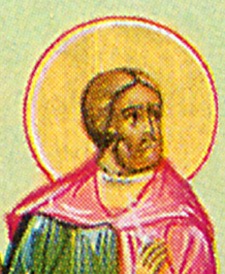
17th SUNDAY AFTER PENTECOST — Martyrs Callistratus and his company (49 Martyrs—ca. 304). Apostles Mark, Aristarchus, and Zenas, of the Seventy (1st c.).
Tone 8 Troparion (Resurrection)
You descended from on high, O Merciful One! You accepted the three day burial to free us from our sufferings!// O Lord, our Life and Resurrection, glory to You!
Tone 4 Troparion (St. Nicholas)
The truth of your deeds has revealed you to your flock as a rule of faith, an image of meekness and a teacher of self-control; your humility exalted you; your poverty enriched you.// O Father Bishop Nicholas, pray to Christ God that our souls may be saved.
Tone 3 Troparion (St. Callistratus)
In contest you were strengthened by the Holy Spirit, O Martyr Callistratus, and were glorious in casting down the Enemy. You offered a noble army of passion-bearers as sweet-smelling incense to Christ.// With them pray for us who praise you with hymns!
Tone 8 Kontakion (Resurrection)
By rising from the tomb, You raised the dead and resurrected Adam. Eve exults in Your Resurrection,// and the world celebrates Your rising from the dead, O greatly Merciful One!
Tone 3 Kontakion (St. Nicholas)
You proved yourself to be be a holy priest, O Nicholas. You served God in Myra and lived the gospel of Christ. You offered your life for your people, And rescued the innocent from death. Therefore God has glorified you as a trustworthy guide of things divine.
Tone 2 Kontakion (St. Callistratus)
Like stars you have shone upon the world, shedding the light of your contests and miracles upon all who cry to you:// “Rejoice, Martyr Callistratus and fellow company of martyrs!”
Tone 6 Kontakion (Steadfast Protectress)
Steadfast Protectress of Christians, Constant Advocate before the Creator; despise not the cry of us sinners, but in your goodness come speedily to help us who call on you in faith. Hasten to hear our petition and to intercede for us, O Theotokos, for you always protect those who honor you!
Tone 8 Prokeimenon (Resurrection)
Pray and make your vows / before the Lord, our God! (Ps. 75:10a)
V. In Judah God is known; His Name is great in Israel. (Ps. 75:1)
2 Corinthians 6:16-7:1 (Epistle)
And what agreement has the temple of God with idols? For you are the temple of the living God. As God has said: “I will dwell in them and walk among them. I will be their God, and they shall be My people.” Therefore “Come out from among them and be separate, says the Lord. Do not touch what is unclean, and I will receive you.” “I will be a Father to you, and you shall be My sons and daughters, says the LORD Almighty.” Therefore, having these promises, beloved, let us cleanse ourselves from all filthiness of the flesh and spirit, perfecting holiness in the fear of God.
Tone 8
Alleluia, Alleluia, Alleluia!
V. Come, let us rejoice in the Lord! Let us make a joyful noise to God our Savior! (Ps. 94:1)
V. Let us come before His face with thanksgiving; let us make a joyful noise to Him with songs of praise! (Ps. 94:2)
Luke 5:1-11 (Gospel)
So it was, as the multitude pressed about Him to hear the word of God, that He stood by the Lake of Gennesaret, and saw two boats standing by the lake; but the fishermen had gone from them and were washing their nets. Then He got into one of the boats, which was Simon’s, and asked him to put out a little from the land. And He sat down and taught the multitudes from the boat. When He had stopped speaking, He said to Simon, “Launch out into the deep and let down your nets for a catch.” But Simon answered and said to Him, “Master, we have toiled all night and caught nothing; nevertheless at Your word I will let down the net.” And when they had done this, they caught a great number of fish, and their net was breaking. So they signaled to their partners in the other boat to come and help them. And they came and filled both the boats, so that they began to sink. When Simon Peter saw it, he fell down at Jesus’ knees, saying, “Depart from me, for I am a sinful man, O Lord!” For he and all who were with him were astonished at the catch of fish which they had taken; and so also were James and John, the sons of Zebedee, who were partners with Simon. And Jesus said to Simon, “Do not be afraid. From now on you will catch men.” So when they had brought their boats to land, they forsook all and followed Him.
Martyr Callistratus and 49 Companions
Saint Callistratus was a native of Carthage. An ancestor of Saint Callistratus, Neochorus, had served under the emperor Tiberius in Palestine, under the command of Pontius Pilate, the procurator of Judea, and was a witness to the suffering on the Cross of our Lord Jesus Christ, His voluntary death and glorious Resurrection.
The saint’s father was a Christian, and he raised his son in faith and piety. Also like his father, Saint Callistratus became a soldier and excelled among his pagan military comrades by his good conduct and gentle disposition.
At night when everyone slept, he usually stayed up at prayer. Once, a soldier sleeping nearby heard Saint Callistratus invoking the Name of the Lord Jesus Christ, and he reported this to the military commander, who in turn summoned Callistratus, interrogated him and wanted to make him offer sacrifice to idols. The saint resolutely refused to do this, so the military commander ordered that the saint be beaten. Then, covered with wounds, the saint was dragged over sharp stones. The beating and the torments did not sway the firm will and brave endurance of the sufferer.
The saint was sewn up in a leather sack and drowned in the sea. By God’s mercy, however, the sack struck a sharp rock and was torn open. Saint Callistratus came to dry land unharmed, carried by dolphins. Viewing such a miracle, forty-nine soldiers came to believe in Christ. Then the military commander threw Saint Callistratus and the believing soldiers into prison. Before this, all of them were subjected to innumerable floggings.
In jail Saint Callistratus continued to preach the Word of God to the soldiers and he bolstered their spirits for martyrdom. Summoned again before the military commander, the sufferers firmly confessed their faith in Christ, after which they were bound hand and foot and thrown into the depths of a great lake behind a dam. But there their bonds broke, and with bright faces the holy martyrs stood in the water, rejoicing in their Baptism, which coincided with the act of martyrdom.
Beautiful bright crowns appeared over their heads, and all heard a voice: “Be brave, Callistratus, with your company, and come rest in the eternal habitations.” At the same time, the earth shuddered and an idol standing nearby fell down and smashed. Seeing this, another 135 soldiers also believed in the Lord Jesus Christ. The military commander, fearing a mutiny in the army, did not put them on trial, but again imprisoned Saint Callistratus with his 49 companions, where they fervently prayed and gave thanks to the Creator for giving them power to endure such sufferings.
At night the martyrs were cut to pieces with swords by order of the military commander. Their holy relics were buried by the 135 soldiers who remained alive. Later, a church was built on the spot of their sufferings, as Saint Callistratus had foretold.
Apostle Mark of the Seventy
The Holy Apostle Mark of the Seventy, also named John, is mentioned by the holy Apostle and Evangelist Luke in the Acts of the Apostles (Acts 12:25, 15:37-39) and also by the holy Apostle Paul in both the Epistle to the Colossians (Col 4:10) and the Epistle to Philemon (Philemon 1:23).
The holy Apostle Mark preached the Word of God together with Paul and Barnabas and was made bishop of the Phoenician city of Biblos. The holy Apostle Mark attained great boldness before God, so that his very shadow healed the sick (also January 4 and April 15).
The gospel of Saint Mark is the shortest, and perhaps the first written, of the gospels, although this is a matter of debate. Its author was not one of the twelve apostles and it is the common view that this gospel presents the “tradition” of Saint Peter. The gospel begins immediately with Jesus’ baptism, the call of the apostles, and the preaching of Jesus accompanied by his works of forgiveness and healing. In this gospel, as in all of them, Jesus is revealed from the very beginning by His authoritative words and His miraculous works as the Holy One of God, the divine Son of Man, Who was crucified and is risen from the dead, thus bringing to the world the Kingdom of God.
Repentance: Joyful Mourning
My beloved brothers, God commands us through the mouth of the prophet Isaiah, “Wash yourselves, and make yourselves clean. Put away the evils from your souls before My eyes. Cease from your evils. Learn to do good” (Isa. 1:16-17). Repentance presupposes sin. Whoever has not sinned does not need to repent. All of us, and I first, sense our sinfulness. Sin is an injury and a wound. It injures the soul, wounds our conscience, and induces severe pain. It injures the body of Christ: the Church to which we as members belong. Sin serves as a nail in the body of Christ and in His recrucifixion. Who has not been wounded by sin? Who has not sinned with words, thoughts, or actions? Who has not been struck right in the chest by the pangs of the conscience?
Whoever alleges that he has not sinned has uttered the biggest lie possible. All they who suffer from ignorance and lack self-knowledge lie and claim that they have no sins.
The great and irrefutable truth is that, without exception, we have all been wounded by the arrows of sin. Nonetheless, if sin has wounded us, repentance is our medicine. Repentance! What a magnificent and blessed gift from God to man! Do you realize what it means to obligate God, at any hour and moment you desire, to wipe clean your criminal record?
Imagine that there is a certain criminal with a heavy criminal record. Imagine that this person, who has committed an endless series of crimes, suddenly makes an appeal that compels the judge to pardon him and expunge his offenses. This appeal is repentance. God confirms this truth through the mouth of the prophet Isaiah: “Come now, and let us reason together, says the Lord. And even if your sins are like crimson, I shall make them white like snow” (Isa. 1:18).
Many Christians have the reverent desire to be baptized in the Jordan River. However, no matter how many times we enter the Jordan River, and no matter how many bottles of holy water we drink, if we do not repent we will not be saved. The Jordan River is close by; it is next to us. It flows in the Church. It is sweet repentance and confession. If we wash ourselves with repentance, all our sins are extinguished. The bath of repentance constitutes a second baptism. One does not unknowingly undergo this divine baptismal bath, which is termed repentance, as is the case with infant baptism; rather, it takes place consciously and decisively.
I wash myself with the intention of not becoming dirty again, regardless of whether or not I accomplish this. I wash myself fully determined not to defile the robe of my soul again. Repentance is a response to God’s mercy; more precisely, God’s mercy is the response to man’s repentance. After Christ’s advent and arrival, repentance is not merely regret and confession of sins: it is remission, forgiveness, effacement, and complete obliteration of sin.
Repentance is a lamentation that leads to joy. It is joyful mourning. Repentance is sowing that takes place with tears, and subsequently leads to a liberating harvest.
The venerable Chrysostom insists that we must lament for the sins of others, if we truly love them. If the other person is about to be devoured by a wolf, will we allow him to perish? If another person is in danger of drowning, will we let him sink? Repentance erases all sins!
Two realities exist. The first is God’s compassion and the second is man’s sinfulness. I will ask you: Which of the two is greater? No matter how many sins we have, they are a specific and finite amount. God’s compassion, however, is infinite and immeasurable. Saint John Chrysostom uses the example of charcoal, in order to console sinful people. A lit charcoal will burn you. If, however, you throw this lit charcoal into the sea, which will prevail? The sea or the charcoal? The sea, of course. As soon as the charcoal hits the water, it is extinguished and disappears.
Repentance gives rise to an extraordinary miracle: it makes God forget. God knows the hearts of men; He knows all things. All of us, and all of our deeds are preserved in His memory. Yet, God Himself develops amnesia! He forgets the sins of people who repent sincerely.
— Ephraim, Elder. The Art of Salvation
 Sunday Bulletin September 20, 2026