
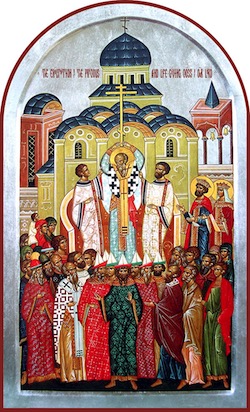
15th SUNDAY AFTER PENTECOST — Forefeast of the Elevation of the Cross. Commemoration of the Founding of the Church of the Resurrection (Holy Sepulcher) at Jerusalem (335). Sunday before Elevation.
Tone 6 Troparion (Resurrection)
The Angelic Powers were at Your tomb; the guards became as dead men. Mary stood by Your grave, seeking Your most pure body. You captured hell, not being tempted by it. You came to the Virgin, granting life. O Lord, Who rose from the dead,// glory to You.
Tone 4 Troparion (Founding)
You have revealed the beauty of the holy dwelling place of Your glory on earth to be like the splendor of the heavenly firmament, O Lord. Through the prayers of the Theotokos, strengthen it for ever and ever and accept our supplication which we ceaselessly offer You therein,// the life and resurrection of all!
Tone 4 Troparion (Forefeast)
We offer in supplication the life-creating Cross of Your goodness, O Lord, which You have granted to us although we are unworthy. // Through the Theotokos, save all Orthodox Christians, O only Lover of man!
Tone 6 Kontakion (Resurrection)
When Christ God, the Giver of Life, raised all of the dead from the valleys of misery with His mighty hand, He bestowed resurrection on the human race.// He is the Savior of all, the Resurrection, the Life, and the God of all.
Tone 2 Kontakion (Founding)
Grant renewal of spirit in our hearts, and illumination to all that is within us, as we celebrate in faith the sacred dedication of Your house, which You were well pleased to have built in Your divine Name,// O You Who alone are glorified in the sanctuary.
Tone 6 Prokeimenon (Sunday Before)
O Lord, save Your people, / and bless Your inheritance! (Ps. 27:9a)
V. To You, O Lord, will I call. O my God, be not silent to me! (Ps. 27:1a)
Tone 4 Prokeimenon (Founding)
Holiness befits Your house, O Lord, / forevermore. (Ps. 92:7b)
Galatians 6:11-18 (Epistle, Sunday Before)
See with what large letters I have written to you with my own hand! As many as desire to make a good showing in the flesh, these would compel you to be circumcised, only that they may not suffer persecution for the cross of Christ. For not even those who are circumcised keep the law, but they desire to have you circumcised that they may boast in your flesh. But God forbid that I should boast except in the cross of our Lord Jesus Christ, by whom the world has been crucified to me, and I to the world. For in Christ Jesus neither circumcision nor uncircumcision avails anything, but a new creation. And as many as walk according to this rule, peace and mercy be upon them, and upon the Israel of God. From now on let no one trouble me, for I bear in my body the marks of the Lord Jesus. Brethren, the grace of our Lord Jesus Christ be with your spirit. Amen.
2 Corinthians 4:6-15 (Epistle)
For it is the God who commanded light to shine out of darkness, who has shone in our hearts to give the light of the knowledge of the glory of God in the face of Jesus Christ. But we have this treasure in earthen vessels, that the excellence of the power may be of God and not of us. We are hard-pressed on every side, yet not crushed; we are perplexed, but not in despair; persecuted, but not forsaken; struck down, but not destroyed – always carrying about in the body the dying of the Lord Jesus, that the life of Jesus also may be manifested in our body. For we who live are always delivered to death for Jesus’ sake, that the life of Jesus also may be manifested in our mortal flesh. So then death is working in us, but life in you. And since we have the same spirit of faith, according to what is written, “I believed and therefore I spoke,” we also believe and therefore speak, knowing that He who raised up the Lord Jesus will also raise us up with Jesus, and will present us with you. For all things are for your sakes, that grace, having spread through the many, may cause thanksgiving to abound to the glory of God.
Hebrews 3:1-4 (Epistle, Church)
Therefore, holy brethren, partakers of the heavenly calling, consider the Apostle and High Priest of our confession, Christ Jesus, who was faithful to Him who appointed Him, as Moses also was faithful in all His house. For this One has been counted worthy of more glory than Moses, inasmuch as He who built the house has more honor than the house. For every house is built by someone, but He who built all things is God.
Tone 1
Alleluia, Alleluia, Alleluia!
V. I have exalted one chosen out of My people. (Ps. 88:18b)
V. For My hand shall defend him and My arm shall strengthen him. (Ps. 88:20)
Tone 2
V. Your foundations are in the holy mountains; the Lord loves your gates, O Zion, more than all the dwellings of Jacob. (Ps. 99:1)
John 3:13-17 (Gospel, Sunday Before)
No one has ascended to heaven but He who came down from heaven, that is, the Son of Man who is in heaven. And as Moses lifted up the serpent in the wilderness, even so must the Son of Man be lifted up, that whoever believes in Him should not perish but have eternal life. For God so loved the world that He gave His only begotten Son, that whoever believes in Him should not perish but have everlasting life. For God did not send His Son into the world to condemn the world, but that the world through Him might be saved.
Matthew 22:35-46 (Gospel)
Then one of them, a lawyer, asked Him a question, testing Him, and saying, “Teacher, which is the great commandment in the law?” Jesus said to him, “’You shall love the LORD your God with all your heart, with all your soul, and with all your mind.’ This is the first and great commandment. And the second is like it: ‘You shall love your neighbor as yourself.’ On these two commandments hang all the Law and the Prophets.” While the Pharisees were gathered together, Jesus asked them, saying, “What do you think about the Christ? Whose Son is He?” They said to Him, “The Son of David.” He said to them, “How then does David in the Spirit call Him ‘Lord,’ saying: ‘The LORD said to my Lord, sit at My right hand, till I make Your enemies Your footstool’? If David then calls Him ‘Lord,’ how is He his Son?” And no one was able to answer Him a word, nor from that day on did anyone dare question Him anymore.
Matthew 16:13-18 (Gospel, Church)
When Jesus came into the region of Caesarea Philippi, He asked His disciples, saying, “Who do men say that I, the Son of Man, am?” So they said, “Some say John the Baptist, some Elijah, and others Jeremiah or one of the prophets.” He said to them, “But who do you say that I am?” Simon Peter answered and said, “You are the Christ, the Son of the living God.” Jesus answered and said to him, “Blessed are you, Simon Bar-Jonah, for flesh and blood has not revealed this to you, but My Father who is in heaven. And I also say to you that you are Peter, and on this rock I will build My church, and the gates of Hades shall not prevail against it.
Commemoration of the Founding of the Church of the Resurrection (Holy Sepulchre) at Jerusalem
The Dedication of the Temple of the Resurrection of Christ at Jerusalem celebrates the dedication of the Church of the Resurrection, built by Saint Constantine the Great and his mother, the empress Helen.
After the voluntary Passion and Death on the Cross of our Lord and Savior Jesus Christ, the holy place of His suffering was long trampled on by pagans. When the Roman emperor Titus conquered Jerusalem in the year 70, he razed the city and destroyed the Temple of Solomon on Mount Moriah, leaving there not a stone upon a stone, as even the Savior foretold (Mt.13:1-2).
Later on the zealous pagan emperor Hadrian (117-138) built on the site of the Jerusalem destroyed by Titus a new city named Aelia Capitolina for him (Hadrian Aelius). It was forbidden to call the city by its former name.
He gave orders to cover the Holy Tomb of the Lord with earth and stones, and on that spot to set up an idol. On Golgotha, where the Savior was crucified, he constructed a pagan temple dedicated to the goddess Venus in 119. Before the statues they offered sacrifice to demons and performed pagan rites, accompanied by wanton acts.
In Bethlehem, at the place the Savior was born of the All-Pure Virgin, the impious emperor set up an idol of Adonis. He did all this intentionally, so that people would forget completely about Christ the Savior and that they would no loner remember the places where He lived, taught, suffered and arose in glory.
At the beginning of the reign of Saint Constantine the Great (306-337), the first of the Roman emperors to recognize the Christian religion, he and his pious mother the empress Helen decided to rebuild the city of Jerusalem. They also planned to build a church on the site of the Lord’s suffering and Resurrection, in order to reconsecrate and purify the places connected with memory of the Savior from the taint of foul pagan cults.
The empress Helen journeyed to Jerusalem with a large quantity of gold, and Saint Constantine the Great wrote a letter to Patriarch Macarius I (313-323), requesting him to assist her in every possible way with her task of the renewing the Christian holy places. After her arrival in Jerusalem, the holy empress Helen destroyed all the pagan temples and reconsecrated the places desecrated by the pagans. She was zealous to find the Cross of our Lord Jesus Christ, and she ordered the excavation of the place where the temple of Venus stood. There they discovered the Sepulchre of the Lord and Golgotha, and they also found three crosses and some nails. In order to determine upon which of the three crosses the Savior was crucified, Patriarch Macarius gave orders to place a dead person, who was being carried to a place of burial, upon each cross in turn. When the dead person was placed on the Cross of Christ, he immediately came alive. With the greatest of joy the empress Helen and Patriarch Macarius raised up the Life-Creating Cross and displayed it to all the people standing about.
The holy empress quickly began the construction of a large church which enclosed within its walls Golgotha, the place of the Crucifixion of the Savior, and the Sepulchre of the Lord, located near each other. The holy Apostle and Evangelist John wrote about this: “Now in the place where He was crucified, there was a garden, and in the garden a new tomb, in which no one had yet been laid. Therefore they laid Jesus there because of the Jewish preparation day, for the tomb was nearby” (John 19:41-42). The Church of the Resurrection was ten years in building, and the holy empress Helen did not survive to see its completion. She returned to Constantinople, and reposed in the year 327.
After her arrival in Jerusalem, the holy empress built churches in Bethlehem, on the Mount of Olives, at Gethsemane and in many other places connected with the life of the Savior and events in the New Testament. The construction of the church of the Resurrection, called “Martyrion” in memory of the sufferings of the Savior, was completed in the same year as the Council of Tyre, and in the thirtieth year of the reign of Saint Constantine the Great. Therefore, at the assembly of September 13, 335, the consecration of the temple was particularly solemn. Hierarchs of Christian Churches in many lands: Bythnia, Thrace, Cilicia, Cappadocia, Syria, Mesopotamia, Phoenicia, Arabia, Palestine, and Egypt, participated in the consecration of the church. The bishops who participated in the Council of Tyre, and many others, went to the consecration in Jerusalem. On this day all the city of Jerusalem was consecrated. The Fathers of the Church established September 13 as the commemoration of this remarkable event.
On how the world hates the witness of its sin
— St. Nikolai
The world cannot hate you; but Me it hateth (John 7:7)
Why does the world hate Christ the Lord? The Lord Himself immediately explained this: Because I testify of it, that the works thereof are evil (John 7:7). Men do not hate anyone as much as a witness to their sin. Because of this, the greatest misdeeds of the world are committed at night, in darkness. But does God not see at night, in darkness? In truth, God sees, but the evildoers do not see God. And even if some of them believe somewhat in God, they think, because of their own insufficient enlightenment, that darkness is a curtain between men and God. The Lord Jesus Christ Himself clearly revealed that God is all-seeing, and that no darkness prevents His eyes from seeing. He Himself saw men at a distance, such as Nathaniel under the fig tree. He saw a donkey with its colt in another village. His sight was not impeded by spatial distance. He foresaw the denial of Peter, the betrayal of Judas, His own death and Resurrection, the destruction of Jerusalem, the eternity of His Church, the suffering of His followers, and the events at the end of time. His sight was not impeded by the distance of time. But what more is there to enumerate? And what is more hidden than the hearts of men? Is not the heart hidden by the thick curtain of the body? Are not the thoughts in the heart more hidden than the heart itself? Nevertheless, He penetrated the darkness of men’s hearts and read their thoughts there: Wherefore think ye evil in your hearts? (Matthew 9:4). Brethren, it is no wonder that all those who thought or committed evil were afraid of such a witness. Is it a wonder, then, that the evildoers hated Him? The world cannot hate you. Whom? All of you who participate in the evil of the world and who, because of your participation, dare not witness against the world. How can those who fear men witness against men? How can those who seek the glory of men bring the condemnation of men against themselves? O my brethren, it is better for us if the world hates us, and Christ loves us—than if the whole world loves us and glorifies us, and Christ turns His face from us, saying: I know you not. If the world hates us, let us be comforted by the words of the Savior: If the world hate you, ye know that it hated Me before it hated you (John 15:18). O Blessed Lord, the Source of all blessings, strengthen our hearts, that we may not be frightened when the world hates us. Only bless and love us, O Good Savior. To Thee be glory and praise forever. Amen.
— Velimirovic, Saint Nikolai. The Prologue of Ohrid
 Sunday Bulletin September 6, 2026