
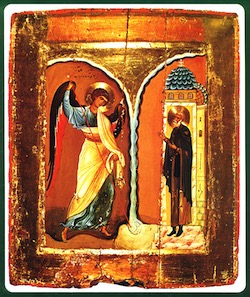
14th SUNDAY AFTER PENTECOST — Commemoration of the Miracle of the Archangel Michael at Colossæ. Martyrs Eudoxius, Zeno, and Macarius (311-312).
Tone 5 Troparion (Resurrection)
Let us, the faithful, praise and worship the Word, co-eternal with the Father and the Spirit, born for our salvation from the Virgin; for He willed to be lifted up on the Cross in the flesh, to endure death, and to raise the dead// by His glorious Resurrection.
Tone 4 Troparion (St. Nicholas)
The truth of your deeds has revealed you to your flock as a rule of faith, an image of meekness and a teacher of self-control; your humility exalted you; your poverty enriched you.// O Father Bishop Nicholas, pray to Christ God that our souls may be saved.
Tone 4 Troparion (Archangel Michael)
O Michael, commander of the heavenly hosts, we who are unworthy beseech you: by your prayers encompass us beneath the wings of your immaterial glory, and faithfully preserve us who fall down and cry out to you:// “Deliver us from all harm, for you are the commander of the Powers on high!”
Tone 5 Kontakion (Resurrection)
You descended into hell, O my Savior, shattering its gates as Almighty, resurrecting the dead as Creator, and destroying the sting of death. You have delivered Adam from the curse, O Lover of man,// and we cry to You: “O Lord, save us!”
Tone 3 Kontakion (St. Nicholas)
You proved yourself to be be a holy priest, O Nicholas. You served God in Myra and lived the gospel of Christ. You offered your life for your people, And rescued the innocent from death. Therefore God has glorified you as a trustworthy guide of things divine.
Tone 5 Kontakion (Archangel Michael)
O Michael, commander of God’s armies and minister of the divine glory, prince of the bodiless angels and guide of mankind; ask for what is good for us, and for great mercy,// as the supreme commander of the Bodiless Hosts.
Tone 6 Kontakion (Steadfast Protectress)
Steadfast Protectress of Christians, Constant Advocate before the Creator; despise not the cry of us sinners, but in your goodness come speedily to help us who call on you in faith. Hasten to hear our petition and to intercede for us, O Theotokos, for you always protect those who honor you!
Tone 5 Prokeimenon (Resurrection)
You, O Lord, shall protect us / and preserve us from this generation forever. (Ps. 11:7)
V. Save me, O Lord, for there is no longer any that is godly! (Ps. 11:1a)
2 Corinthians 1:21-2:4 (Epistle)
Now He who establishes us with you in Christ and has anointed us is God, who also has sealed us and given us the Spirit in our hearts as a guarantee. Moreover I call God as witness against my soul, that to spare you I came no more to Corinth. Not that we have dominion over your faith, but are fellow workers for your joy; for by faith you stand. But I determined this within myself, that I would not come again to you in sorrow. For if I make you sorrowful, then who is he who makes me glad but the one who is made sorrowful by me? And I wrote this very thing to you, lest, when I came, I should have sorrow over those from whom I ought to have joy, having confidence in you all that my joy is the joy of you all. For out of much affliction and anguish of heart I wrote to you, with many tears, not that you should be grieved, but that you might know the love which I have so abundantly for you.
Tone 5
Alleluia, Alleluia, Alleluia!
V. I will sing of Your mercies, O Lord, forever; with my mouth I will proclaim Your truth from generation to generation. (Ps. 88:1-2)
V. For You have said: Mercy will be established forever; Your truth will be prepared in the heavens. (Ps. 88:3)
Matthew 22:1-14 (Gospel)
And Jesus answered and spoke to them again by parables and said: “The kingdom of heaven is like a certain king who arranged a marriage for his son, and sent out his servants to call those who were invited to the wedding; and they were not willing to come. Again, he sent out other servants, saying, ‘Tell those who are invited, “See, I have prepared my dinner; my oxen and fatted cattle are killed, and all things are ready. Come to the wedding.”’ But they made light of it and went their ways, one to his own farm, another to his business. And the rest seized his servants, treated them spitefully, and killed them. But when the king heard about it, he was furious. And he sent out his armies, destroyed those murderers, and burned up their city. Then he said to his servants, ‘The wedding is ready, but those who were invited were not worthy. Therefore go into the highways, and as many as you find, invite to the wedding.’ So those servants went out into the highways and gathered together all whom they found, both bad and good. And the wedding hall was filled with guests. But when the king came in to see the guests, he saw a man there who did not have on a wedding garment. So he said to him, ‘Friend, how did you come in here without a wedding garment?’ And he was speechless. Then the king said to the servants, ‘Bind him hand and foot, take him away, and cast him into outer darkness; there will be weeping and gnashing of teeth.’ For many are called, but few are chosen.”
Commemoration of the Miracle of the Archangel Michael at Colossae
In Phrygia, not far from the city of Hieropolis, in a place called Cheretopos, there was a church named for the Archangel Michael, built over a miraculous spring. (In classical antiquity, Phrygia was a kingdom in the west-central part of Anatolia, in what is now Asian Turkey, centered on the Sangarios River. -wikipedia)
This church was built by a certain inhabitant of the city of Laodicia in gratitude to God for healing his mute daughter. The holy Chief Commander Michael appeared to this man in a dream and revealed to him that his daughter would receive the gift of speech after drinking from the water of the spring. The girl actually did receive healing and began to speak. After this miracle, the father and his daughter and all their family were baptized. In fervent gratitude, the father built the church in honor of the holy Chief Commander Michael. Not only did Christians begin to come to the spring for healing, but also pagans. In so doing, many of the pagans turned from their idols and were converted to the faith in Christ.
At this church of the holy Chief Commander Michael, a certain pious man by the name of Archippus served for sixty years as church custodian. By his preaching and by the example of his saintly life he brought many pagans to faith in Christ. With the general malice of that time towards Christians, and especially against Archippus, the pagans thought to destroy the church in order to prevent people from coming to that holy place of healing, and at the same time kill Archippus.
Toward this end they made a confluence of the Lykokaperos and Kufos Rivers and directed its combined flow against the church. Saint Archippus prayed fervently to the Chief Commander Michael to ward off the danger. Through his prayer the Archangel Michael appeared at the temple, and with a blow of his staff, opened a wide fissure in a rock and commanded the rushing torrents of water to flow into it. The temple remained unharmed. Seeing such an awesome miracle, the pagans fled in terror. Archippus and the Christians gathered in church glorified God and gave thanks to the holy Archangel Michael for the help. The place where the rivers plunged into the fissure received the name “Chonae”, which means “plunging.” The Chudov (“of the Miracle”) monastery in Moscow is named for this Feast.
REFLECTION From St. Nikolai
Victory over anger is one of the greatest victories of a soldier of Christ. We generally become angry either at those we wish to turn back from sin, or at those who slander us. However, in doing so we forget that anger is a mortal sin, and in desiring the salvation of others we lose our own, according to the words of St. Macarius. Anger against our enemies is usually tied to another evil impulse, the desire for revenge. St. Eupsychius so overcame the passion of anger in himself, that before his death, he gave one portion of his great estate to the poor and another portion to his slanderers, because of whom he was being tortured and slain. He considered his slanderers as his benefactors. St. John Chrysostom writes: “Let us clip the wings of anger, and evil will not rise high. Anger is an evil sickness that can destroy our souls… Anger is a terrible fire which devours everything…. If an angry man could see himself at the moment of his anger, he would need no other counsel not to become an-gry—because there is nothing more unpleasant than an angry face.” Abba Ammon confessed of himself: “I spent fourteen years in Scetis, praying to God day and night, to give me victory over anger.”
—Velimirovic, Saint Nikolai. The Prologue of Ohrid
HOMILY From St. Nikolai
on spiritual food
“My meat is to do the will of Him that sent Me” (John 4:34)
Behold, here is love! Behold, here is instruction! Behold, here is humility! Behold, here is an example! As there is in good bread all that is needed for our body, so in every word of the Lord Jesus Christ there is all that is needed for our soul. The divine unity of the nature of the Father and the Son is expressed in the love of the Father for the Son, and the Son for the Father. He who loves, obeys. If you want to know how great your love for God is, measure your obedience to the will of God and you will know immediately. A lack of obedience is a sure sign of the lack of love. He who loves, fulfills the will of his beloved. The Son of God loves His Father so much that He regarded fulfilling the Father’s will as the sweetest food. What is the will of the Father? The salvation of mankind. Our Lord, the Son of God, felt the insatiable hunger to fulfill the Father’s will. When He saved someone, He felt as if nourished with the sweetest food. Do you see how exalted Christ’s spirituality is? His disciples brought Him food from the city and urged Him: Master, eat! At that moment He was too occupied with His main work, the saving of human souls. There was the Samaritan woman, ready to embrace the teaching of salvation; there was the entire city of Sychar, already drawn to the Kingdom of God; and there was the great field ready for the harvest of salvation. For Christ this was food sweeter than all physical food and worldly sweetness. The body is a vehicle in which man, the king, rides. When the king performs his royal duty—ransoming his heirs from bondage—the vehicle must be put aside and not interfere in the work of the king. The king is so focused on saving his beloved heirs, that this mission is his food, drink, reward, sole satisfaction and dignity. O my brethren, if you could know how much Christ the Lord hungers, even today, for our salvation! If we did, then we would give Him the food that He likes most! Who is a greater guest, closer relative, or more sincere friend than He? When we host far lesser guests, more distant relatives and less sincere friends, we give them the food that we know they like. Then, why do we not host our Lord with the only food that is pleasing to Him? Let us embrace the salvation that He offers us—that, for Him, is the most pleasant food. He turns His head away from all other food. O Lord Jesus, insatiable Lover of our salvation, have mercy on us and save us. To Thee be glory and praise forever. Amen.
—Velimirovic, Saint Nikolai. The Prologue of Ohrid
Some reminders that can impel our will toward the desire to please God in every activity
In order that you may move your will more easily to this one desire in everything – to please God and to work for His glory alone- remind yourself often that He has granted you many favors in the past and has shown you His love. He has created you out of nothing in His own likeness and image and has made all other creatures your servants; He has delivered you from your slavery to the devil, sending down not one of the angels but His Only-Begotten Son to redeem you, not at the price of of corruptible gold and silver, but by His priceless Blood and His most painful and degrading death. Having done all this, He protects you, every hour and every moment, from your enemies; He fights your battles by His divine grace; in His immaculate Mysteries, He prepares the Body and Blood of His beloved Son for your food and protection. All this is a sign of God’s great favor and love for you, a favor so great that it is inconceivable how the great Lord of hosts could grant such favors to our nothingness and worthlessness. Judge from this what honor and devotion we must offer to the boundless majesty of Him who has done such wonderful things for us.
— From Unseen Warfare, page 156.
The Prosphoron: More than Fancy-looking Bread
Subdeacon Gregory Levitsky
The significance of prosphora loaves in the Liturgy and at home
A significant aspect of worship in the Orthodox Church is the prosphoron, or holy bread (plural “prosphora”). From the Greek meaning “offering,” prosphora occupy a central place in the Liturgy. Most importantly, the Lamb – the portion of bread that becomes the Body of Christ- is taken from the prosphoron. It is imprinted with a stamp; usually a cross with the letters IC-XC NI-KA (“Jesus Christ conquers”).
Baking prosphora is, then, a matter of great responsibility. Those who are tasked with doing so are usually parish volunteers or members of the parish sisterhood, continuing the early Church practice of bringing bread as an offering to the services. Traditionally, the bread that is used for the Lamb contains only flour, water, and salt (as well as yeast if a starter is not used). Depending on local tradition, bakers may prepare through confession,fasting and prayer. Special prayers are read before, during, and after the baking process.
In some practices, the loaves used for Liturgy are separate; in others, one large loaf is used. In both cases, five parts of the bread are specially designated for:
- the Lamb, which will become the Body of Christ
- the Theotokos
- the nine ranks of saints
- the living, and
- the departed.
Portions of these loaves are cut out and placed on the paten or diskos. Surrounding the Lamb, taken together these pieces represent the whole of Christ’s Church both in Heaven and on earth. This happens at every Divine Liturgy. It is important to note that these other particles do not become part of the Lamb itself, and are not given to the faithful as part of Holy Communion.
At the end of Liturgy, the particles are wiped from the paten into the chalice with the words, “By Thy precious Blood, O Lord, wash away the sins of those here commemorated, through the intercessions of Thy saints.”
Regarding the commemoration of the living and the dead, the Holy Hierarch Symeon of Thessalonica says:
“We have received a teaching from the ancient Fathers that the particles bring manifold benefit to those for whom they are offered. During the sacred rite, the particles represent the very people on whose behalf they are removed, serving as an offering to God on their behalf. This is confirmed by the words the priest speaks during the Proscomedia: ‘Accept, O Lord… this sacrifice into Thy Heavenly altar!’ Particles offered for the saints redound to their glory and honor, increasing their dignity and allowing them to receive the Divine Light more fully; those offered for the faithful – whether for the departed or the living – are an intercession for the remission of sins and participation in divine grace. For the living, provided they lead lives of repentance, these particles offer protection against misfortune and serve as an intercession for the forgiveness of sins.”
The remainder of these loaves (that is, the particles not placed on the paten) are cut up and distributed to the faithful. Some will be part of the zapivka, which is consumed immediately following the receiving of the Eucharist, and some will be the antidoron, bread distributed to the faithful after the service.
The prosphoron also plays a role in the commemoration of loved ones in some local churches. The particulars of this may even vary on a parish-by-parish basis. In many churches, the faithful will buy or bring their own loaves for individual commemoration. These will be submitted with lists (or in some cases booklets) with names, have particles taken out, and be returned for consumption throughout the coming week. In other practices, names are simply submitted by themselves.
Importantly, it is customary only to commemorate Orthodox Christians at Liturgy, and the slips should have their full baptismal name (Michael, not Mike; Susanna, not Suzie).
Those who take their loaves – or portions of the antidoron – home with them will store them in a safe place (a dedicated spot in the refrigerator or in one’s icon corner). Sometimes the bread is cut into small pieces and allowed to dry in order to prevent mold. Some believers have special containers in which to keep the bread. It is then taken in the morning, on an empty stomach, with holy water and a special prayer. This is a reminder of the Eucharist and the grace of Liturgy one received the previous Sunday.
All of these practices point to something greater than the bread itself. What begins as ordinary ingredients mystically becomes an image of us, the faithful. In the greatest instance, it becomes the very Body of our Lord Jesus Christ, of which we partake and by which we are saved. Righteous John of Kronstadt beautifully captures this reality in describing the particles taken from the prosphora loaves:
“During the Proscomedia, the entire Church… is symbolically represented as gathered around the Lamb Who takes away the sins of the world… What a close bond exists between the Lord and His saints, between Him and those living piously on earth and those who have died in faith and piety. Remember the close bond between us and the saints and those who have died in Christ. Love everyone as members of the Lord and as your own members. What closeness exists between the inhabitants of Heaven and earth – the Mother of God, all the saints, and all of us Orthodox Christians – when the Divine, universal, Heavenly, and all-uniting Liturgy is celebrated!”
 Sunday Bulletin August 30, 2026