
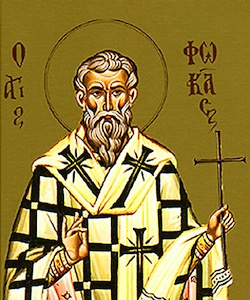
 13th SUNDAY AFTER PENTECOST — Tone 4. Apostle Quadratus of the 70. Hieromartyr Phocas, Bishop of Sinope (117). Prophet Jonah (8th c. BC).
Tone 4 Troparion (Resurrection)
When the women disciples of the Lord learned from the angel the joyous message of Your Resurrection, they cast away the ancestral curse and elatedly told the apostles: “Death is overthrown! Christ God is risen,// granting the world great mercy!”
Tone 4 Troparion (St. Nicholas)
The truth of your deeds has revealed you to your flock as a rule of faith, an image of meekness and a teacher of self-control; your humility exalted you; your poverty enriched you.// O Father Bishop Nicholas, pray to Christ God that our souls may be saved.
Tone 3 Troparion (St. Quadratus)
Holy Apostle Quadratus, entreat the merciful God// to grant our souls forgiveness of transgressions!
Tone 4 Troparion (St. Phocas)
By sharing in the ways of the Apostles, you became a successor to their throne. Through the practice of virtue, you found the way to divine contemplation, O inspired one of God; by teaching the word of truth without error, you defended the Faith, even to the shedding of your blood.// O Hieromartyr Phocas, entreat Christ God to save our souls!
Tone 4 Kontakion (Resurrection)
My Savior and Redeemer as God rose from the tomb and delivered the earth-born from their chains. He has shattered the gates of hell, and as Master,// He has risen on the third day!
Tone 3 Kontakion (St. Nicholas)
You proved yourself to be a holy priest, O Nicholas. You served God in Myra and lived the gospel of Christ. You offered your life for your people, And rescued the innocent from death. Therefore God has glorified you as a trustworthy guide of things divine.
Tone 8 Kontakion (St. Quadratus)
The universe offers You, O Lord, the Apostle Quadratus as a most honored hierarch and athlete of great strength; with hymns it honors his all-venerable memory// and asks that through him You grant forgiveness of transgressions to those who sing his praise.
Tone 2 Kontakion (St. Phocas)
The Master established you as a brilliant sun shining on all the faithful, glorious Hieromartyr Phocas. He has accepted you life, faith and contest as myrrh,// for He is rich in mercy.
Tone 4 Kontakion (Steadfast Protectress)
Steadfast Protectress of Christians, Constant Advocate before the Creator; despise not the cry of us sinners, but in your goodness come speedily to help us who call on you in faith. Hasten to hear our petition and to intercede for us, O Theotokos, for you always protect those who honor you!
Tone 7 Prokeimenon (Resurrection)
O Lord, how manifold are Your works; / in wisdom have You made them all. (Ps. 103:26)
V. Bless the Lord, O my soul! O Lord, my God, You are very great! (Ps. 103:1)
1 Corinthians 16:13-24 (Epistle)
Watch, stand fast in the faith, be brave, be strong. Let all that you do be done with love. I urge you, brethren – you know the household of Stephanas, that it is the firstfruits of Achaia, and that they have devoted themselves to the ministry of the saints – that you also submit to such, and to everyone who works and labors with us. I am glad about the coming of Stephanas, Fortunatus, and Achaicus, for what was lacking on your part they supplied. For they refreshed my spirit and yours. Therefore acknowledge such men. The churches of Asia greet you. Aquila and Priscilla greet you heartily in the Lord, with the church that is in their house. All the brethren greet you. Greet one another with a holy kiss. The salutation with my own hand – Paul’s. If anyone does not love the Lord Jesus Christ, let him be accursed. O Lord, come! The grace of our Lord Jesus Christ be with you. My love be with you all in Christ Jesus. Amen.
Tone 4
Alleluia, Alleluia, Alleluia!
V. Go forth, prosper and reign, for the sake of meekness, righteousness and truth! (Ps. 44:3b)
V. For You love righteousness, and hate iniquity. (Ps. 44:6)
Luke 5:1-11 (Gospel)
So it was, as the multitude pressed about Him to hear the word of God, that He stood by the Lake of Gennesaret, and saw two boats standing by the lake; but the fishermen had gone from them and were washing their nets. Then He got into one of the boats, which was Simon’s, and asked him to put out a little from the land. And He sat down and taught the multitudes from the boat. When He had stopped speaking, He said to Simon, “Launch out into the deep and let down your nets for a catch.” But Simon answered and said to Him, “Master, we have toiled all night and caught nothing; nevertheless at Your word I will let down the net.” And when they had done this, they caught a great number of fish, and their net was breaking. So they signaled to their partners in the other boat to come and help them. And they came and filled both the boats, so that they began to sink. When Simon Peter saw it, he fell down at Jesus’ knees, saying, “Depart from me, for I am a sinful man, O Lord!” For he and all who were with him were astonished at the catch of fish which they had taken; and so also were James and John, the sons of Zebedee, who were partners with Simon. And Jesus said to Simon, “Do not be afraid. From now on you will catch men.” So when they had brought their boats to land, they forsook all and followed Him.
Apostle Quadratus of the Seventy
Saint Quadratus, Apostle of the Seventy preached the Word of God at Athens and at Magnesia (eastern peninsula of Thessaly), and was Bishop of Athens. His biographer called him “a morning star” among the clouds of paganism. He converted many pagans to the true faith in Christ the Savior, and his preaching aroused the hatred of the pagans. Once, an angry mob fell upon the saint to pelt him with stones. Preserved by God, Saint Quadratus remained alive, and they threw him into prison, where he died of starvation. His holy body was buried in Magnesia.
In the year 126, Saint Quadratus wrote an Apologia in defence of Christianity. Presented to the emperor Hadrian (117-138), the Apologia affected the persecution of Christians, since the emperor issued a decree saying that no one should be convicted without just cause. This Apologia was known to the historian Eusebius in the fourth century. At the present time, only part of this Apologia survives, quoted by Eusebius: “The deeds of our Savior were always witnessed, because they were true. His healings and raising people from the dead were visible not only when they were healed and raised, but always. They lived not only during the existence of the Savior upon the earth, but they also remained alive long after His departure. Some, indeed, have survived to our own time.”
Saint Quadratus is also commemorated on January 4.
Prophet Jonah
The Holy Prophet Jonah lived in the eighth century before the birth of Christ and was a successor of the Prophet Elisha. The Book of the Prophet Jonah contains prophecies about the judgments on the Israelite nation, the sufferings of the Savior, the downfall of Jerusalem, and the end of the world. Besides the prophecies, the Book of Jonah relates how he was sent to the Ninevites to preach repentance (Jon. 3: 3-10).
Our Lord Jesus Christ, addressing the Scribes and the Pharisees who demanded a sign from Him, said that no sign would be given except for the sign of the Prophet Jonah, “As Jonah was in the belly of the whale three days and three nights, so also shall the Son of Man be in the heart of the earth three days and three nights” (Mt. 12: 40). From these words the Lord shows clearly the symbolic meaning of the Book of the Prophet Jonah in relation to Christ’s death on the Cross, descent into Hell, and the Resurrection.
Reproaching the lack of penitence and recalcitrance of the Jews, the Lord said, “The Ninevites shall rise in the judgment with this generation and will condemn it, because they repented at the preaching of Jonah; and one greater than Jonah is here” (Mt. 12: 41).
Saint Dimitri, Metropolitan of Rostov: Commemorated Sept. 21st
a) According to the word of the Savior, we always have the poor with us and therefore can always demonstrate in practice the God-loving virtue of mercy. We meet with many unfortunate, ill-fated people who require our care for them. How many poor people are there, covered in rags and without shelter or daily food? Here is a wretched widow, from whom her children wait in vain for bread, for she herself feeds only on tears; there are homeless old people, burdened with infirmities, suffering from incurable diseases, not having the strength to earn a piece of bread by labor. There are even starving villages and entire localities suffering from a lack of essential supplies.
b) Whose heart is not moved with pity or compassion for all such unfortunates? Are they not our brethren? Does not the Most High Provider bestow blessings on some so that they may give of their abundance to the poor and needy? Both our own hearts and the direct commands of God prompt us to alleviate the lot of the unfortunate. “Open your hands to your poor brother” (Deut. 15:11), said God in the ancient covenant; “Give to him that asks you” (Luke 6:30), commanded the Savior to us.
c) How guilty before the Lord are those who turn away from the needy, who do not want to spare even a piece of bread from their rich table for the poor! What great, terrible punishment awaits from the Rewarder those people who not only do not give aid to the hungry, but also, taking advantage of their difficult situation, make unjust profits from them? Saint Basil the Great says of such a hard-hearted person: “Is it not worthwhile to call him a murderer, in order to rank him among the fierce beasts? What punishments does he deserve who is hard-hearted to a hungry man?”
III. In abstaining from such shameful deeds for a Christian, let us, beloved, render all possible assistance to everyone who asks, expecting nothing in return. Let us feed the hungry, look after the suffering, and console their bitter lot as best we can. By our compassion for those suffering from hunger, we will best prove that it is not in vain that we are called Christians, that we remember and are ready to fulfill the holy commandments of our Savior, Jesus Christ, Who at His terrible judgment will say to compassionate and merciful Christians: “Come, blessed of My Father, inherit the Kingdom prepared for you from the foundation of the world.”
“With the [Jesus] Prayer man becomes like a child. It brings him back to the simplicity and innocence that Adam had in Paradise before the fall. With the Prayer one acquires blessed, holy dispassion. Through the Prayer you sanctify the place you are sitting and the work you are doing. Prayer arranges all things. It enables you to walk on water. It eliminates distances between you and others. It changes the will of others. It gives courage, faith, and patience in life.”
~ St. Amphilochios (Makris), Precious Vessels of the Holy Spirit
“We enter into prayer without realizing it. We need to find ourselves in appropriate surroundings. Converse with Christ, conversation, the reading of Scripture, the singing of psalms, the light of the oil lamp and the fragrance of incense all create the appropriate atmosphere so that everything happens naturally, in simplicity of heart. As we read the divine offices with love, we are sanctified without being aware of it. The divine words fill our hearts with gladness. This gladness of heart, this joy is our own effort so that we enter easily into the atmosphere of prayer—it’s our warm-up, as you might say… This effort is gentle, without bloodshed. But don’t let us forget what the Lord said, ‘Without me, you can do nothing’ (John 15:5).
The Lord Himself will teach us how to pray. We won’t learn prayer on our own, nor will anyone else, teach us it.”
St. Porphyrios, Wounded By Love, p. 114
 Sunday Bulletin September 15, 2024